
SaaS marketing has more tools available to it than almost any other function in the business. Ads platforms, email tools, website builders, chat widgets, CRMs, attribution software, SEO tools, the list goes on.
Every one of them promises to solve a specific problem, and most of them genuinely do. The trouble is nobody hands you a map of which ones you actually need.
Most SaaS teams we speak to have picked up more software than they know what to do with, often added one at a time as a new job came up, without much thought for how it fits alongside everything else.
Each tool does its bit well enough on its own. But when you’re trying to figure out which categories actually matter, and which tools within them are worth paying for, it gets overwhelming fast.
In this guide, we’ve laid out the main categories a SaaS marketing team needs to have covered, what each one is actually for, and where teams tend to get stuck choosing between them.
We discuss:
- What is SaaS marketing software
- Key categories of SaaS marketing software
- What to look for SaaS marketing software
- SaaS marketing tools reviewed 2027
Pro Tip
If you’re already finding it hard to say which channels are paying for themselves, it’s worth seeing this in action rather than reading about it in the abstract. Book a demo and we’ll show you how it works against your own data.
What we mean by SaaS marketing software
When we say SaaS marketing software, we mean the tools a marketing team uses to plan, run, measure and improve the activity that brings in and retains customers.
This covers a wide range of tools, including platforms for website and content management, SEO and paid media, email and marketing automation, CRM, analytics and attribution, and increasingly AI-driven tools for content generation, personalisation and reporting.
Some of these are marketing-specific (an email platform, an SEO tool); others sit at the boundary between marketing and sales or product (a CRM, a product analytics tool), and are relevant here because of how directly they shape marketing decisions and results.
And that’s the lens we’ll use throughout, not “is this a marketing tool” but “does this shape marketing outcomes.”
The key categories of SaaS marketing software
Not every SaaS business needs every category below. A five person startup selling a single product with a short sales cycle needs a much lighter stack than an enterprise SaaS vendor selling into regulated industries with a twelve month buying process.
We’ve grouped tools by the job they do, in alphabetical order, and included examples of platforms in each. Where a tool sits across more than one category, we’ve said so, because the lines here are genuinely getting blurrier as platforms bundle more functionality in.
| Category | What it does | What to look for | Examples |
| BI, data integration and reporting | Pulls data from marketing and sales tools into one place, blended with product, finance and CS data | Strong native connectors, handles messy real world data, reporting non technical people can use | Looker, Tableau, Power BI, Fivetran, Segment |
| Content creation and distribution | Produces and publishes content, then pushes it out across channels | Overlaps with SEO and social, sits early in the journey | Canva, Grammarly, HubSpot content hub |
| Conversational marketing and live chat | Lets prospects get an answer or book a call in real time, human or bot | Routing rules, CRM integration, reporting beyond chat volume | Intercom, LiveChat, Tawk.to |
| CRM and customer management | Holds the single record of a customer, tracks deals and relationships | Depends on sales complexity, this becomes the system everything else needs to talk to | HubSpot, Salesforce, Pipedrive |
| Customer research and surveys | Understands customers directly through onboarding feedback, NPS, churn surveys, win/loss | Survey logic flexibility, CRM or product integration, analysis beyond raw scores | Typeform, SurveyMonkey, Tally |
| Email marketing | Nurtures leads, onboards users, retains customers | Segmentation, personalisation, behavioural triggers from product or website activity | Mailchimp, Klaviyo, Behivv |
| Events, webinars and community | Runs live interaction for considered purchases, extends into ongoing community | Registration and follow up automation, CRM integration, post event reporting | Zoom Events, Goldcast |
| Landing pages and conversion optimisation | Builds and tests dedicated campaign pages, improves site conversion | Speed of building, native A/B testing, form data flowing back to CRM or analytics | Unbounce, Leadpages, Instapage, Webflow |
| Lead generation and prospecting | Finds and reaches potential customers directly for outbound and ABM | Database size, enrichment depth, workflow automation | Apollo, Clay, ZoomInfo |
| Marketing analytics and reporting | Tracks website and digital channel behaviour, traffic and on site conversions | Usually the first measurement layer in place, strong on sessions, weaker on revenue | Google Analytics, HubSpot native reporting |
| Marketing attribution and revenue measurement | Connects marketing touchpoints to actual outcomes, not just website conversions | Where most SaaS teams hit a wall, since leads rarely match up cleanly with CRM opportunities | Ruler Analytics, CRM built in reporting |
| Marketing automation and lead nurturing | Runs email sequences, lead scoring and workflow triggers, plays into onboarding too | Lead scoring flexibility, triggers from product data, CRM syncing | HubSpot, Marketo, ActiveCampaign |
| Marketing intelligence and modelling | Explains why performance happened and what to do next, multi touch and mix modelling | A category most SaaS stacks are underinvested in relative to execution spend | Ruler Analytics |
| Paid media and advertising | Runs demand generation and search capture across search, social, display, video | Audience targeting depth, conversion tracking, sending offline or CRM data back to improve bidding | Google Ads, Meta Ads, LinkedIn Ads |
| Product analytics and behavioural data | Tracks in product usage, drop off points, patterns that precede upgrades or churn | Event tracking flexibility, cohort analysis, ease of pushing data to CRM or reporting | Mixpanel, Amplitude, Pendo |
| SEO and organic search | Improves organic visibility through keyword research, audits, backlinks, competitor tracking | Depends on whether the priority is content, technical health or competitive tracking | Ahrefs, Semrush, Moz |
| Social media management | Handles scheduling, publishing and reporting, increasingly social listening too | Scheduling reliability, approval workflows, reporting beyond engagement | Buffer, Hootsuite, Sprout Social |
| Website and content management | The hub most other tools connect into, forms, tracking scripts, landing pages | Flexibility without developers versus design and performance control | WordPress, Webflow, Squarespace |
How the different SaaS tools should work together
A useful way to think about this, and one we use with the teams we work with, is a simple framework. Attract, capture, nurture, convert, understand, optimise.
- Website, SEO, content, paid media and social all sit in the attract stage, generating awareness and demand.
- Landing pages, forms, chat and lead generation tools sit in capture, turning that attention into an identifiable lead.
- Email and marketing automation carry the nurture stage, keeping prospects warm and moving them towards a decision.
- CRM and sales tooling manage convert, taking a qualified opportunity through to a closed deal.
- Analytics, attribution and product analytics sit in understand, showing what actually happened across all of that activity.
- And marketing intelligence, modelling and planning sit in optimise, turning that understanding into better decisions about where to invest next.
Most stacks break down at the joins rather than within a single stage. Leads get captured but never sync to the CRM properly. Analytics can see traffic but not revenue.
The framework is less about picking the right tool for each stage, and more about making sure the handoffs between stages don’t lose data along the way.
What we recommend looking for when building a SaaS marketing stack
A few things come up repeatedly in conversations with SaaS marketing leaders reviewing their stack, and they’re worth thinking through before adding anything new.
Start from the job, not the tool. It’s easy to buy something because a competitor uses it, or because a salesperson made a compelling case. It’s more useful to start by asking which of the jobs above genuinely isn’t being done well today, and let that drive the shortlist.
Check how data moves, not just what a tool does in isolation. A CRM, a marketing automation platform and an analytics tool can all be excellent individually and still leave you with three different, slightly contradictory pictures of performance if they don’t share data cleanly. Native integrations, API access and how well a vendor documents their data model all matter more than they get credit for during a demo.
Plan for consolidation before you plan for expansion. With the martech landscape now sitting at over 15,000 solutions globally, up 9 per cent year on year according to chiefmartec’s most recent count, and Gartner reporting that the average enterprise stack now runs around 91 tools with utilisation sitting close to 49 per cent, it’s worth assuming some of what’s already in place is underused before adding more.
Don’t confuse activity metrics with revenue metrics. Leads, trials and demo bookings are useful early indicators, but they can mask real differences in lead quality, sales velocity and eventual customer value. A stack that reports heavily on activity but can’t connect that activity to revenue will eventually run into the same question from finance, which of this is actually working.
SaaS marketing software reviewed for 2027
Bringing this together, here’s a quick description of where each of the tools mentioned above tends to sit, and who they tend to suit.
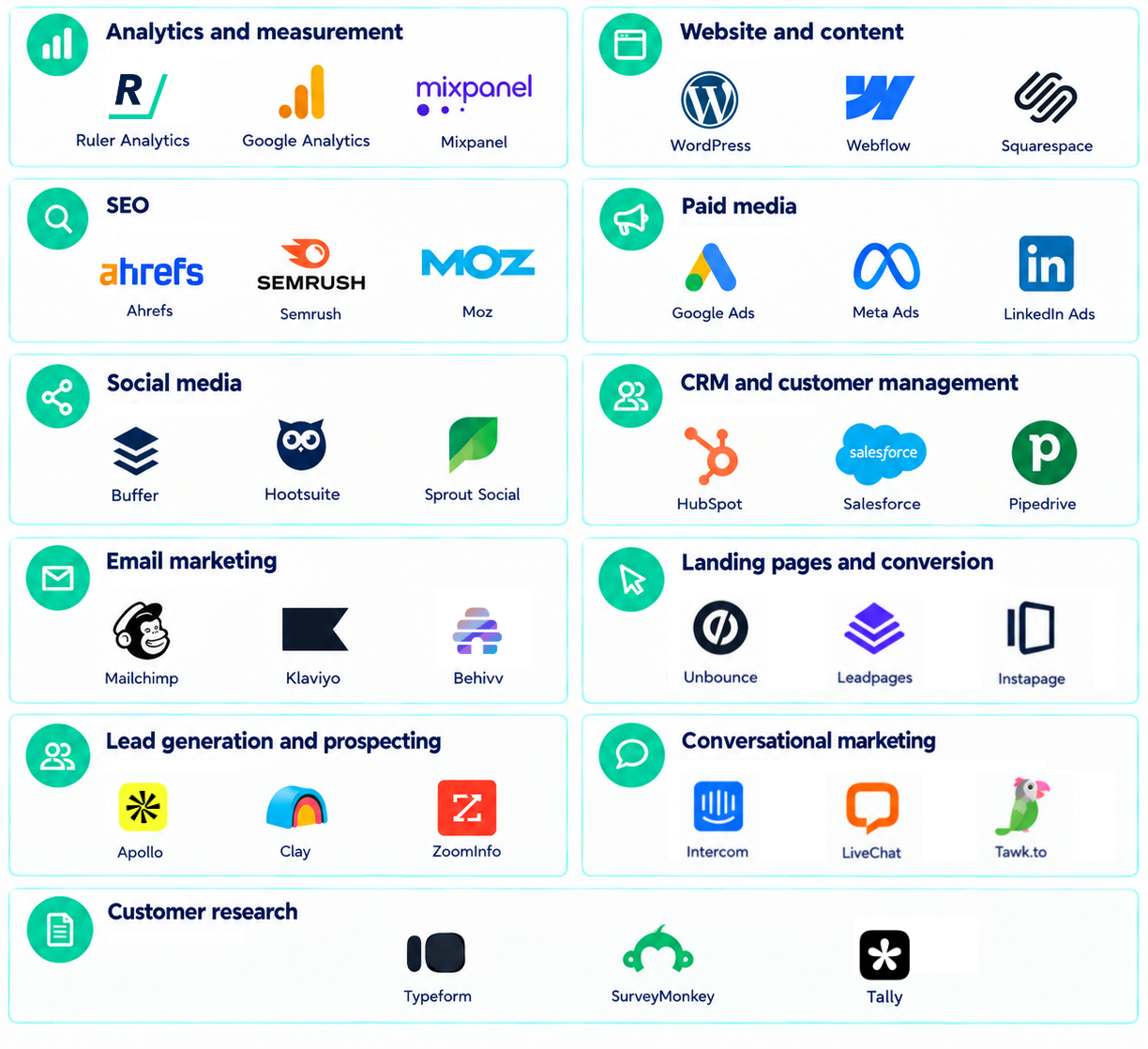
Marketing analytics, attribution and intelligence. Google Analytics covers on site behaviour well and is the natural starting point for most teams. Mixpanel extends that into product usage and behavioural analysis. Ruler Analytics sits alongside these as the layer connecting marketing touchpoints, CRM outcomes and revenue, which we’ve covered in more depth below, along with our approach to marketing mix modelling and budget allocation for teams planning investment beyond click based channels.
See how Ruler fits in. Google Analytics and Mixpanel are genuinely good at what they do, one gives you a clear read on website behaviour, the other on product usage. What neither was built to do natively is tell you which of that activity actually turned into revenue. That’s what Ruler adds, connecting the touchpoints tracked across your marketing channels to CRM and revenue systems, so you can see which channels are driving outcomes, online and offline, and feed those signals back to ad platforms for optimisation. Book a demo with Ruler to see how it works with your stack.
Website and content. WordPress suits teams that want the widest plugin ecosystem and don’t mind managing more of the technical side themselves. Webflow suits teams that want design control without full development resource. Squarespace suits smaller teams prioritising speed of setup over deep customisation.
SEO. Ahrefs and Semrush are broadly comparable all rounders covering keyword research, site audits and competitor tracking, while Moz tends to suit teams wanting a slightly simpler, more approachable toolset.
Paid media. Google Ads remains the default for capturing existing search intent, Meta Ads suits broader awareness and retargeting plays, and LinkedIn Ads tends to perform well for B2B SaaS targeting by role and company, albeit at a higher cost per click.
Social media. Buffer suits smaller teams wanting simple scheduling, while Hootsuite and Sprout Social add deeper listening and reporting for larger teams managing multiple channels and stakeholders.
CRM and customer management. HubSpot suits teams wanting marketing, sales and service in one ecosystem. Salesforce suits larger, more complex sales organisations needing deep customisation. Pipedrive suits smaller sales teams wanting a simpler, pipeline focused view.
Email marketing. Mailchimp suits general purpose email and light automation. Klaviyo leans towards ecommerce style behavioural triggers, and Behivv is worth evaluating directly against your own segmentation and send volume needs.
Landing pages and conversion. Unbounce, Leadpages and Instapage are all built specifically around fast page building and testing, while Webflow again covers this alongside full website management.
Lead generation and prospecting. Apollo and ZoomInfo both offer contact databases and enrichment at different price points, while Clay leans more towards flexible, workflow driven enrichment and outreach.
Conversational marketing. Intercom suits teams wanting chat tied closely into a wider customer messaging platform, LiveChat suits teams wanting a dedicated, straightforward chat tool, and Tawk.to suits teams wanting a free entry point.
Customer research and surveys. Typeform suits teams wanting well designed, higher completion rate surveys. SurveyMonkey suits broader research use cases with more advanced analysis. Tally suits teams wanting a lightweight, free option.
None of this is a ranking. Two tools in the same category can both be good choices for different reasons, and the right answer depends on your business model, sales cycle and team size more than any single feature comparison.
Where Ruler’s unified measurement fits in
We’ve mentioned Ruler a few times throughout this guide, so it’s worth being direct about what it actually does and doesn’t do.
Ruler is a marketing measurement platform and its job is to help SaaS teams move from fragmented channel, marketing and sales data towards a more complete view of marketing performance, revenue and where investment should go next. It does this in a few connected ways.
- First party tracking. Ruler tracks calls, form submissions, live chat and other conversions and follows that journey from the first visit through to whatever happens next, whether that’s a trial, a demo or a closed deal.
- Matching to CRM outcomes. Ruler connects those tracked enquiries to CRM records, so a team can see which channels and campaigns are producing pipeline and revenue, rather than relying on lead or demo volume as a proxy.
- Multi touch attribution. Rather than committing to a single attribution model, Ruler lets teams compare models side by side to understand how different touchpoints contributed across often long, non linear SaaS journeys.
- Deduplication and unified reporting. Individual platforms tend to over report their own conversions when measured in isolation. Ruler helps build a more consistent view by deduplicating conversions across channels, and by unifying that reporting so teams aren’t left reconciling numbers manually.
- Upper funnel and offline measurement. Not every touchpoint leaves a click to track. Ruler’s modelling accounts for the influence of impressions and offline activity that contribute to a decision without ever being clicked on, and can send offline conversion and revenue signals back to advertising platforms to improve bidding and audience optimisation.
- Marketing mix modelling and budget planning. For channels where click based attribution genuinely can’t capture the full picture, things like CTV, out of home, TV, radio or broader brand activity, Ruler’s marketing mix modelling measures channel level impact statistically. The budget scenario planner then uses that modelling to show diminishing returns and help teams understand where additional investment is likely to have the greatest impact, before any spend is committed.
And where it’s useful, Ruler also brings this data into BI and reporting environments, so marketing performance can sit alongside the rest of the business rather than in its own silo.
The point isn’t that any one of these methods gives a perfect answer on its own. Click path tracking, attribution modelling and marketing mix modelling each answer a slightly different question, and combining them tends to get teams closer to the truth than relying on any single method alone.
Bring your SaaS marketing software together
If there’s one thing worth taking from all of this, it’s that the strongest SaaS marketing stacks aren’t the ones with the most tools. They’re the ones where the team can see what’s happening, understand why, and act on it with some confidence that the data is telling them something real. Too many tools without a connected way of measuring them just creates more places for the real answer to hide.
If your activity is scattered across platforms that don’t agree with each other, leads and trials that don’t clearly translate into revenue, or upper-funnel spend you can’t quite justify to finance, that’s exactly the gap Ruler was built to close.
We connect the marketing activity your stack is already generating to real customer journeys, sales outcomes and revenue, so you can make investment decisions based on what’s actually working rather than what the last click happened to suggest.
Book a demo and we’ll walk through how it would look against your own data and your own stack.