
Across the calls we have with marketing leaders, the more common problem is a stack that generates plenty of activity but very little clarity on what that activity is actually worth.
In our own research, 56% of marketers say the majority of their leads come from inbound marketing, yet 44% say joining up cross-channel journeys, both online and offline, is one of the biggest challenges in getting attribution right.
Traffic goes up, content gets engagement, leads come in, but the link between all of that and revenue often stays murky.
This guide walks through the categories of software that support an inbound marketing motion, what each one is genuinely good for, and where the honest gaps tend to show up, particularly the gap between running activity and understanding what it contributed to the business.
We you’ll find:
- What we mean by inbound marketing software
- Categories of inbound marketing tools
- What to look for in inbound marketing platforms
- Inbound marketing software recommendations
Pro Tip
If you already have a stack full of tools but still can’t say which channels or campaigns are producing customers rather than just leads, book a demo with Ruler to see how first-party tracking and attribution can close that gap.
What we mean by inbound marketing software
Inbound marketing software is any tool that helps a business attract, engage and convert prospects through content and experiences people choose to interact with, rather than through interruptive outbound tactics like cold calling or unsolicited ads.
That covers a wide span of jobs, getting found in search, giving a website visitor a reason to stay, answering a question in the moment, nurturing someone who isn’t ready to buy yet, and eventually connecting all of that activity back to a closed deal.
No single tool does all of this. In practice, “inbound marketing software” is really a collection of purpose-built systems, each covering a different stage of the same journey, from a stranger’s first visit to a website through to a signed customer. A CRM, an email platform, an SEO tool and an attribution platform are all inbound marketing software in this sense, even though a marketer would rarely describe them the same way or expect them to look alike.
The key categories of inbound marketing software
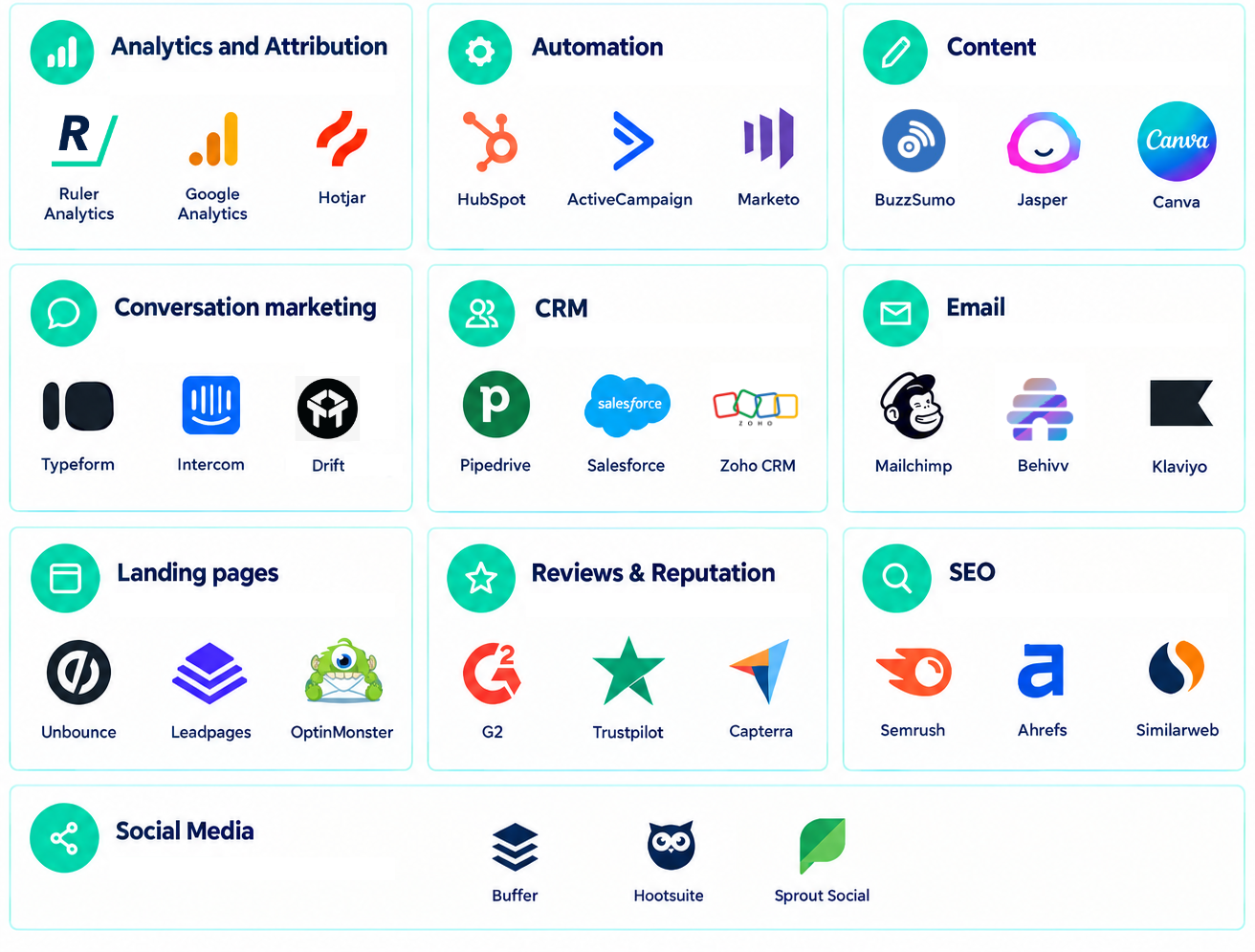
To simplify this guide, we’ve grouped inbound marketing software into ten categories. None of them are mandatory in isolation, and plenty of teams run a smaller stack than this list might suggest. What matters more than category coverage is whether the systems you do use are able to share data with each other.
| Category | What it does | Example tools |
| Analytics & attribution | Web analytics tools show what happened on-site; attribution platforms connect that behaviour to leads, sales and revenue. | Ruler Analytics, Google Analytics, Hotjar |
| Marketing automation | Manages the repetitive work of nurturing a lead once they’ve entered the funnel, the right email, an updated lead score, a workflow trigger. | HubSpot, ActiveCampaign, Marketo |
| Content | Splits into two jobs. Working out what to create, and actually producing it. | BuzzSumo, Jasper, Canva |
| Conversation marketing | Captures intent in the moment, when a visitor is on-site with a question, rather than asking them to fill in a form and wait. | Typeform, Intercom, Drift |
| CRM | Where sales and marketing data meet, contact records, deal stages, and the history of every interaction. | Salesforce, Pipedrive, Zoho CRM |
| Email marketing | Nurtures existing contacts and re-engages people who’ve already shown interest. | Mailchimp, Brevo, Klaviyo |
| Landing pages | Lets marketers create and test dedicated campaign pages without needing a developer for every change. | Unbounce, Leadpages, OptinMonster |
| Reviews & reputation | Surfaces what other customers say about a business, which increasingly shapes buying decisions before a salesperson is contacted. | G2, Capterra, Trustpilot |
| SEO | Supports the research and measurement side of organic search, still the single largest source of inbound traffic for many businesses. | Semrush, Ahrefs, Similarweb |
| Social media | Handles content distribution and discovery across networks, both organic and paid. | Buffer, Hootsuite, Sprout Social |
What we recommend looking for when building an inbound marketing stack
Building the right stack isn’t about acquiring one tool per category on this list. Based on what we see across the businesses we work with, a handful of principles tend to separate stacks that function well from ones that create more reporting work than they save.
- Make sure conversions are tracked consistently. Calls, chat, form fills and offline enquiries should all count as leads if you want an accurate picture, not just the conversion types that happen to be easy to track.
- Push for a shared source of truth on revenue. Marketing and sales should be working from the same numbers, which usually means connecting the revenue to whatever is running attribution.
- Check how each platform reports on upper-funnel activity. If a tool can only measure last-click conversions, it will systematically undervalue channels like paid social, video and offline advertising.
- Plan for growth, not just today’s volume. A stack that works for a small team can start to strain once lead volume, channel count or sales complexity increases, so it’s worth asking how a platform scales before committing budget.
Inbound marketing software worth considering in 2027
A quick reference list of the platforms covered above, grouped by category.
Analytics and Attribution
Understand what visitors do on your website and connect that behaviour to leads, conversions and revenue.
Ruler Analytics
Ruler is a marketing measurement and intelligence platform that helps businesses understand what’s driving revenue, and where to improve next. It combines first-party tracking, multi-touch attribution and unified marketing and sales data to connect customer journeys, conversions and revenue across channels. But Ruler goes beyond attribution. Its statistical modelling, including data-driven attribution, impression modelling and marketing mix modelling, helps measure the impact of activity that isn’t fully captured by click-based tracking.
Ruler also closes the loop between measurement and activation by sending enriched revenue and qualified conversion signals back to advertising platforms. This gives ad platforms better-quality signals to optimise against, helping them focus on the customers, leads and outcomes that matter most to the business, rather than simply optimising for conversion volume.
With marketing mix modelling, teams can understand channel impact, diminishing returns and ROI across digital and offline activity, while scenario planning helps model the potential impact of changing budgets before investment is committed. With AI Analyst and AI Media Planner, Ruler is evolving from reporting marketing performance to helping teams interpret results and make better-informed investment decisions.
Pro Tip
Book a demo to see how Ruler can connect your marketing activity to revenue, improve the signals you send to ad platforms, and model where your next marketing investment could have the greatest impact.
Google Analytics
Google Analytics remains the default choice for tracking website traffic, user behaviour and conversion paths, largely because it’s free and deeply embedded in most marketing stacks already. Based on what we’ve heard from marketers using it daily, GA4’s event based model took some getting used to after Universal Analytics, and the learning curve can be steep for newer users. Reporting is powerful once configured properly, though the interface isn’t always intuitive. The free tier covers most small to mid sized businesses comfortably, while Google Analytics 360 for enterprise needs runs into tens of thousands annually. A solid foundation, even if not the friendliest tool to learn.
Mixpanel
Mixpanel is a product analytics platform built around tracking specific user events and actions, rather than just pageviews, so teams can see exactly how people move through a product or website. From conversations we’ve had with marketers and product teams, its funnel and retention reports are often what people reach for first, showing where users drop off and which cohorts stick around longest. The setup requires proper event tracking to be planned out in advance, which takes more initial effort than simpler analytics tools, and teams without a clear taxonomy sometimes end up with messy, hard to compare data. Pricing starts free for smaller volumes of tracked users, with paid plans from around £20 a month scaling up based on monthly tracked users and data history. A strong fit for product led teams wanting behavioural detail beyond basic traffic numbers.
Marketing automation tools
Automate repetitive marketing tasks, from lead nurturing and scoring to email sequences and workflow triggers.
HubSpot
HubSpot is one of the most recognised names in inbound marketing, bundling CRM, email, landing pages and automation into a single connected platform. What we’ve found from conversations with marketers is that its biggest strength is how everything talks to everything else, reducing the need to stitch tools together manually. The downside, and it’s a common one, is cost, which climbs quickly as you add contacts and unlock premium features. Pricing starts free for basic CRM functions, with Marketing Hub plans running from roughly £15 a month up to several hundred for Professional and Enterprise tiers. A strong all rounder for growing teams.
ActiveCampaign
ActiveCampaign focuses on email marketing and automation with a level of workflow sophistication that goes beyond most competitors at a similar price point. Based on the leads we’ve tracked through client campaigns, its automation builder is genuinely flexible, letting you branch sequences based on behaviour rather than simple triggers. The CRM functionality feels a bit bolted on compared to dedicated sales tools, and the interface can overwhelm newcomers at first. Pricing starts around £15 a month for the Starter plan, moving up to £70 plus for Plus and Professional tiers depending on contact volume. Good value for automation heavy teams.
Marketo
Marketo, now under Adobe, is built for larger organisations running complex, multi channel campaigns across marketing and sales teams. From what marketers have told us, its lead scoring and nurturing capabilities are genuinely enterprise grade, handling scale that smaller platforms struggle with. It’s not a tool you pick up in an afternoon though, and most teams need dedicated admin support to get real value from it. Pricing isn’t published publicly and is quoted per business based on database size and modules needed, typically starting well into four figures monthly. Best suited to established B2B marketing departments with the resource to match.
Content software
Help marketers identify what content to create, then produce it more efficiently across different channels.
BuzzSumo
BuzzSumo helps you find what content is already performing well across a topic or competitor, along with influencer and backlink data to support outreach. From our conversations with content teams, it’s most useful early in the planning process, when you’re trying to work out what’s worth writing before committing hours to it. Some users find the data occasionally lags behind real time trends, which matters less for evergreen research and more for fast moving news topics. Pricing starts around £119 a month for the Content Creation plan, rising toward £259 and beyond for agency level access. A handy research companion rather than a full content platform.
Jasper
Jasper is an AI writing assistant built specifically for marketing content, offering templates for blog posts, ads and social copy alongside brand voice controls. What we’ve heard from marketers using it day to day is that it speeds up first drafts considerably, though output still needs a proper edit before it reads naturally. It works best as a starting point rather than a finished product, and heavier users sometimes find the credit based pricing adds up faster than expected. Plans start around £39 a month for individuals, with team pricing scaling from there based on seats and output volume. Useful for teams producing content at volume.
Canva
Canva has become the go to design tool for marketers who need professional looking visuals without a design background, covering everything from social graphics to full presentations. Based on the leads we’ve tracked from content teams, its drag and drop simplicity is the main draw, letting non designers produce decent work quickly. Advanced designers sometimes find it limiting compared to dedicated software like Photoshop or Illustrator, particularly for precise brand work. The free plan covers a lot of ground already, with Canva Pro priced around £10 a month and Teams plans scaling per user from there. Excellent value for everyday marketing design needs.
Conversation marketing
Capture visitor intent in the moment and turn website conversations into leads without relying solely on forms.
Typeform
Typeform turns forms and surveys into something people actually want to complete, using a conversational, one question at a time format that feels less like admin. From conversations with marketers we’ve spoken to, response rates genuinely improve compared to traditional static forms, particularly for lead generation and feedback collection. It can feel slow for longer forms with many fields, since the one question format isn’t always the fastest way to gather data. Pricing starts free for basic use, with paid plans from around £25 a month for more responses, logic jumps and integrations. A neat tool for making data collection feel less clinical.
Intercom
Intercom combines live chat, chatbots and help desk functionality into one platform, helping teams talk to website visitors and customers in real time. What we’ve found from conversations with marketers is that it works particularly well for SaaS businesses wanting to blend support and sales conversations in one place. Pricing has shifted toward a more complex, seat and resolution based model in recent years, which some smaller teams have found harder to predict month to month. Plans typically start around £29 a month per seat, with costs rising quickly for automation and advanced features. Strong for conversational support, less so for pure marketing automation.
Drift
Drift built its name on conversational marketing, using chatbots to qualify leads and book meetings directly from a website in real time rather than waiting on form fills. Based on the leads we’ve tracked through client sites, it works well for B2B teams with a defined sales process, routing hot leads straight to reps. Pricing isn’t published openly, and quotes tend to come in higher than comparable chat tools, which has pushed some smaller businesses toward lighter alternatives. It’s generally positioned for mid market and enterprise teams rather than solo marketers or small businesses on a tighter budget.
CRM tools
Bring sales and marketing data together in one place, including contact records, deal stages and customer interactions.
Pipedrive
Pipedrive is a sales focused CRM built around a visual pipeline that makes it easy to see where every deal stands at a glance. From our discussions with marketers and sales teams alike, its simplicity is the main appeal, particularly for smaller teams who found other CRMs overly complex for what they needed. Marketing features are fairly basic compared to dedicated platforms, so it’s often paired with a separate email or automation tool. Pricing starts around £14 a month per user for the Essential plan, moving up to £99 for Power and Enterprise tiers with more automation and reporting.
Salesforce
Salesforce is the most established name in CRM, offering an enormous range of customisation options across sales, service and marketing clouds for businesses of any size. What we’ve heard from marketers working within it is that the flexibility is genuinely unmatched, but that same flexibility means implementation often requires dedicated admins or consultants to get right. It’s rarely the first choice for small teams given the cost and complexity involved. Pricing starts around £20 a month per user for basic plans, climbing into hundreds for Enterprise and Unlimited editions with full marketing cloud capability. Built for scale rather than simplicity.
Zoho CRM
Zoho CRM offers a genuinely capable feature set at a price point well below most major competitors, covering pipeline management, automation and reporting in one package. Based on conversations with marketers we’ve spoken to, it’s often chosen by budget conscious teams who want more than a basic CRM without paying enterprise level prices. The interface feels a little dated compared to newer entrants, and some integrations require more manual setup than expected. Pricing starts free for very small teams, with paid plans from around £14 a month per user up to £45 for Ultimate tier functionality.
Email tools
Nurture existing contacts, build relationships and re-engage people who have already shown an interest in your business.
Mailchimp
Mailchimp is one of the most widely used email marketing platforms, known for its accessible interface and generous free tier that suits smaller businesses just getting started. From what we’ve found through conversations with marketers, it’s a comfortable entry point, though many outgrow its automation and segmentation capabilities as their lists and ambitions grow. Deliverability and reporting are solid without being exceptional. Pricing starts free for up to 500 contacts, with paid plans from around £13 a month rising based on list size, reaching significantly higher costs for larger databases with advanced automation needs.
Brevo
Brevo, formerly Sendinblue, combines email, SMS and basic CRM functionality with pricing based on emails sent rather than contact list size, which suits businesses with large lists but modest sending frequency. Based on the leads we’ve tracked, this pricing model is often the deciding factor for teams switching from list based platforms. The automation builder is capable without being as advanced as some dedicated competitors. Plans start free for up to 300 emails a day, with paid tiers from around £19 a month scaling with volume. A sensible choice for list heavy, low frequency senders.
Klaviyo
Klaviyo is built specifically for ecommerce, integrating tightly with platforms like Shopify to trigger emails and SMS based on actual purchase behaviour rather than generic segments. What we’ve heard from marketers running online stores is that its revenue attribution per campaign is genuinely useful, showing which sends actually drove sales. It’s less suited to non ecommerce businesses, where much of its functionality goes unused. Pricing starts free for smaller lists, with paid plans from around £35 a month rising steeply as contact numbers grow. A strong specialist choice rather than a general purpose email tool.
Landing page builders
Create, launch and test campaign-specific landing pages without needing a developer for every change.
Unbounce
Unbounce specialises in landing pages built for conversion, offering AI powered copy suggestions and testing tools designed to squeeze more performance out of paid traffic. From conversations with marketers we’ve spoken to, the page builder itself is intuitive, though the pricing has crept upward in recent years relative to newer competitors. It’s a dedicated tool rather than part of a broader suite, so it usually sits alongside a separate email or CRM platform. Plans start around £74 a month for the Launch tier, rising to £180 or more for Accelerate and beyond based on traffic and conversions.
Leadpages
Leadpages offers a more budget friendly route into landing page building, with templates geared toward small businesses and solo marketers who need something functional without a steep learning curve. Based on the leads we’ve tracked, it’s a common starting point for teams testing landing pages for the first time before graduating to more advanced tools. Design flexibility is more limited than some competitors, and advanced testing features sit behind higher tiers. Pricing starts around £32 a month for the Standard plan, rising to £70 plus for Pro tier with A/B testing included.
OptinMonster
OptinMonster focuses specifically on conversion optimisation through popups, slide ins and exit intent forms designed to capture leads who might otherwise leave without converting. What we’ve found from conversations with marketers is that the exit intent technology genuinely recovers leads that would have been lost, particularly on ecommerce and content sites. It’s a lead capture tool rather than a full landing page builder, so it complements rather than replaces platforms like Unbounce. Pricing starts around £7 a month for the Basic plan, moving up to £49 plus for Growth tier with advanced targeting rules.
Reviews and reputation tools
Monitor customer feedback and manage your online reputation, helping potential customers make more informed buying decisions.
G2
G2 has become a default research stop for B2B buyers comparing software, with verified user reviews carrying real weight in purchase decisions. From our discussions with marketers, having a strong G2 presence genuinely influences pipeline, since prospects often check reviews before ever speaking to sales. Building up a healthy volume of reviews takes ongoing effort, and negative reviews can be difficult to manage once posted. A free profile is available, with paid marketing packages for enhanced visibility and reporting starting from several hundred pounds monthly depending on category competitiveness. Valuable for B2B software specifically.
Trustpilot
Trustpilot is widely recognised by consumers, making it a natural fit for B2C businesses wanting to build trust through visible, verified customer reviews. Based on what marketers have told us, displaying a Trustpilot score on site and in ads noticeably improves conversion, particularly for newer brands without much other social proof. Managing responses to negative reviews takes ongoing attention, and the free plan limits how much you can do with review collection and widgets. Pricing starts free for basic use, with paid plans from around £199 a month for more automation and customisation options.
Capterra
Capterra focuses on software reviews specifically, helping buyers compare tools across categories much like G2 but with slightly different audience reach and geographic strength in certain markets. From conversations with marketers we’ve had, it’s often used alongside G2 rather than instead of it, since the two platforms attract slightly different buyer segments. Review volume tends to be lower than G2 for many categories, which can make rankings feel less stable. Listings are free, with paid advertising and lead generation packages priced on a cost per click basis depending on category.
SEO tools
Research, optimise and measure organic search performance, from keyword opportunities and rankings to competitors and traffic.
Semrush
Semrush is a comprehensive SEO and competitive research platform covering keyword tracking, site audits, backlink analysis and paid search data in one place. What we’ve heard from marketers using it regularly is that the sheer breadth of features is both its strength and its challenge, since newer users can feel a bit lost navigating everything available. Data accuracy is generally strong, though some smaller or newer keywords can be underreported. Pricing starts around £108 a month for the Pro plan, rising to £191 plus for Guru and Business tiers with more projects and reporting depth.
Ahrefs
Ahrefs is particularly well regarded for its backlink data, which many marketers we’ve spoken with consider among the most accurate and comprehensive available in any SEO tool. Site audits, keyword research and content gap analysis round out a genuinely strong feature set. The interface takes some getting used to for complete beginners, and pricing has increased over recent years relative to some competitors. Plans start around £99 a month for Lite, moving up to £199 for Standard and beyond for Advanced and Enterprise tiers based on data volume and users.
Similarweb
Similarweb gives a broader view of traffic and market intelligence, estimating competitor website traffic, sources and audience overlap rather than focusing purely on keyword rankings. From the conversations we’ve had with marketers, it’s most useful for competitive research and market sizing rather than day to day on page SEO work. Traffic estimates are directional rather than exact, which is worth keeping in mind when presenting figures externally. Pricing isn’t published openly for most plans and is typically quoted based on data needs, generally sitting at a premium compared to keyword focused SEO tools.
Social media tools
Plan, publish and measure content across social networks, covering both organic and paid activity.
Buffer
Buffer offers straightforward social media scheduling and basic analytics across the main platforms, built with simplicity in mind rather than trying to cover every possible feature. Based on what we’ve found from conversations with marketers, it suits smaller teams and solo marketers well, though larger organisations sometimes outgrow its reporting and collaboration tools. The clean interface is consistently praised as one of its biggest strengths. Pricing starts free for limited channels, with paid plans from around £5 a month per channel scaling up for larger teams needing more advanced analytics and collaboration.
Hootsuite
Hootsuite has been a long standing player in social media management, offering scheduling, monitoring and reporting across a wide range of platforms and integrations. From our discussions with marketers, it suits teams managing many channels and stakeholders, though the interface can feel busier and less modern than newer competitors. Pricing has moved upmarket in recent years, pricing out some smaller teams who’ve since switched to lighter tools. Plans start around £89 a month for Professional, rising to £220 plus for Team tier with more users and approval workflows included.
Sprout Social
Sprout Social combines scheduling, monitoring and fairly deep analytics with a strong focus on team collaboration and reporting, making it a common choice for agencies and larger marketing departments. What we’ve heard from marketers using it is that the reporting quality stands out, particularly for demonstrating social ROI to stakeholders who need clear numbers. It sits at a higher price point than many alternatives, which puts it out of reach for smaller budgets. Pricing starts around £199 a month per seat for the Standard plan, rising to £299 plus for Professional and Advanced tiers.
Is Ruler the inbound marketing software you need?
Generating inbound conversions is, for most of the businesses we speak to, the easier half of the problem. Understanding what happens to those conversions afterwards, which ones turn into conversations, which conversations turn into customers, and which channels and campaigns are actually behind that, is where most stacks still fall short.
Ruler connects your marketing activity to real sales outcomes by tracking every enquiry back to its original journey and matching it to your CRM data, so you can see which inbound investments are actually producing revenue rather than just leads.
Book a demo to see how Ruler connects your marketing activity to offline activity and revenue.