

For over 20 years, click-based measurement served as the industry standard, and for good reason.
Google Search was among the earliest scaled paid advertising channels, and Google Analytics was designed to measure those same interactions, a user clicks an ad, arrives on a landing page, and completes a defined goal. The framework was logical, traceable, and operationally efficient.
As paid social platforms emerged, first Facebook, followed by Instagram and TikTok, the consumer journey began to evolve.
Unlike search, where intent is explicit, social platforms operate in environments driven by awareness, discovery, and influence, much like traditional media. Users are not necessarily seeking a product or service; they are engaging with content.
However, measurement approaches largely remained rooted in click-based frameworks.
Teams understandably relied on established tools and methodologies that had proven effective in search environments, systems designed for shorter, more direct paths to conversion.
At the same time, the broader data ecosystem was changing. The release of iOS 14.5 significantly altered third-party data practices, limiting the effectiveness of view-through tracking. Browser policies began limiting cookies, and pixel-based tracking became less comprehensive.
As a result, the observable portion of user behavior narrowed. While click-based reports may still appear precise, precision within a constrained data set, does not necessarily equate to complete accuracy, it often ignores part of the picture.
In this article, we discuss:
- What clicks and impressions represent
- The challenges of view-through conversions
- How relying on one source can distort decisions
- Building a more balanced measurement framework
What clicks measure
A click represents a signal of intent. When someone clicks on an ad, they are indicating that the content is worth their time and attention.
This action reflects a transition from passive exposure to active engagement, making it a meaningful and valuable metric.
Click-based measurement, including last-click attribution, data-driven attribution in Google, or first-party multi-touch attribution, is particularly effective for lower-funnel activity.
This includes search campaigns, shopping ads, and retargeting efforts, where individuals already demonstrate a degree of awareness or interest. In these contexts, a click provides clear insight into engagement, offering concrete information about the performance of bottom-funnel activity.
Click data is fast, deterministic, and useful for tactical decisions such as optimising bids, refining audience targeting, and improving landing page conversion rates. However, clicks capture behavior at a single point in time. They do not provide insight into the factors that shaped a person’s perception, built familiarity with the brand, or influenced their receptiveness to an offer at the moment they engaged.
What impressions measure
An impression records that an ad was shown to a person. There is no click and no active engagement, only exposure.
While a single impression may provide limited insight on its own, impressions are the mechanism through which influence is established, and that influence is meaningful even when it cannot be tracked directly.
Upper-funnel channels illustrate this process. A person may scroll past a video on Meta without stopping or clicking, yet the brand is registered in their awareness. They encounter additional ads over the following days.
By the fifth or tenth impression, the brand becomes familiar. When the person later enters the market for that product, the brand is already part of their consideration set. This occurs not because of conscious engagement, but due to accumulated exposure.
This phenomenon is often referred to as the halo effect or awareness effect. It highlights the distinction between demand capture, such as search and retargeting, and demand creation, including paid social, video, and display. Clicks primarily measure demand capture, while impressions provide insight into demand creation.
Impression-driven channels can sometimes appear to underperform in click-based reports. For example, if a person sees a TikTok ad without clicking, then later searches for the brand and converts through a search ad, last-click attribution assigns all credit to the search ad. The TikTok impressions that contributed to creating the demand are not reflected in that attribution.
Challenges with view-through conversions
Ad platforms address impression-based influence with view-through conversions, which record a conversion when someone is served an ad and later completes a purchase, even without clicking. In theory, this accounts for the impact of impression-driven channels. In practice, it introduces several challenges.
Related: Your guide to mastering view-through conversions
The first challenge is causation. Seeing an ad and later making a purchase does not necessarily mean the ad caused the purchase. The individual may have intended to buy regardless, been influenced by other factors, or been exposed to an impression that had little effect on their decision. View-through conversions assign credit without definitive evidence of causation.
The second challenge is duplication. When campaigns run across multiple platforms using view-through attribution, the same conversion can be credited to multiple channels. This can make reported return on ad spend (ROAS) appear significantly higher than actual business results.
The desire to establish a deterministic link between an impression and a conversion is understandable, as it simplifies measurement and reporting. However, customer journeys are inherently multi-touchpoint. Attempting to attribute a single conversion to one impression can misrepresent how marketing drives outcomes in practice.
How using only one signal can distorts decisions
When measurement is primarily based on clicks, budget allocation tends to follow the metrics. Channels that generate measurable click-through activity and last-click conversions are often prioritised, while channels that build awareness and influence without driving immediate clicks may receive less investment.
Over time, this can create a structural bias toward short-term performance at the expense of long-term growth. Optimisation efforts may appear efficient on paper, yet underinvestment in demand-creation activities can gradually limit the pipeline. This effect is often subtle and slow to emerge, becoming apparent only when growth slows and no immediate tactical explanation is evident.
A complementary challenge arises when too much emphasis is placed on impression data and view-through conversions are taken at face value. In this case, the operational insights provided by click data, such as which campaigns are converting, which landing pages are underperforming, and which audiences are actively in-market, can be lost.
Neither clicks nor impressions, when considered in isolation, provide a fully reliable basis for decision-making. Used together, they offer complementary insights that support more balanced and informed marketing strategies.
A more balanced measurement framework
The practical solution isn’t to pick one signal over the other, it’s to apply each where it’s appropriate and build a unified view of performance that reflects marketing impact.
At Ruler, we describe it as MTA corrected by impression modelling, combining the granularity of MTA with upper-funnel correction. The result is a fair, holistic view of the impact of all channels, while still retaining the actionable detail that makes MTA valuable.
Deterministic tracking for click-based channels
For click-based channels, search, shopping, retargeting, email, first-party multi-touch attribution can trace the actual path a customer took to conversion.
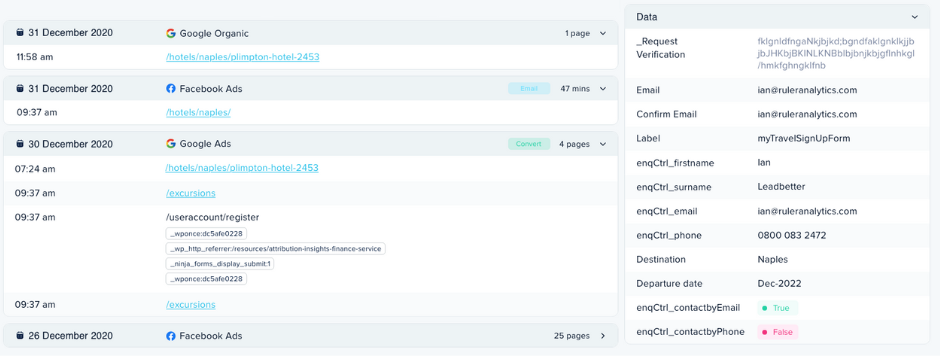
This gives you a reliable, deterministic picture of lower-funnel performance without relying on third-party data or platform-reported metrics.
MTA is particularly powerful at the granular level. It can tell you which campaigns, keywords, and ads are contributing to conversions, and in what sequence.
However, MTA is only as good as the clicks it can see. It misses the upper-funnel influence that never generated a click, the impression that sparked awareness, the video that prompted a brand search days later. For anything that happens before someone enters the click path, MTA has nothing to work with.
Impression modelling for upper-funnel channels
For impression-heavy channels, paid social, video, display, modelling is the most reliable and fairest approach.
Ruler’s impression model combines data-driven attribution (DDA) with impression-based modelling to give fair credit to upper-funnel activity, such as display advertising, which rarely drives direct clicks, by applying principles from marketing mix modelling.
It uses aggregated data to estimate the incremental contribution of exposure over time, accounting for the lag between seeing an ad and eventually converting, the halo effects that impressions create across channels, and the awareness-building that simply doesn’t show up in any click path.
Related: The role of impression modelling in marketing measurement
It’s a statistical approach rather than a deterministic one, but that’s precisely what makes it appropriate for channels that don’t operate through clicks.
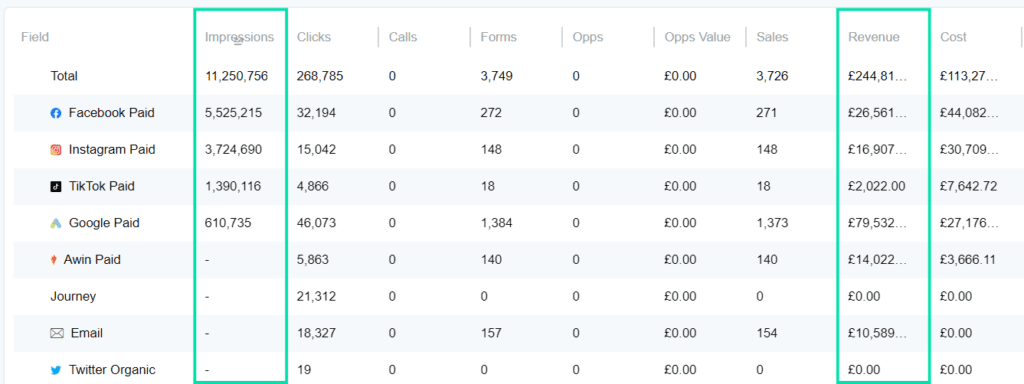
Impression modelling also solves the duplication problem. Rather than each platform claiming full credit for every conversion it touched, the model looks at the relationship between spend, impressions, and revenue across all channels simultaneously, giving you a much fairer like-for-like comparison between Google, Meta, TikTok, and everything else.
The limitation of modelling alone, though, is granularity. It can tell you that Facebook prospecting performed at a certain ROAS overall.
But, it can’t tell you which campaigns within Facebook were driving that performance and which were dragging it down, which is why it needs deterministic tracking.
How this unified approach works in practice
An example can help show the effects of using a unified measurement approach.
One marketing team we helped were running Google non-brand search campaigns alongside Meta prospecting efforts.
Last click showed, the following results:
| Google Non-Brand Search Spend: £100,000 Reported Revenue: £400,000 ROAS: 4.0 | Facebook Prospecting Spend: £100,000 Reported Revenue: £20,000 ROAS: 0.2 |
The data here suggests that Google is driving the majority of conversions with a strong ROAS, while Meta appears expensive and difficult to justify. Based on this data alone, your instinct might be to protect Google spend and scale back on Meta.
However, when impression modelling is applied, a different story emerges. Google non-brand search is approaching saturation. The marginal ROAS, the incremental revenue generated by each additional dollar spent, is below one, indicating diminishing returns.
| Channel | Last click ROAS | MMM ROAS | Marginal ROAS |
| Google Non-Brand Search | 4.0 | 1.2 | 0.4 |
| Facebook Prospecting | 0.2 | 4.1 | 2.6 |
In contrast, Meta prospecting demonstrates significant potential. The model reveals that Meta campaigns are effectively building awareness and driving incremental brand searches, which ultimately convert through Google.
As these conversions occur via a click on a search ad, last-click attribution fails to credit Meta for its contribution.
The unified approach resolves this discrepancy. MMM provides a fair, channel-level view, confirming that Meta is undervalued, while MTA identifies which specific Meta campaigns are generating the most impact.
This insight enables reduced spend on an oversaturated lower-funnel channel and increased investment in upper-funnel activities that are generating demand upstream.
See the full impact of your marketing efforts
Click measurement provides insight into where consumer intent manifests, while impression measurement highlights where influence is being established.
High-potential marketing channels, such as paid social, video, and creator-driven content, are inherently impression-led. Measurement frameworks that don’t fully account for how these channels operate risk overlooking significant portions of audience engagement.
Click data remains essential for understanding lower-funnel performance and informing tactical optimisations.
However, it was never intended to serve as the sole basis for attribution. As customer journeys become more complex and data signals increasingly fragmented, relying exclusively on clicks can result in an incomplete view of performance.
Unifying click and impression measurement, tracking one deterministically while modeling the other, establishes a measurement framework that is both operationally actionable and strategically transparent.
While no single approach can capture every nuance, this combined perspective offers a more complete and balanced understanding of marketing impact.
If you’re looking to unify click tracking with impression modeling, book a demo, and we’ll show you how we can help.