
When comparing Ruler Analytics and Triple Whale, we consistently see clear differences in how their features map to different needs.
Triple Whale and Ruler Analytics are commonly part of the same evaluation for teams when researching attribution and measurement tools.
Both are marketing measurement platforms, use first-party data, exist because marketers stopped trusting what Google and Meta tell them about their own performance.
Triple Whale is an eCommerce analytics platform built specifically for Shopify-native DTC brands. It centralises store data, ad spend, and creative performance into one dashboard, with an AI assistant built for the kind of questions a DTC performance marketer asks every day. It’s focused, fast to set up, and genuinely well-suited to the audience it was designed for.
Ruler is a unified measurement platform built for businesses where the journey from first touch to closed revenue is longer, messier, and harder to track. Multi-touch attribution, marketing mix modelling, offline conversion tracking, CRM enrichment, across any business model, any channel mix, any tech stack.
We look at what each one actually does, where they overlap, and where the differences start to matter.
Where we see Ruler and Triple Whale align
It makes sense to start with where they align.
- Neither platform trusts platform-reported data. Google telling you Google is working, Meta telling you Meta is working, both Ruler and Triple Whale were built on the belief that this is insufficient. Both use first-party pixels to collect their own data independently of the ad platforms.
- Both do multi-touch attribution. Triple Whale offers seven models including their Total Impact model, which blends click data with post-purchase survey responses. Ruler offers six models built on deterministic click tracking. The methodology differs but the intent is the same, understanding the full path to conversion rather than crediting the last touchpoint. It also has its own DDA and impression model that reallocates credit to upper-funnel channels such as TikTok and Instagram, which don’t often drive clicks but contribute influence through impressions.
- Both believe marketers deserve a single source of truth. Rather than toggling between GA4, your ad platform dashboards, and a spreadsheet, both products try to centralise your measurement into one place.
- Marketing mix modelling. We should also include a section on marketing mix modelling (MMM) to clarify the difference in approach. Triple Whale’s MMM is positioned as AI-led, using machine learning to generate outputs and insights directly from aggregated data, with Moby acting as the primary interface for interpretation. Ruler’s MMM, by contrast, is built on a data-scientist-designed modelling framework using ML to train on high-quality first-party deterministic data, with AI layered on top to surface and explain insights rather than drive the modelling itself. The key distinction is AI-led inference versus statistically grounded modelling with AI used for interpretation and activation.
For a certain type of business, a Shopify-native DTC brand spending heavily on Meta and Google with a clean click-to-purchase journey, Triple Whale does all of the above well. Fast setup, polished dashboard, strong creative analytics, and an AI assistant in Moby that’s genuinely useful for day-to-day questions.
Where Ruler fills the gaps Triple Whale misses
Triple Whale was built for a specific customer and it serves that customer well. But we talk to marketers regularly who’ve outgrown those boundaries, or were never quite inside them to begin with. These are the situations we see most often.
| Platform | Ruler Analytics | Dreamdata |
| Multi-touch | Yes First-party, deterministic click tracking across all channels with 6+ attribution models. | Yes (B2B only) Pixel-based MTA with 7 models including Total Impact blending click + post-purchase survey data. |
| Marketing mix modelling | Yes Probabilistic MMM using multivariate regression across up to 30 variables, with budget optimiser and forecasting. | Limited MMM available but positioned as supplementary. Primary measurement method remains pixel-based attribution. |
| Blended MTA & MMM | Yes Proprietary DDA model combines MTA + MMM outputs to redistribute credit to upper-funnel channels. | Limited AI Agent can compare MMM and attribution side-by-side but does not blend them into a single output. |
| CRM enrichment | Yes Enriches leads and opportunities with in CRMs with marketing attribution and source data. | No No native CRM enrichment. Focused on Shopify transaction data, not CRM-driven sales pipelines. |
| Offline conversion tracking | Yes Tracks phone calls, form fills, live chat, and offline deal close — links all back to originating marketing source. | No Not designed for offline conversions. Attribution is centred on eCommerce transactions via Shopify. |
| Budget optimisation & forecasting | Yes MMM-driven diminishing returns curves, scenario planning, and forward forecasting baked in. | No AI tools offers revenue and ad spend forecasting, but limited to seasonal and linear models. |
| Platform integrations compatability | ✓ Platform Agnostic Works across all eCommerce platforms, CRMs, B2B, and lead-gen models regardless of tech stack. | Shopify only Native integration is Shopify-centric. Significantly limited for non-Shopify stores. |
| Upper-funnel measurement | Yes MMM specifically models TV, radio, OOH, and other impression-only channels. | Limited Attribution outside Meta / Google / TikTok is minimal. Offline and organic campaigns largely excluded. |
When your journey doesn’t end at a checkout
Triple Whale’s attribution is centred on eCommerce transactions through Shopify. The pixel fires, the purchase is recorded, the channel gets credit. That works cleanly when the path from ad to sale is short and digital.
If your conversion is a form fill handled by a sales team, a phone call from someone who saw your ad three weeks ago, a booked demo that closes in a CRM 45 days later, Triple Whale doesn’t see any of it.
Ruler tracks phone calls, form fills, live chat, and offline deal closes, and links every single one back to the originating marketing source.
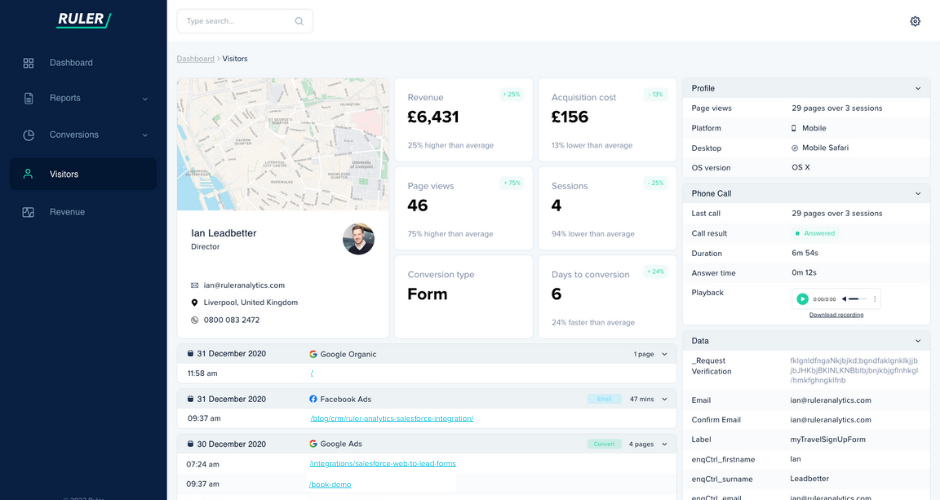
So if someone first found you through paid search, came back through a branded Google search a fortnight later, called your team, and converted in a sales conversation, we attribute that correctly across every touchpoint.
For any business where revenue lives in a CRM rather than a cart, that’s not a secondary consideration. It’s the entire measurement problem.
When you’re spending on channels that don’t produce clicks
Triple Whale’s attribution outside Meta, Google, and TikTok is minimal. Traditional channels are largely excluded. TV, radio, out-of-home, podcast sponsorships, display campaigns, YouTube brand activity, if these are part of your channel mix, you’re working without a proper read on what they contribute.
That’s an increasingly expensive blind spot as more brands invest in upper-funnel and brand-building activity.
Ruler’s MMM layer models impression-only and offline media using probabilistic multivariate regression across up to 30 variables.
It looks at the relationship between spend, external factors, and revenue outcomes to understand contribution. You can get a genuine read on what a radio campaign or an OOH burst actually did, even with no UTM parameter in sight.
For brands starting to invest beyond the bottom of the funnel, that capability changes what’s possible in a planning conversation.
When you need to plan forward, not just report backward
Measurement that only tells you what happened is useful. Measurement that tells you what to do next is where real budget leverage comes from.
Triple Whale’s AI-driven forecasting is built on seasonal and linear models. It can help you anticipate a trading period or project revenue based on recent trends. That’s genuinely handy for in-season planning and short-range decisions.
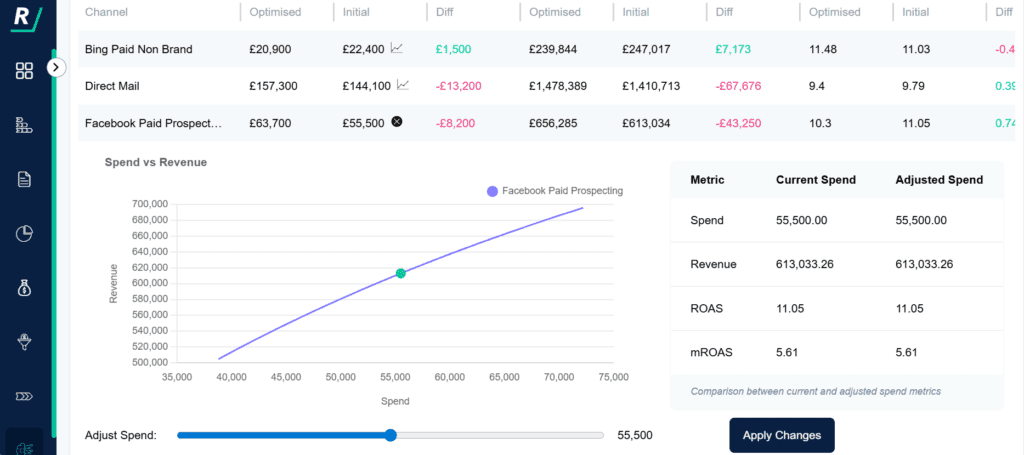
Where it runs out of road is when the question gets harder, what happens to return if we increase YouTube spend by 40%? Where is our Meta investment hitting diminishing returns? What does rebalancing the mix towards brand look like over the next two quarters?
Ruler’s MMM layer is built specifically to answer those questions. Diminishing returns curves show you where additional spend stops generating proportional return on a channel-by-channel basis.
Scenario planning lets you model budget reallocation before you commit to it. Marginal ROAS analysis tells you the incremental return on the next pound you spend, not just the average return on what you’ve already spent.
These are the outputs that hold up in a conversation with leadership or a board. They’re also the outputs that make the difference between a marketing team that reports on performance and one that actively shapes budget strategy.
When you’re not on Shopify
This one is straightforward but important. Triple Whale’s native integration is Shopify-centric. The pixel, the data model, the dashboard, all of it is built around the Shopify data structure.
Non-Shopify stores can connect, but the experience is significantly more limited and the depth of data available reduces meaningfully.
If you’re on WooCommerce, Magento, a custom-built platform, or a mix of systems, or if you’re running a hybrid model with both eCommerce and lead gen revenue streams, Triple Whale is going to create integration friction that compounds over time. You’ll spend more effort maintaining the setup and get less from it.
Ruler is platform agnostic by design. It works across any eCommerce platform, CRM, or tech stack. Whether you’re running Salesforce and a custom storefront, HubSpot and WooCommerce, or something more bespoke, the integration approach is built to flex rather than to assume.
Ruler Analytics vs Triple Whale: Pricing
The pricing structures are quite different and worth understanding before you go further.
Triple Whale prices on Gross Merchandise Value, which means your cost scales with your store’s revenue. Ruler prices on monthly unique visitors, which scales with traffic rather than revenue or account volume.
| Platform | Ruler Analytics | Triple Whale |
| Pricing basis | Monthly unique visitors | Gross Merchandise Value (GMV) |
| MTA starting price | From £199/mo | From $129/mo |
| MTA mid-tier | From £1,249/mo | From $1,129/mo |
| MMM | From £999/mo | Add-on, price not published |
| Blended MTA + MMM | From £1,499/mo | Not available |
| Seats | Unlimited, no extra cost | Varies by plan |
| Platform | Platform agnostic | Shopify-native |
One thing worth flagging. Triple Whale’s MMM is an add-on with pricing that isn’t publicly listed. If that capability is important to you, factor in a sales conversation before you get too far into an evaluation.
What is the best use case to use Ruler
We’d suggest looking at Ruler if any of these apply to you.
- Your sales cycle is longer than a single session. If there’s a lead stage, a consideration period, a sales conversation, or a CRM involved in your revenue process, you need measurement that follows that journey.
- You have offline conversions. Phone calls, form fills, deals closed outside a digital transaction. Ruler tracks and attributes all of these. Triple Whale doesn’t.
- You need to model upper-funnel or impression-only spend. TV, radio, OOH, display, CTV. Without MMM, there’s no rigorous way to measure these. Triple Whale’s attribution outside the major social platforms is minimal.
- You need a defensible budget justification. Diminishing returns curves, scenario planning, forward forecasting, marginal ROAS. If you need to make a statistical case for a budget decision, you need MMM underneath it.
- You’re not on Shopify, or not purely DTC. Ruler is platform agnostic. It works across eCommerce, B2B, lead gen, and mixed models regardless of tech stack.
- Your products are high-value with lower visitor volumes. Ruler’s traffic-based pricing works well for businesses with lower visitor counts but high-value conversions. Triple Whale’s GMV-based model means high revenue stores pay more regardless of measurement complexity.
Triple Whale’s dashboard is genuinely polished. For a DTC brand that lives in Shopify, the out-of-the-box experience is fast and clean in a way that takes longer to replicate elsewhere.
Their creative analytics tooling, understanding which ad creatives are performing, is strong and well-regarded. Moby, their AI assistant, is useful for quick questions across your store data. Setup is fast.
If that’s the world you operate in, those things matter.
Want a walk-through of how Ruler works in detail?
If you’re evaluating measurement platforms and you’re not entirely sure which problem you’re trying to solve, that’s actually the most useful conversation to have first.
Book a demo with our team. We’ll ask the right questions, be honest about what fits, and if Triple Whale genuinely makes more sense for your business we’ll say so.