
How a global travel brand implemented a unified measurement system that connects online and offline marketing to revenue and enables them to make confident budget allocation decisions.
For some businesses, marketing is inherently difficult to measure because of how it operates. For this travel brand, selling holidays across multiple touchpoints, including third-party agents and its own channels, that complexity had become a major strategic challenge.
Campaigns spanned paid search, paid social, CTV and programmatic display, while bookings came in online, over the phone and through independent, third-party agents.
This made it hard to measure ROI and optimise spend across channels, particularly for upper-funnel activity. Most standard analytics tools weren’t designed to handle that level of fragmentation.
They partnered with Ruler to better understand how marketing investment drives revenue across both online and offline channels. By combining marketing mix modelling with multi-touch attribution, the team built a unified, data-driven view of performance, enabling more confident decisions and smarter budget allocation.
The measurement challenge
Roughly 60% of the company’s business flows through third-party travel agents. Of the remaining 40% that comes direct, only around 10% completes entirely online.
A lot of the bookings, the ones that actually matter commercially, happen after someone has left the digital trail entirely. They’ve seen the ad, visited the site, maybe submitted an enquiry, and then picked up the phone, walked into a travel agency, or simply waited weeks before booking through a vacation planner.
Traditional attribution doesn’t know what to do with that. It either ignores it or misattributes it. Cost per enquiry had been the team’s primary benchmark for close to ten years, because it was trackable. Platforms like Google and Meta would each claim credit for leads.
A single prospective customer who submitted three tour enquiries in one session would often arrive in the data as three leads. Meanwhile the actual booking, the one with real revenue attached, sat somewhere downstream in a CRM, unconnected to any campaign.
The gap between total web leads and net assigned leads was a known problem, it just hadn’t been solvable until now.
There was also another layer to this, and it came from the top. The company had been investing in Connected TV for several years across two of its brands, with genuine belief from the marketing team and their agency that it was performing.
However, proving it was another matter entirely. When the channel comes under scrutiny, conviction isn’t enough, you need numbers.
CTV doesn’t generate clicks, but it builds awareness. It sits in that hard-to-measure upper-funnel space where the impact is real, but the measurement, with most tools, simply isn’t.
Bringing everything together with unified measurement
Here’s how the team built a unified view of marketing performance across every channel, online and offline.
Before anything else could be modelled, the revenue data itself needed to be in one place. That meant pulling together historical performance across every channel, paid search, paid social, CTV, programmatic, phone sales, travel agent bookings, into a single consolidated view. The result was a holistic picture of marketing performance across the full funnel, with ROAS calculable for the first time against real, deduplicated revenue rather than overlapping platform-reported figures.
A significant portion of their revenue didn’t happen online at all, bookings came through inbound phone sales and via third-party travel agents. By integrating directly with the CRM, those offline revenues were brought into the same attribution framework as online transactions. For the first time, the marketing team could see the full picture of what their spend was driving, not just the portion that happened to leave a digital footprint.
With revenue data unified, MMM could be applied across the full channel mix, including those previously impossible to evaluate. Roughly 100 weeks of historical data fed into the model, surfacing patterns that shorter windows miss, seasonality, budget shifts, and the delayed impact of brand-building on eventual conversion. The long-term brand awareness effects of CTV showed up clearly in the model output.
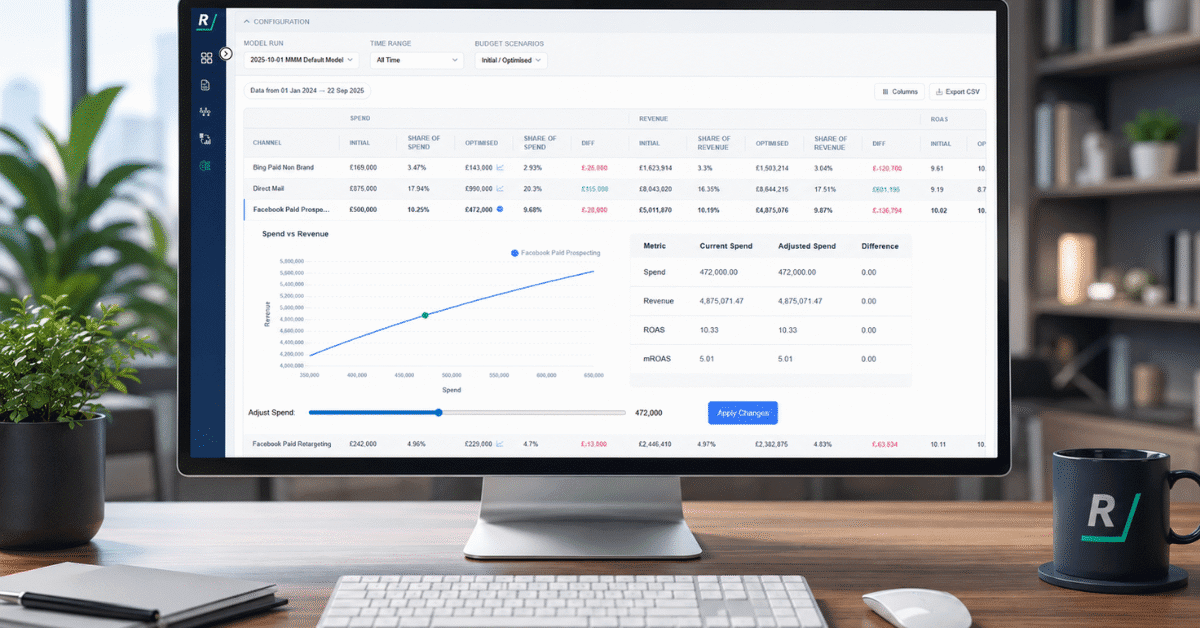
The Scenario Planner turned the MMM output into something the team could actively use for planning, simulating the revenue impact of increasing or reducing spend across channels before budget decisions were locked in. Instead of relying on instinct or blanket cuts, the team could see where diminishing returns were setting in and where spend was still driving strong incremental revenue.
What the data now shows
With a single, unified view of marketing performance in place, the team’s decision-making changed significantly.
- CPL-based decisions
- Fragmented attribution
- No offline visibility
- Gut-driven budget allocation
- CTV unproven to leadership
- Revenue-based decisions
- Holistic online & offline view
- Full CRM integration
- Predictive scenario planning
- CTV validated ROAS
See how this could be applied to your marketing
This work shows what changes when marketing data is brought out of silos and tied back to real revenue. By combining MMM and multi-touch attribution, the team moved from channel-level assumptions and lead-based reporting to a clearer view of incremental impact across online bookings, phone sales, and third-party agents
If you want to see how this approach could work in your own setup, book a demo with Ruler to explore how unified attribution and marketing mix modelling can connect your online and offline data, remove duplication in conversion reporting, and give you a clearer, revenue-led view of performance that supports more confident budget decisions across every channel.
This work shows what changes when marketing data is brought out of silos and tied back to real revenue. Book a demo with Ruler to explore unified attribution and marketing mix modelling for your own channel mix.
Book a demo Learn more