
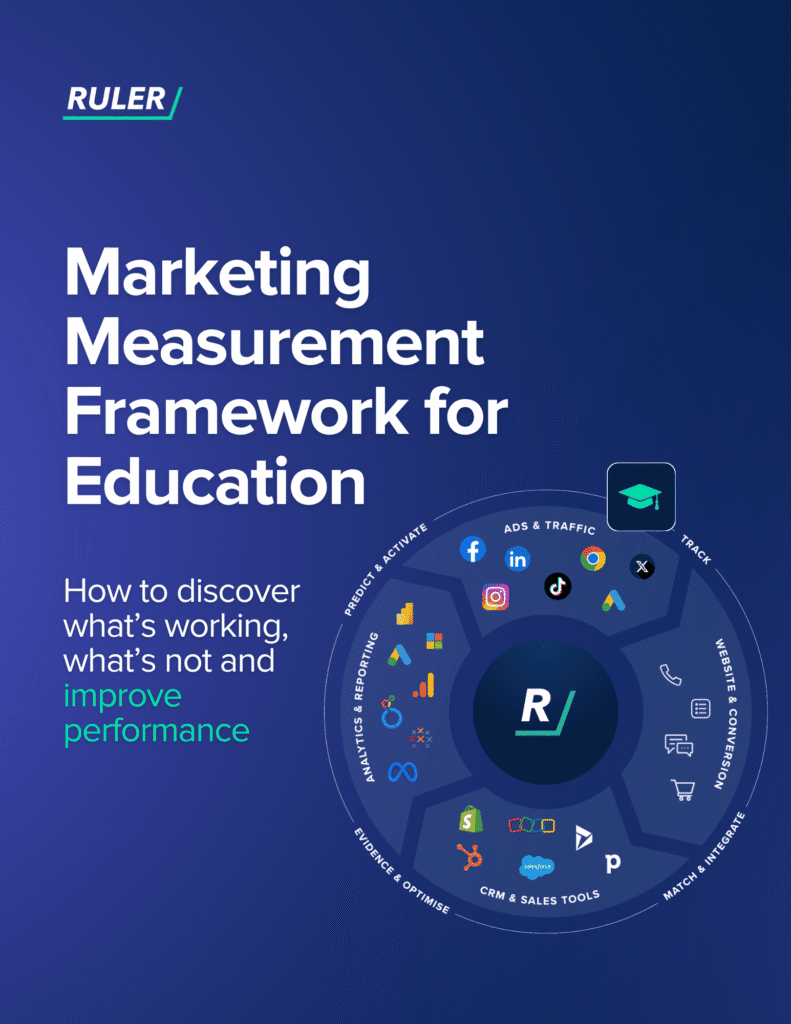
Track how your prospective students research, engage, select and apply for a place, and quantify the impact of your marketing activities on applications and enrolments, to make better-informed marketing decisions.
By the time a place is accepted, most of the touchpoints that influenced that decision have already been forgotten by your attribution model. If you’re relying on GA4 and platform-reported metrics to make budget decisions, you’re making them on an incomplete picture.
Here’s what’s being missed ↓
Four ways standard attribution misses the full picture
Long consideration windows
Prospective students rarely convert after a single interaction. They may first discover a course through paid social, research through comparison sites and open day content, and return weeks later through organic search before applying. Without a model that captures influence across the full journey, early-stage channels appear undervalued.
Last-click bias toward bottom-of-funnel channels
By assigning all value to the final touchpoint before application, last-click makes channels such as branded search and direct traffic appear more effective than they are. This can lead to budget being shifted away from the channels that create awareness and demand earlier in the funnel.
Offline applications and enrolments
Complex course enquiries are often finalised offline. Prospective students call your admissions team, attend an open day, or apply weeks after speaking to someone at a school or college fair. When those offline touchpoints aren’t connected back to the marketing that drove them, these applications drop out of your reporting, and the channels doing the heaviest lifting receive the least value.
Platform reporting that doesn’t add up
Google, Meta, and TikTok each report enquiries within their own attribution windows, and none of them account for what the others are claiming. Add up the totals and you’ll typically find they sum to two or three times your actual applications or enrolments. Most budget decisions get made on those individual platform views, which means you’re optimising against inflated figures that don’t reflect reality.
A measurement model shaped around the education applicant journey
First-party tracking, every conversion type
Ruler tracks calls, form submissions, and live chat enquiries using a first-party tag that follows the full journey from first visit to completed enrolment, holding up as third-party cookies keep degrading.
Multi-touch attribution
Compare first click, last click, linear, position-based, time decay, and data-driven models side by side. Enquiries and applications match to CRM and SIS records and full journey data, so you report on enrolments, not just application counts.
DDA + impression modelling
Click-path data combines with MMM-derived impression weightings. Attribution shifts away from over-weighted direct and brand search, towards the upper-funnel activity that shaped the decision but never earned a click.
Marketing mix modelling
Statistical modelling across every channel, including TV, radio, and offline media, with historical lookback and forward budget forecasts. Accounts for seasonality, intake cycles, and diminishing returns across up to 30 variables at once.
Budget scenario planner
Diminishing return curves show exactly where each channel is saturated and where incremental spend still delivers. Model optimised, efficiency, and custom budget scenarios before committing spend, provided for a sector where demand shifts around intake and clearing cycles.
Integrations and data enrichment
Ruler ingests data from your ad platforms, CRM, and SIS, then pushes enriched attribution data back out, so enrolment signals power smarter bidding, not just sit in a report.
What changes with a unified measurement model
One measurement view you can trust
Ruler deduplicates enquiries and applications across every channel and aligns them to actual enrolments. One view of performance, not one per platform.
Offline applications and enrolments in the model
Applications and enrolments completed away from your website are captured in the model too, a fundamental change for education providers where complex-course enrolments are finalised offline.
Recognition for channels without clicks
Display, video, CTV, and paid social build consideration but rarely earn the last click. Impression modelling gives them value the data says they deserve.
Better signals back to your platforms
When Google and Meta receive real enrolment data rather than just enquries and applications, automated bidding gets meaningfully more efficient.
Trusted by teams who need the full picture
Fixed our problem with revenue attribution. We can now see exactly which campaigns drive closed revenue, not just leads.
With Ruler’s data we’re now able to optimise campaigns based on actual won business, as opposed to web conversions.
A must-have to track leads across multiple tech stacks. The CRM enrichment alone changed how our sales team works.
Ruler Analytics allows us to invest in the right channels and create effective campaigns that deliver results for our clients.
Ready to see how marketing influences applications and enrolments?
Ruler connects your channels to applications and enrolments, closes the gaps that standard attribution leaves open, and gives you the measurement clarity that education marketing demands.