

Cookie deprecation is breaking conversion tracking across every channel, and most reporting setups aren’t built to handle it.
If your GA4 data and your actual sales figures don’t quite match, or if your paid campaigns look less efficient than they did two or three years ago without a clear explanation, the most likely cause isn’t campaign quality. It’s a tracking problem.
The privacy changes that have rolled out across browsers and operating systems over the past several years have fundamentally changed what gets measured.
Cookies that used to last months can expire in 24 hours. Cross-device journeys that were once fully trackable are now mostly invisible. Conversions are being missed, misattributed, or silently dropped.
The platforms you’re relying on to report performance are working with incomplete data, and that affects every budget decision they inform.
This isn’t a failure of your setup. It’s a structural shift in how browsers handle tracking, and it’s affecting measurement across the industry.
We discuss in more detail what’s changed, what it means for your data, and what actually works to fix it.
- How cookie deprecation impacts tracking
- How this shows up in your reporting
- What to do about cookie deprecation and conversion tracking
Key takeaways
Safari and Firefox already block third-party cookies by default, covering roughly 20–35% of global browser traffic.
Safari’s Intelligent Tracking Prevention can shorten cookie lifespans to as little as 24 hours when traffic arrives via ad click parameters like gclid or fbclid, meaning any customer with a consideration cycle longer than a day can be lost entirely from your attribution.
The result shows up as inflated direct traffic, GA4 revenue that doesn’t match your backend, and paid channels that look less efficient than they actually are.
A unified reporting layer is the most effective fix, sitting independently from ad platforms, it tracks clicks deterministically, fills cookie gaps with machine learning, models impression impact probabilistically, and connects website activity directly to CRM revenue.
Google Enhanced Conversions and Meta’s Conversions API are worthwhile in-platform fixes, but they only recover signal within their own ecosystems and don’t solve the broader attribution picture.
Your CRM or e-commerce backend is your source of truth, comparing it against GA4 and combined platform totals is the clearest way to understand the size of your current tracking gap.
What’s changed and why it matters
The shift didn’t happen overnight. It began in 2017 when Apple introduced Intelligent Tracking Prevention (ITP) in Safari. The restrictions have tightened steadily since, and the cumulative impact on conversion tracking has become substantial.
Safari and Firefox block third-party cookies by default. Safari holds roughly 18–20% of global browser share. Firefox adds another 3–4%. Combined, a meaningful proportion of your traffic is already browsing in an environment where the cross-site tracking that underpins traditional pixel-based attribution simply doesn’t function as intended.
Safari caps JavaScript-set cookies at 7 days, or just 24 hours. This is where ITP has its most significant practical impact on marketing measurement. Any first-party cookie set via JavaScript, which includes most tracking pixels, including Google Analytics and the Meta Pixel, is capped at 7 days in Safari. The restriction is even tighter for users who arrive on your site through a link containing ad tracking parameters, such as the gclid parameter that Google appends to paid search URLs or the fbclid that Meta adds to ad links, as ITP reduces those cookies’ lifespan to just 24 hours.
Think about what that means for any product or service with a consideration cycle longer than a day. A user clicks your Google ad on Monday, browses your site, and returns to buy on Thursday. The attribution cookie connecting that conversion to your campaign was deleted on Tuesday. The conversion either disappears from your reporting entirely, or it gets attributed to “direct” because there’s no longer a trail connecting it to the original click.
Ad blockers compound the gap. Around 31% of internet users globally use ad blockers at least some of the time. These frequently prevent tracking pixels from firing at all, meaning conversions from a significant portion of your audience are never recorded, regardless of which browser they’re using.
iOS privacy changes reduced mobile signal. Apple’s App Tracking Transparency framework, introduced with iOS 14.5, required apps to ask users for explicit tracking permission. Opt-out rates were high. For Meta in particular, this created a significant data gap in mobile conversion tracking, one the Conversions API was partly built to address.
Chrome’s position is more stable, for now. Google reversed its original plan to phase out third-party cookies entirely, instead introducing user controls in 2024 and maintaining the current approach in 2025. Chrome still allows third-party cookies, which matters given its roughly 65% global browser share. But the direction of travel across browsers is clearly toward more restriction, not less. Building measurement infrastructure on third-party cookies is increasingly fragile regardless of Chrome’s current stance.
How cookie deprecation shows up in your reporting
The practical effects tend to appear in a few consistent ways. The most common is conversions being attributed to “direct” when they shouldn’t be, when a tracking cookie expires before a customer converts, or a browser blocks it from being set, analytics tools lose the attribution thread.
The conversion still records, but the source shows as direct because there’s no data to say otherwise. This artificially deflates the apparent performance of upper-funnel activities and paid channels and quietly inflates direct traffic figures.
You’ll also likely notice that GA4 revenue doesn’t match your backend, underreporting of 15–30% compared to actual backend data isn’t unusual for businesses with significant Safari or iOS traffic, or audiences that use privacy tools.
If you’re running the same campaigns with similar targeting but efficiency metrics have deteriorated without a clear explanation, signal loss is a plausible cause.
When Google Ads or Meta don’t receive complete conversion data, their bidding algorithms have less to work with, which typically means less efficient optimisation over time. This hits hardest on long-consideration purchases, B2B and high-consideration B2C journeys that span days, weeks, or longer are exactly the ones cookie expiry restrictions affect most, because the early touchpoints that initiated the journey get no credit by the time conversion finally happens.
We regularly see this pattern in accounts where finance and marketing are looking at meaningfully different versions of the same revenue period. The gap is almost never a mistake in setup. It’s explained by the structural limitations above.
What to do about cookie deprecation and conversion tracking
The good news is that effective solutions exist. None perfectly replicate the unrestricted tracking available five years ago, but implemented together they recover a substantial proportion of the signal that would otherwise be lost.
1. Build a unified reporting layer
Rather than patching individual tracking gaps in isolation, a unified reporting layer is built around recovering and connecting the full picture of what’s driving revenue. Our methodology works across four areas to make this possible:
- Clicks tracked deterministically through multi-touch attribution for direct-response channels, so user-initiated interactions are accurately recorded and linked to real outcomes, rather than lost to cookie expiry or misattributed to direct traffic.
- Cookie gaps filled using machine learning, including Smart Fill Impression Modelling, which estimates the incremental impact of ad exposure over time, accounting for the delay between seeing an ad and converting, cross-channel halo effects, and the brand awareness that never appears in any direct click path and gets no credit in last-click reporting.
- Impression impact modelled probabilistically for awareness channels, so upper-funnel activity that drives pipeline but never gets clicked gets measured, rather than being written off because it doesn’t fit a click-based attribution framework.
- Website activity connected directly to CRM revenue, closing the gap between what analytics reports as a lead and what finance recognises as revenue, particularly important for B2B teams where the journey from first touch to closed deal can span weeks or months.
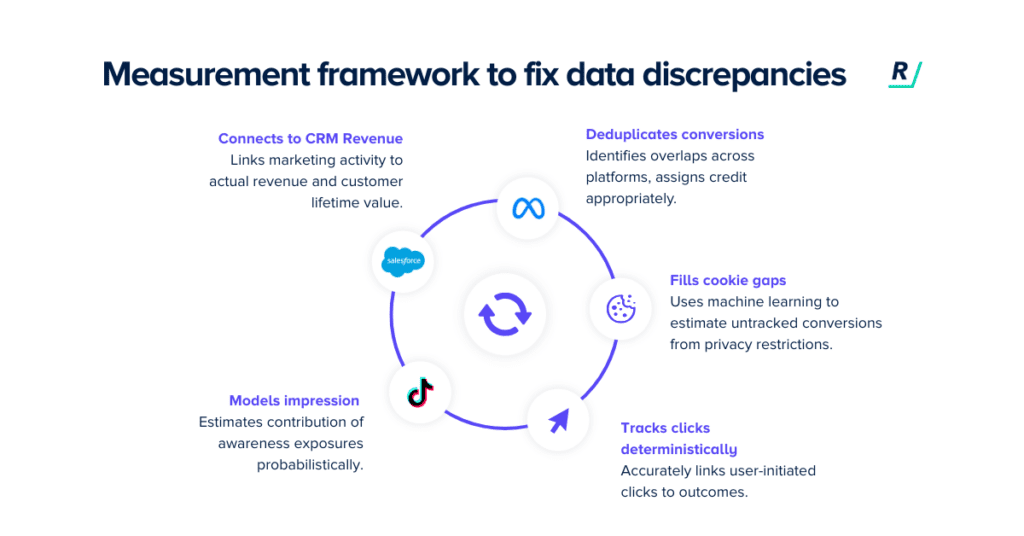
The result is a view of performance that recovers the signal most measurement setups are silently losing, the conversions dropped by cookie expiry, the upper-funnel touches that never get credit, and the revenue that exists in your CRM but never makes it back into your reporting.
2. Google Enhanced Conversions
Building a unified reporting layer is the most complete solution because it sits independently from ad platforms, which all carry their own duplication issues on top of the privacy and cookie challenges we’ve discussed. But there are also in-platform features worth having in place.
Enhanced Conversions is Google’s approach to recovering attribution where cookie data falls short. When a customer converts and provides information like an email address, that data is hashed and sent to Google alongside the conversion event. Google matches it against signed-in accounts, recovering attribution for conversions that would otherwise have been lost to cookie expiry or cross-device journeys.
It works within Google’s existing framework without requiring a separate infrastructure rebuild, and it’s particularly effective for advertisers with high iOS or Safari traffic where standard cookie-based tracking misses the most.
Meta Conversions API (CAPI)
On the Meta side, the Conversions API creates a direct server-to-server connection between your backend and Meta’s platform, bypassing browser restrictions entirely. The recommended approach is to run both the browser Pixel and CAPI together, the Pixel captures what it can from the browser, CAPI fills in what the browser can’t.
Meta deduplicates the two streams provided you pass consistent event IDs, so you’re recovering the signal without reintroducing the double-counting problem discussed earlier. If you’re already running CAPI, check your Event Match Quality score in Meta’s Events Manager. A low score means the events being sent don’t contain enough identifying information for Meta to match them reliably to users, which limits how much signal you’re actually recovering.
Establishing CRM revenue as your baseline
Whether you implement a unified reporting layer, in-platform fixes, or both, the most important change is anchoring all measurement to your actual revenue data. Your CRM or e-commerce backend records every sale regardless of what tracking was active, making it the one source of truth that exists independently of platform reporting, cookie availability, or attribution logic.
Comparing it against your analytics and platform data tells you how large your current tracking gap is and gives you a benchmark to measure improvement against. A useful starting point is to take the total revenue from your backend for the last 30 days, compare it against GA4’s reported revenue, then compare it against combined conversions claimed across all your ad platforms.
The first gap shows you analytics signal loss. The second shows you attribution overlap. Both are worth understanding clearly before making any investment decisions.
Where to go from here with conversion tracking and cookie deprecation
Cookie deprecation isn’t a future problem to prepare for, it’s a current one that’s already affecting the data you’re making decisions with today. The conversions being dropped by browser restrictions, the attribution lost to cookie expiry, the upper-funnel activity that never gets credit, none of it shows up as an obvious error in your reporting.
It just quietly makes your paid and upper-funnel channels look less efficient, inflates your direct traffic, and widens the gap between what marketing reports and what finance sees.
What you need is enough signal to make confident decisions, a baseline in your CRM, in-platform fixes that recover what browsers are blocking, and ideally a unified reporting layer that works independently of what each platform chooses to report.
Start with the comparison. Pull your backend revenue, compare it against GA4, then compare it against combined platform totals. The size of the gap tells you where to focus first. For most businesses, even closing half of it changes the quality of every budget conversation that follows.
If you want to see how a unified measurement layer recovers lost signal and connects your full customer journey to actual revenue, book a demo with Ruler Analytics and we’ll show you what your reporting is currently missing.
Cookie depreaction & conversion tracking FAQs
Cookie deprecation refers to browsers restricting or blocking third-party cookies, the files that enabled tracking users across different websites. Safari and Firefox already block them by default. As these restrictions have grown, conversion tracking that relies on cookies has become increasingly incomplete, with more conversions being missed or attributed to the wrong source.
Google Analytics relies heavily on client-side tracking, which means it sets cookies in the user’s browser to identify sessions, stitch together journeys, and attribute traffic sources. As Safari and Firefox block third-party cookies by default and ITP shortens the lifespan of JavaScript-set cookies to as little as 24 hours, GA4 loses the ability to connect returning visitors to their original source. The practical result is more sessions attributed to direct traffic, underreported revenue compared to your backend, and an increasingly incomplete picture of how customers are actually finding and engaging with your site.
Attribution depends on cookies being present at the point of conversion to trace the journey back to the original touchpoint. When a cookie expires before a customer converts, which happens frequently for any product or service with a consideration cycle longer than a day, that connection is severed. The conversion may still be recorded, but the channel that started the journey gets no credit. This disproportionately affects upper-funnel channels like display and paid social, where the gap between first exposure and conversion tends to be longest, and it’s a key reason why last-click attribution already undercounts the contribution of awareness activity.
Ad platforms rely on browser-based pixels to match conversions back to ad exposures and clicks. When cookies are blocked or expire before conversion, those matches fail, meaning platforms receive an incomplete picture of the conversions their campaigns actually drove. This affects reported ROAS, inflates apparent cost-per-acquisition, and reduces the quality of the conversion signals that power automated bidding. Platforms are less able to optimise toward the right audiences when the data feeding their algorithms has gaps, which over time leads to less efficient campaign performance even when targeting and creative remain unchanged