


We explain how Apple’s App Tracking Transparency affects marketing measurement and what teams can do to rebuild a more reliable view of performance.
Paid social performance numbers are getting increasingly hard to interpret, and many teams are seeing similar challenges.
Apple’s App Tracking Transparency framework changed the rules for how marketers can track users on iOS devices, and most of those users chose not to be tracked.
For marketing teams trying to report on campaign performance, allocate budgets, and justify spend to senior stakeholders, this creates a genuine measurement problem. The data coming back from ad platforms is less complete than it used to be, and the gaps are not always obvious.
This blog explains what ATT actually does, where the measurement gaps show up, and how to build a more reliable picture of performance despite them.
We discuss:
- What Apple’s ATT is
- Where measurement gaps show up
- How it affects budget decisions
- What to do about Apple’s ATT & measurement
Key takeaways
Apple’s App Tracking Transparency (ATT) framework requires user opt-in before apps can track activity across other apps and websites, and most users decline.
This creates significant gaps in conversion data for any marketer running paid campaigns on iOS, particularly Meta and other social platforms.
The impact extends beyond mobile, cross-channel journeys that begin on iOS are harder to measure end-to-end.
Deterministic click tracking and probabilistic modelling can help recover lost signals.
Unified attribution that connects all touchpoints to CRM revenue gives the clearest picture of what is actually working.
What is Apple’s App Tracking Transparency framework
Introduced with iOS 14.5 in April 2021, App Tracking Transparency requires apps to request explicit permission before tracking a user’s activity across other apps and websites. Prior to ATT, this kind of tracking happened by default.
When an iOS user opens an app that wants to track them across other platforms, they now see a prompt asking whether to allow tracking. The majority of users decline.
Estimates vary, but opt-in rates have consistently sat below 30% globally, meaning the tracked portion of iOS traffic is a minority of the total.
For marketers, this is significant because a large share of mobile traffic runs on iOS, particularly in markets like the UK and US, where iPhone usage is high.
When users decline tracking, ad platforms lose visibility into what those users do after seeing or clicking an ad.
Where the measurement gaps show up
The effect of ATT is not limited to one channel. It ripples through any measurement approach that relies on device-level tracking across apps and websites.
Paid social attribution
Meta’s advertising platform was among the most affected. Facebook and Instagram are iOS apps, and because Meta’s pixel depends on cross-app tracking to attribute conversions, ATT directly reduced the data available for attribution.
Meta responded with Aggregated Event Measurement, a privacy-preserving framework that limits the number of trackable conversion events per domain and introduces modelled reporting. This means the numbers you see in Ads Manager are partly reported, partly estimated.
The practical effect is that some conversions genuinely driven by Meta campaigns do not get attributed back to those campaigns. The platform underreports, which makes decision-making on Meta spend harder to ground in reliable data.
Cross-channel journey gaps
Most customers don’t convert after a single interaction with a single channel. A prospect might first encounter a brand through a LinkedIn ad, later search for it directly, read a blog post through organic search, and eventually convert through a retargeting campaign.
When any of those earlier touchpoints happen on an iOS device where tracking has been declined, that part of the journey disappears from your attribution data entirely.
The problem compounds across channels because each platform only sees the portion of the journey it was involved in. A user who clicked a paid social ad on mobile, then returned via email on desktop, then converted through organic search will look like a purely organic conversion in most reporting setups.
The paid social and email touchpoints are invisible, not because they did not happen, but because ATT removed the thread that would have connected them.
Audience data and retargeting
ATT also affects the quality of custom audiences built from app activity and website visits. Smaller, less complete audiences mean retargeting campaigns reach fewer of the people who have actually engaged with a brand, which can reduce efficiency even when campaigns appear to be running normally.
How this affects budget decisions
The measurement gaps created by ATT do not just affect reporting accuracy, they affect how confidently marketing teams can allocate and justify budgets.
When attribution data is incomplete, a few things tend to happen.
Channels that depend heavily on last-click attribution and deterministic tracking, like paid search, appear to perform better relative to channels where tracking is more affected, like paid social.
Budget naturally follows the cleaner data, which may not reflect where actual impact is occurring.
Upper-funnel awareness activity, which was already hard to attribute before ATT, becomes even harder to defend in budget conversations.
Impressions and early-stage touchpoints on iOS are largely invisible in standard reporting, so the contribution of awareness campaigns is systematically underrepresented.
For marketing leaders making the case for investment in channels that are disproportionately affected by ATT, the challenge is not just fixing the data, it is communicating the limitations clearly enough that decisions are made with appropriate context rather than misplaced precision.
What you can do about Apple’s ATT and measurement
There is no single fix that fully restores the data that ATT removes. But a combination of approaches can substantially reduce the impact on your ability to measure and make decisions.
Use deterministic click tracking
Where users actively click through from an ad to a website, that click can be tracked deterministically using URL parameters and first-party data. This approach does not depend on cross-app tracking and is not affected by ATT in the same way.
Ruler, for example, tracks visitor journeys at the click level using first-party methods, connecting those visits to downstream outcomes including CRM revenue, without relying on third-party identifiers.
Deterministic click data gives a reliable baseline for direct-response channels, even in a post-ATT environment.
Apply probabilistic modelling for impression-based channels
For awareness campaigns where direct attribution is not possible, probabilistic modelling can estimate the contribution of impressions and upper-funnel activity to overall performance.
These approaches do not claim precision at the individual conversion level, instead they identify patterns across aggregate data that reveal the relationship between spend, exposure, and outcomes.
Ruler’s impression modelling uses machine learning to estimate the impact of impression-based touchpoints, filling gaps that deterministic tracking cannot reach.
Ground everything in CRM revenue
Platform-reported conversions will always be affected by tracking limitations. CRM revenue data is not. Using your CRM as the source of truth, and working backward to understand which marketing activities preceded closed revenue, gives a more reliable foundation for measurement than relying on ad platform attribution alone.
Connecting website and marketing activity to CRM outcomes is particularly valuable for B2B organisations, where the journey from first touchpoint to closed deal can involve multiple people, devices, and months of engagement.
Build unified attribution across channels
Fragmented, platform-specific reporting will always present an incomplete and sometimes contradictory picture.
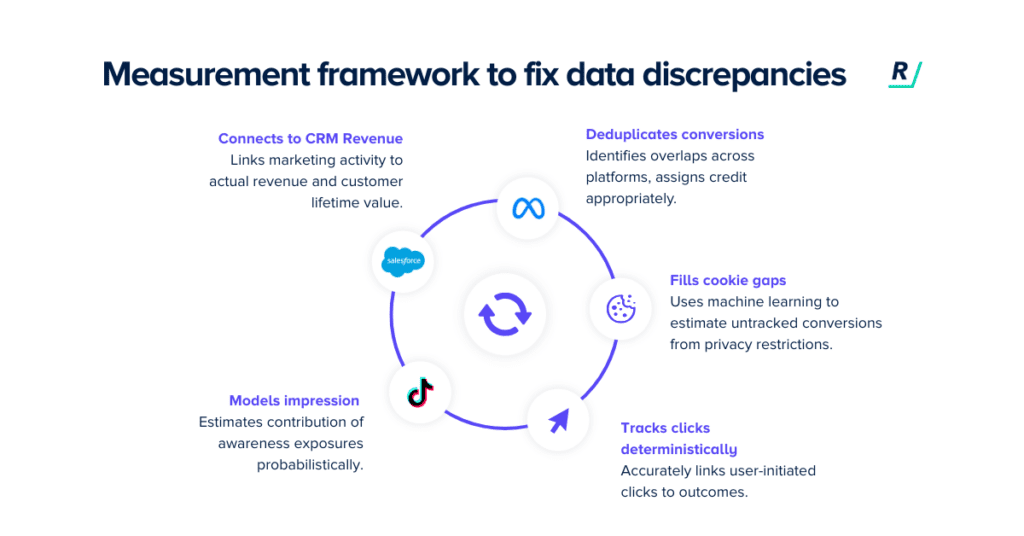
A unified attribution layer aggregates data from all channels, deduplicates conversions, and connects marketing activity to actual revenue, combining deterministic tracking for clicks you can measure directly, probabilistic modelling to estimate the contribution of touchpoints that fall outside direct tracking, and lift testing to validate incremental impact at the channel level.
Together, they provide the kind of clarity that supports confident budget decisions, even when individual data sources are imperfect.
What this means for how you report
ATT has made it necessary to be more explicit about what your data does and doesn’t show.
Reports that present platform-attributed conversions as definitive will mislead stakeholders, particularly when those numbers are compared across channels that are affected by ATT to different privacy regulations.
Presenting a clearer picture means distinguishing between what is directly measured and what is modelled, showing actual CRM revenue alongside attributed conversions, and being transparent about the limitations of any single data source.
That transparency, counterintuitively, tends to increase confidence rather than reduce it. Stakeholders who understand the methodology behind a number are better placed to use it appropriately than those who are given a single figure without context.
Final Thoughts on Apple’s ATT and measurement
Apple’s App Tracking Transparency has permanently changed the information available to marketers running campaigns on iOS, and that is unlikely to reverse. The goal is not to recover the tracking capabilities that existed before ATT, but to build a measurement approach that is reliable enough to support good decisions in the environment that now exists.
That means combining deterministic tracking where it is possible, probabilistic modelling where it is not, and grounding everything in CRM revenue as the one source of data that consent frameworks do not affect.
If you want to see how Ruler can help you build that picture, book a demo and we can walk through what it would look like for your specific setup.
Apple’s ATT and measurement FAQs
App Tracking Transparency (ATT) is a privacy framework introduced by Apple with iOS 14.5. It requires apps to ask users for permission before tracking their activity across other apps and websites. Users who decline can’t be tracked across platforms, which limits the data available for ad attribution.
Meta’s advertising attribution relies heavily on cross-app and cross-channel tracking. When iOS users decline ATT, Meta loses visibility into their post-click and post-view behaviour. This means some conversions driven by Meta campaigns are not attributed, and Ads Manager reporting is partly based on modelled estimates rather than direct measurement.
Google Ads is less directly affected than Meta because much of its conversion tracking happens through the Google ecosystem rather than cross-app tracking. However, cross-channel measurement and some display attribution are still impacted, particularly where iOS users are involved in the journey.
A combination of first-party deterministic click tracking, and probabilistic modelling provides the most complete picture. Connecting this data to CRM revenue gives a reliable source of truth that is not affected by consent-based tracking limitations.