
We’ve spoken to many marketers evaluating Ruler Analytics and HockeyStack. Here’s what we actually recommend based on real use cases.
Before diving into the comparison, it’s worth making one thing clear that this isn’t a takedown piece.
HockeyStack and Ruler are aligned on a lot of the same thinking. Both platforms were built on the same core frustration, that last-click attribution, platform-reported numbers, and GA4 alone give marketers a dangerously incomplete view of what’s actually driving revenue.
Both companies staked our products on the belief that the full customer journey matters. Not just the last touchpoint or the form fill. The whole path, stitched together across sessions, channels, and campaigns, from first touch through to closed deal.
Both platforms connect marketing activity to pipeline and revenue. That’s especially true where sales cycles are long and the relationship between an ad impression and a ‘closed won’ opportunity can span months. Marketers need a source of truth that lives outside the ad platforms, somewhere that isn’t Google telling you Google is working, or Meta telling you Meta is working.
That shared philosophy is actually why comparisons between Ruler and HockeyStack come up so often. The audience and the problem being solved is largely the same. Where things diverge is in the approach, the depth of specific capabilities, and which kinds of businesses each platform genuinely fits.
💡Pro Tip
If your marketing sits across multiple channels, longer sales cycles, or offline conversions, Ruler Analytics is built to give you the full picture of what’s actually driving revenue, no matter if you’re B2B, B2C, or operating across multiple verticals. You can see exactly what’s working, what isn’t, and how every touchpoint contributes to revenue in one place.
If you want to see how this would work for your setup, you can book a demo with our team.
What each platform is built for and key features
Ruler Analytics is a unified marketing measurement platform. We built it for businesses with complex, multi-touchpoint customer journeys, the kind where a lead might come in through paid search, get nurtured over email for three months, convert on a call, and then close four weeks later in a CRM deal. We handle that whole journey.
MTA, MMM, incrementality testing, offline conversion tracking, CRM enrichment, audience activation. It’s designed to work across any business model or industry vertical, including both B2B and B2C lead generation companies.
HockeyStack is an AI-powered GTM intelligence platform built specifically for B2B. It’s strong on buyer journey mapping, account intelligence, and AI agents for sales and marketing teams. If your world is SaaS or B2B tech with a defined set of target accounts, it’s clearly been designed with you in mind.
One key difference is that Ruler is not limited to B2B. While HockeyStack is heavily focused on SaaS and account-based GTM teams, Ruler can also support B2C lead generation businesses with long, offline-influenced buying journeys.
Their differences become most obvious when you compare how each platform handles shared use cases.
| Platform | Ruler | Hockeystack |
| Overview | A unified marketing measurement platform built for businesses with complex, multi-touchpoint customer journeys. Combines multi-touch attribution (MTA), marketing mix modelling (MMM), and incrementality testing alongside first-party data, CRM enrichment, and audience activation – across any business model or industry vertical. | AI-powered B2B GTM intelligence and revenue data platform that offers AI agents for marketing and sales teams, with multi-touch attribution, buyer journey mapping, account intelligence, and lift/incrementality reporting capabilities. |
| Multi-touch | Yes First-party, deterministic click tracking across all channels with 6+ attribution models – first, last, position, time decay, dda, impression | Yes (B2B only) B2B multi-touch attribution with cookieless tracking and account-level buyer journey mapping. |
| Marketing mix modelling | Yes Probabilistic MMM using multivariate regression across up to 30 variables, with budget optimiser and forecasting. | Limited HockeyStack offers MMM, however, this is part of their AI modelling layer rather than a full MMM product with auditable outputs. |
| Blended MTA & MMM | Yes Proprietary DDA model combines MTA + MMM outputs to redistribute credit to upper-funnel channels. | No No published blended model methodology or auditable output equivalent to Ruler’s DDA model. |
| CRM enrichment | Yes Enriches leads and opportunities with in CRMs with marketing attribution and source data. | Yes (b2b only) Salesforce and HubSpot integrations. Nova AI surfaces account intelligence and actions in the CRM. |
| Offline conversion tracking | Yes Tracks phone calls, form fills, live chat, and offline deal close — links all back to originating marketing source. | No No native call tracking or offline conversion measurement. Focused on digital interactions, CRM data and ad/review site platforms. |
| Budget optimisation & forecasting | Yes MMM-driven diminishing returns curves, scenario planning, and forward forecasting baked in. | No No budget optimisation, diminishing returns modelling, scenario planning, or Marginal ROAS analysis. |
Multi-touch attribution
We talk to a lot of marketers who come to us after relying on last-click for years. They know it’s broken, and multi-touch attribution is usually the starting point.
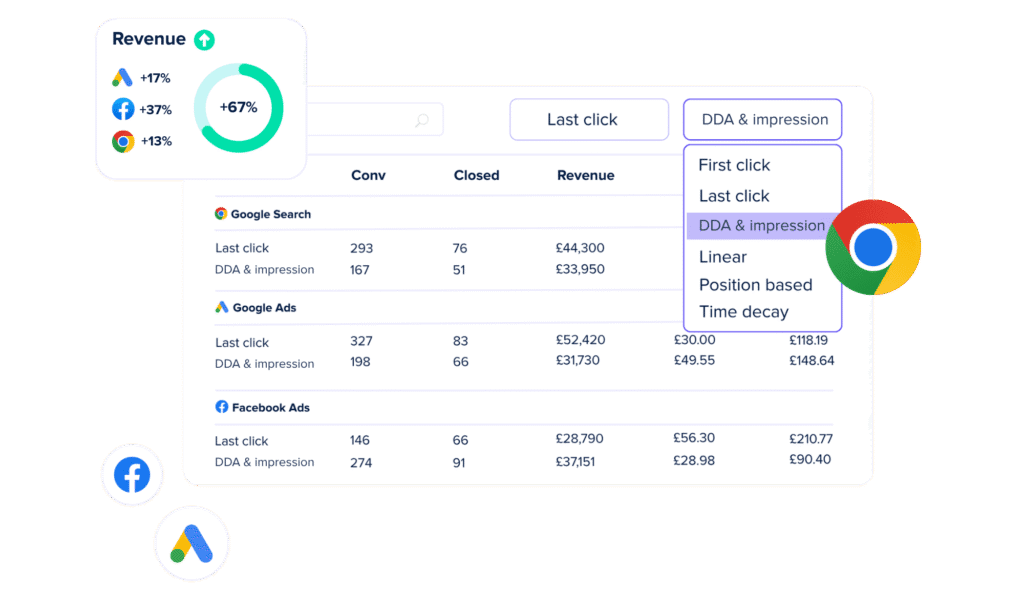
Ruler uses first-party, deterministic click tracking across all your channels. We offer six attribution models, first touch, last touch, position-based, time decay, data-driven attribution (DDA), and impression-based.
It’s built on first-party data such as, first-party cookies, UTMs, click IDs, referrers, and session data and the data is tied to real user journeys, not modelled estimates.
HockeyStack also does multi-touch attribution, and for B2B specifically, their account-level buyer journey mapping is genuinely impressive. They track which people from a target account have interacted with your content and marketing, then surface that at an account level. If you’re running ABM motions, that’s useful.
What we’d say here is that if you’re not exclusively B2B, or if your revenue model includes leads that come in via phone or offline channels, Ruler’s MTA layer is going to give you a more complete picture.
Marketing mix modelling
This is where we see the biggest gap between the two products, and we want to be honest about what that means in practice.
Ruler’s marketing mix modelling uses probabilistic multivariate regression across up to 30 variables. It gives you auditable outputs. You can see the model and can interrogate it.
Related: How marketing mix modelling transforms budget planning
The budget optimiser and forecasting are built directly off those outputs, so the recommendations are grounded in the same modelling layer. That matters when you’re presenting to a CFO who wants to understand why you’re recommending a 30% increase in spend on YouTube.
HockeyStack includes MMM as part of their AI modelling layer. From what we’ve seen and from conversations with marketers who’ve used it, the outputs aren’t independently auditable in the same way.
It’s more of a black box, which isn’t inherently bad, but it does mean you’re trusting the AI rather than being able to walk someone through the methodology.
For teams, particularly those in businesses where stakeholder trust and transparency around modelling decisions is important, the lack of auditable outputs is a problem. We’d recommend thinking carefully about who in your business needs to understand and validate the model before you commit.
Blended MTA and MMM
This is something we’ve invested heavily in at Ruler because we genuinely believe neither MTA nor MMM alone gives you the full picture.
MTA is great for granular, channel-level decisions. MMM is better for big-picture budget strategy. The problem is they often tell you different things, and most platforms force you to pick one or the other.
Our proprietary DDA model combines the two. It uses MTA data to inform the MMM outputs, redistributing credit to upper-funnel channels that MTA typically undervalues.
Related: Ruler Analytics impression modelling
You get the granularity of click-level tracking with the strategic view of regression-based modelling.
HockeyStack doesn’t have a published blended model methodology. From what we understand, their AI layer does some of this work implicitly, but there’s no equivalent auditable output.
If you’re specifically looking for a platform that can bridge the gap between your channel-level attribution and your board-level forecasting, that’s a gap worth knowing about.
CRM enrichment
Salesforce and HubSpot integrations are available on both platforms, along with CRM enrichment capabilities. But again, the approach differs.
Ruler enriches your leads and opportunities with attribution and source data directly in your CRM. So when a sales rep opens a contact record, they can see exactly which marketing touchpoints influenced that lead, which campaign, which keyword, which ad.
That helps sales have better conversations. It also means your revenue data in the CRM is tied back to marketing spend, not sitting in a separate platform.
HockeyStack takes a slightly different approach with their Nova AI feature, which surfaces account intelligence and recommended actions inside the CRM. It’s more focused on telling sales what to do next rather than explaining what marketing did to get the lead there.
Both are genuinely useful things. They’re just useful for different people. Sales teams who want AI-generated next-best-action prompts will probably prefer HockeyStack’s CRM experience. Marketing teams who want closed-loop attribution visible inside the CRM will probably prefer Ruler’s.
Offline conversion tracking
This one matters more than people think.
We often see marketers who’ve done a solid job tracking digital touchpoints but have a completely blind spot around offline conversions. Phone calls, in-person meetings, deals that close over email or in a sales call rather than through a form.
These are often some of the highest-intent conversions in the entire journey, and most platforms don’t track them.
Ruler tracks phone calls, form fills, live chat, and offline deal closes, and we link all of them back to the originating marketing source. That means if someone sees your paid social ad, searches your brand name three days later, calls your sales team, and closes six weeks after that, we can attribute that revenue to the right channels at every stage.
HockeyStack doesn’t have native call tracking or offline conversion measurement. Their platform is focused on digital interactions, CRM data, and connections to ad platforms and review sites.
For purely digital B2B businesses with a well-defined inbound funnel, that might be enough. However, if your sales process involves phone calls, events, or any meaningful offline element, that’s a real limitation.
Budget optimisation and forecasting
We’ll be direct about this one because it’s something we’re proud of and something we think genuinely changes how marketers work.
Ruler’s MMM layer includes diminishing returns curves, scenario planning, and forward forecasting. So rather than just telling you what happened, it tells you what’s likely to happen if you shift budget from one channel to another.
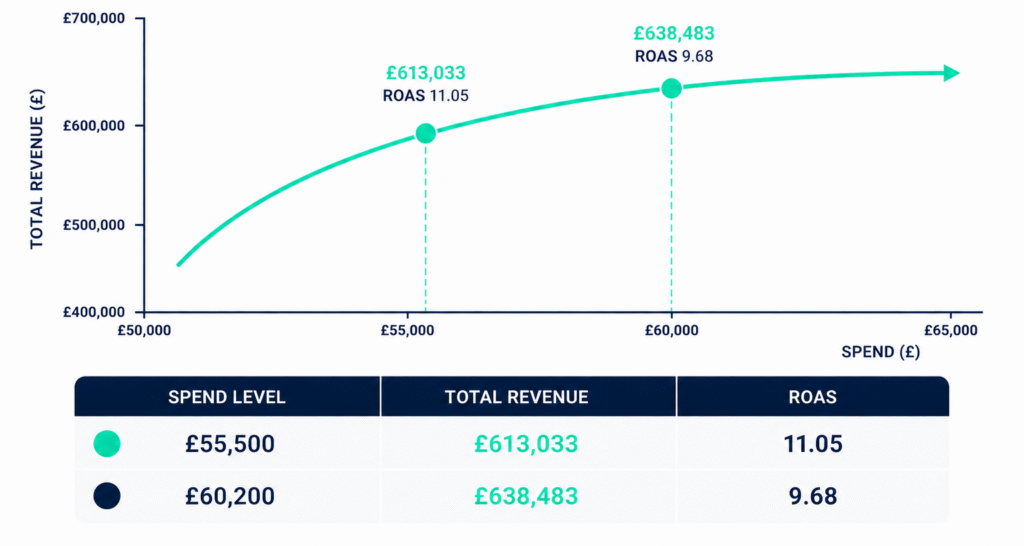
You can model different scenarios, see where marginal ROAS starts to decline, and walk into budget meetings with forward-looking analysis instead of just historical reporting.
HockeyStack doesn’t currently offer budget optimisation, diminishing returns modelling, scenario planning, or marginal ROAS analysis. It’s a strong measurement and intelligence platform. It’s not positioned as a forecasting tool, and that’s a meaningful distinction if budget strategy is a core part of what you’re trying to do with measurement data.
How much is Hockeystack vs Ruler?
Pricing is one of the more practical parts of this comparison, and it’s where things get notably different between the two platforms.
Ruler publishes pricing openly. HockeyStack requires a sales conversation to get a quote, figures below are based on third-party sources including G2 and may not reflect current packaging.
| Ruler Analytics | HockeyStack | |
| Pricing basis | Monthly unique visitors | Monthly tracked users + feature tier |
| Starting price | From £199/mo | From $2,200/mo* |
| MTA | From £199/mo | Included |
| MMM | From £999/mo | Included (limited) |
| Blended MTA + MMM | From £1,499/mo | Not available |
| Seats | Unlimited, no extra cost | Varies by tier |
| Pricing transparency | Published on website | Sales conversation required |
| Price lock | Fixed for 12 months | Not published |
*This is based on third-party data from G2 and reflects information accurate as of the blog’s publication date.
Ruler Analytics vs Hockeystack: Which is the best fit?
HockeyStack could be a strong fit if you are a B2B or SaaS business running ABM, if your sales team wants AI-driven account intelligence and next-best-action prompts, and if your measurement needs are primarily focused on the digital buyer journey.
We recommend Ruler if you are running marketing across multiple channels and business models, if offline conversions matter to your revenue picture, if you need auditable modelling you can present to senior stakeholders, or if you want a platform that combines MTA, MMM, and forecasting in one place.
If you’re evaluating marketing measurement platforms and want to understand what Ruler would actually look like for your business, book a demo with our team.
We’ll walk through your specific channels, your conversion types, and your reporting needs, and we’ll be upfront if we think something else is a better fit. We’d rather you make the right decision than the fast one.