Login
Book a Demo

See which channels drive impact and deserve budget with marketing mix modelling.
Most CMOs approach budget planning using data from their CRM or eCommerce platform attribution reports, usually informed by data from their ad platforms and GA4 to predict future ROI.
Budget increases typically assume the same return will be generated from the same channels when scaled.
This ignores a fundamental truth about marketing channels; they don’t scale linearly.
Doubling your budget won’t double your revenue, because marketing channels become saturated over time and are subject to diminishing returns that traditional attribution reports fail to capture.
As a result, CMOs face an impossible challenge: hitting aggressive growth targets without understanding where their next pound or dollar of spend will generate the highest return.
The example below shows that although Google Ads initially showed signs of generating a higher ROI, it has already reached the point of diminishing returns and has begun to flatline, whereas TikTok, Facebook, and LinkedIn Ads still have more headroom for growth.
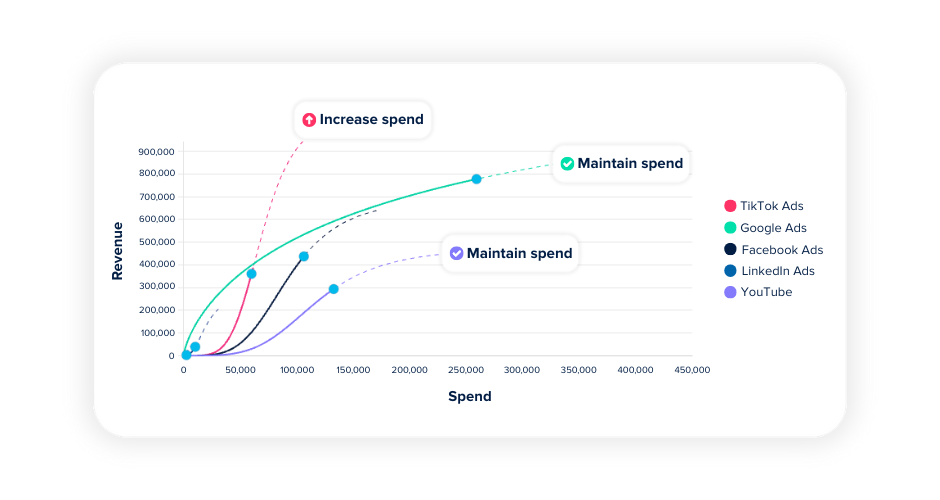
These insights would not typically be available in the reporting that most CMOs used for budget planning, which is why so many marketing decision makers see declines in revenue growth despite investing more in the channels that have historically shown a positive ROI.
💡 Pro Tip
Tools like Ruler simplify marketing mix modelling by giving you clear, reliable insights to guide budget and channel decisions. One key feature is its ability to pinpoint where each channel hits diminishing returns. From there, Ruler’s Budget Optimiser recommends how to reallocate spend to improve performance across your mix.
Book a demo to see how it works in practice
Antiquated budgeting approaches create three critical blind spots that systematically undermine marketing performance:
1. Marketing teams over-invest in bottom-funnel channels like Google Ads Performance Max because these channels are easy to measure and appear to drive immediate results. Last-click attribution makes them look profitable even when they’re operating well beyond their optimal efficiency point.
2. Upper-funnel awareness channels such as Facebook prospecting, Instagram, LinkedIn, and TikTok get systematically underfunded. Click-based attribution models make these channels appear loss-making when they’re actually driving crucial brand awareness and new customer acquisition that fuels long-term growth.
3. Without clear evidence of how increased spending will drive growth, marketers struggle to justify budget increases. Growth stagnates as teams remain trapped in cycles of diminishing returns with no strategic path forward.
Marketing mix modelling provides the holistic view traditional attribution models cannot deliver.
Unlike click-based systems that operate in data silos, MMM evaluates all channels fairly by measuring true incremental impact across your entire marketing mix.
MMM reveals saturation curves and diminishing returns for every channel while identifying your current position on each curve through marginal ROAS (mROAS), the return you can expect from your next pound of spend in any given channel.
This transforms budget planning from educated guesswork into strategic decision-making.
Instead of wondering whether to increase budgets, you can identify which channels have headroom for additional investment and predict exact returns.
Growth often stalls when the bulk of your media budget sits in Google Non-Brand and Performance Max campaigns.
These channels drive most of your attributed revenue, so dialling back spend can feel risky.
But when marginal returns decline, maintaining the same budget becomes inefficient.
Marketing mix modelling offers a way forward. It might show, for example, that Performance Max is generating just £0.30 in incremental revenue for every £1 spent.
Meanwhile, Facebook prospecting returns £2.60 per pound. In that case, the most effective response is a reallocation of spend, away from saturated bottom-funnel activity and towards underinvested top-funnel channels.
This isn’t guesswork. It’s a structured, test-and-learn process.
Begin by shifting 10% of spend to minimise disruption. Run a one-month test on Facebook. Reset budget. Then test Instagram. Monitor results at each stage.
Update your MMM model monthly or quarterly to measure real impact.
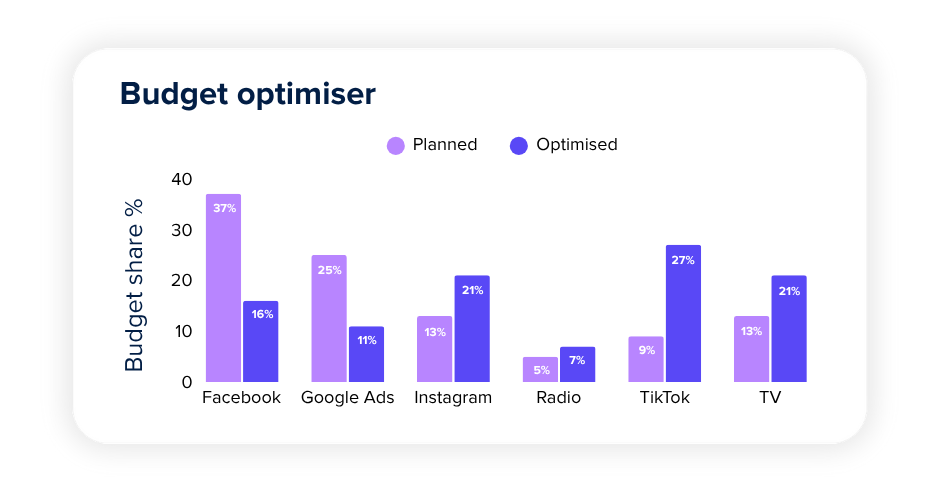
Over time, it will reflect shifts in your channel performance and support sharper budget decisions.
Marketing is shifting from broad, unfocused campaigns to structured, evidence-based planning.
Marketing mix modelling supports this shift by using statistical analysis and incrementality testing to measure impact accurately.
This approach helps leadership make informed decisions.
When results link directly to revenue, marketers can justify spend and plan with clarity.
They gain the data needed to protect budgets and allocate them where they will deliver the most value.
MMM often reveals gaps in traditional marketing attribution. For instance, Google Performance Max might report a ROAS of 2.3 through platform data, while MMM shows a true ROAS of 0.9 and a marginal ROAS of just 0.6, suggesting diminishing returns due to saturation.
Facebook Prospecting might appear to deliver no value in last-click models, yet MMM shows a 4.1 ROAS and a marginal ROAS of 2.6, highlighting real potential.
MMM turns budget planning into a practical, repeatable process. It allows marketers to plan for diminishing returns, reallocate spend, and invest effectively across the funnel.
As pressure grows to prove marketing’s value, teams using MMM are better placed to plan, adapt, and grow. Those relying on last-click and platform attribution risk falling behind.
Many marketing teams still plan to spend using platform attribution and last-click data.
These reports often ignore how channels behave at scale and miss the impact of upper-funnel activity. The result is over-investment in saturated campaigns and underfunding of channels that drive long-term growth.
Marketing mix modelling offers a way forward. It measures the true incremental impact of each channel, accounts for diminishing returns, and corrects for overlapping or inflated platform reporting. This enables a structured reallocation of budget based on marginal ROAS.
If you need a marketing reporting system that links spend to revenue across the full funnel, online and offline, Ruler can help. Its MMM solution gives you the data to make informed, repeatable budget decisions.
Book a demo to see how Ruler can support your next round of budget planning.