


As tracking becomes more limited, marketers are finding it harder to measure performance. By helping marketers implement MMM, we’re seeing a shift toward privacy-safe, first-party measurement.
Last-click attribution hands all the credit to the final touchpoint and ignores everything that came before it. Impression-led channels look like they’re doing nothing, budgets get cut, and performance quietly drops weeks later.
At the same time, every ad platform claims credit for the same conversions, Meta says yes, Google says yes, and your blended ROAS looks healthy while actual revenue flatlines.
Add shrinking tracking signals, no third-party cookies, ITP cutting first-party data lifespans, lower consent rates, and the picture your analytics stack shows you is incomplete at best, actively misleading at worst.
Marketing mix modelling software helps to address this, as they don’t rely on cookies, don’t pull from platforms incentivised to overclaim, and give every channel a fair read on its contribution to revenue. Below, we’ve reviewed the MMM tools worth knowing about in 2026.
Here’s what we’ll cover:
- How we define marketing mix modelling tools?
- Why is MMM growing in popularity?
- What we recommend in MMM tools
- Best marketing mix modelling software reviewed
💡 Pro Tip
Browser restrictions and privacy regulations are getting tighter, but that doesn’t mean marketing measurement has to suffer. We’re leading the way with innovative cookieless solutions like marketing mix modelling to ensure you get the insights you need without compromising privacy.
Skip to learn more about Ruler’s MMM or book a demo to see it in action.
How we define marketing mix modelling tools
Marketing mix modelling tools are software platforms that use statistical methods, most commonly regression analysis, to quantify the contribution of different marketing channels to business outcomes like revenue, conversions, or sales volume.
Rather than tracking individual users across sessions, these tools work with aggregated data such as, spend levels, impressions, GRP, pricing, seasonality, and macroeconomic factors.
The result is a model that tells you, at a strategic level, which channels are working, which are over- or under-funded, and what would happen if you shifted budget around.
What distinguishes a good MMM tool from a basic one is the quality of the underlying model, the speed of output, and how actionable the recommendations are. Some tools produce static reports; others generate live budget optimisation recommendations you can act on immediately.
Why we’ve seen MMM growing in popularity?
Marketing mix modelling might have its roots in the 1960s, but it’s experiencing a modern resurgence due to the complexities of today’s digital marketing landscape. Let’s break it down.
Increasingly complex customer journeys: The days of relying on a single channel for growth are over. 73% of consumers now juggle multiple channels throughout their shopping journey, and as campaigns grow in complexity, understanding what’s actually driving sales becomes harder. Marketing mix modelling software cuts through the clutter, revealing which channels deliver the biggest return and where hidden synergies exist across your mix.
Browser restrictions and stricter privacy regulations: Safari and Firefox already block third-party cookies, and Chrome is following suit. However, even first-party data isn’t safe, Apple’s ITP limits cookie lifespans to as little as 24 hours, meaning returning visitors are regularly treated as new ones. Layer on GDPR, CCPA, and ATT, and the tracking signals most teams rely on are shrinking fast. MMM bypasses all of it, requiring no cookies and no user-level data to produce accurate results.
Rise of privacy-conscious users: Beyond regulation, users themselves are opting out. Ad blockers, tracker blockers, and declining consent rates mean a growing share of your audience is invisible to your analytics stack by choice. When you combine this with tightening browser defaults and privacy laws, the data gap widens further, and last-click models become even less reliable.
What we recommend to look for in MMM Tools
Not all MMM tools are built the same. Before committing to a platform, here are the criteria we’d recommend prioritising:
| Coverage of online and offline channels | A model that only handles digital spend will give you an incomplete picture. Look for tools that can incorporate TV, radio, out-of-home, and other offline activity alongside paid search, social, and display. |
| Diminishing returns modelling | Knowing that a channel is working is one thing. Knowing when it stops working efficiently is where real budget optimisation happens. Look for tools that model saturation curves and identify the point of diminishing returns per channel. |
| Scenario planning and budget optimisation | The best tools don’t just tell you what happened, they help you simulate what could happen. Budget optimisation features that recommend reallocation across channels are a significant differentiator. |
| Integration with your existing stack | A tool that sits in isolation adds friction. Look for platforms that connect with your CRM, ad platforms, and analytics tools to reduce the effort of pulling data together. |
Best marketing mix modelling tools and software reviewed
Given the complexities of tracking marketing impact across various channels, robust marketing mix modelling solutions are essential. Below we’ve curated a list of the most innovative MMM tools for 2026 and beyond, perfect for both MMM newbies and those looking to boost their existing setup.
- Ruler Analytics
- Adobe Mix Modeler
- Cassandra
- Google’s Meridian
- Keen
- Leavened
- Maximus
- Meta’s Robyn
- Nielsen
- Orbit
Ruler Analytics
Ruler provides two core solutions focused on marketing mix modelling and multi-touch attribution. As this roundup focuses on marketing mix modelling, we’ll focus on that, but you can learn more about Ruler’s first-party tracking MTA here.
Ruler’s MMM uses machine learning to quantify the impact of each marketing channel on business outcomes. It incorporates both online and offline activity, including TV, radio, and digital advertising, to provide a comprehensive view of marketing performance.
Unlike attribution models that rely solely on clicks, Ruler’s approach captures the broader influence of marketing across the entire customer journey. A key strength of Ruler’s MMM is its ability to identify the point of diminishing returns for each channel. This allows marketers to understand precisely how incremental spend affects performance and where additional investment begins to lose efficiency.
Using these insights, Ruler’s Scenario planner recommends the optimal allocation of spend across channels, helping teams maximise ROI while avoiding wasted budget.
What we’ve designed it to solve
We built Ruler’s MMM to address a fundamental gap in how most marketing teams measure performance which is the growing disconnect between what tracking tools report and what’s actually driving revenue.
Cookie deprecation, ad blockers, and privacy regulations have made user-level tracking increasingly unreliable. At the same time, most MMM solutions on the market were either expensive consulting engagements or highly technical open-source tools that required data science resources to run.
We designed Ruler to bridge that gap, giving growth-focused marketing teams access to statistically rigorous, channel-level measurement without needing a modelling team to operationalise it. And because Ruler also offers multi-touch attribution, teams can move fluidly between strategic budget decisions and granular journey analysis within the same platform.
Where we see it work best
Ruler’s MMM tends to deliver the most value for teams running spend across multiple channels simultaneously, particularly where a mix of digital and offline activity makes last-click attribution especially misleading. It’s particularly well-suited for:
- Agencies managing multi-channel campaigns for clients who need transparent, explainable measurement across a mixed media portfolio.
- B2B and lead generation businesses where the path from first touch to closed revenue spans weeks or months and involves multiple channels.
- Retailers and ecommerce brands running a combination of paid social, paid search, TV, and promotions, where understanding channel interaction is critical.
- Marketing teams under pressure to justify budget allocation to leadership and looking for a model-backed recommendation rather than gut-feel decisions.
Ruler in Action
Here’s a real example drawn directly from Ruler’s platform. A Facebook prospecting campaign is running at £55,500 spend, generating £613,033 in revenue, a ROAS of 11.05x. Ruler’s Budget Optimiser recommends increasing spend to £60,200. At that level, projected revenue rises to £638,483, with ROAS adjusting to 9.68x.
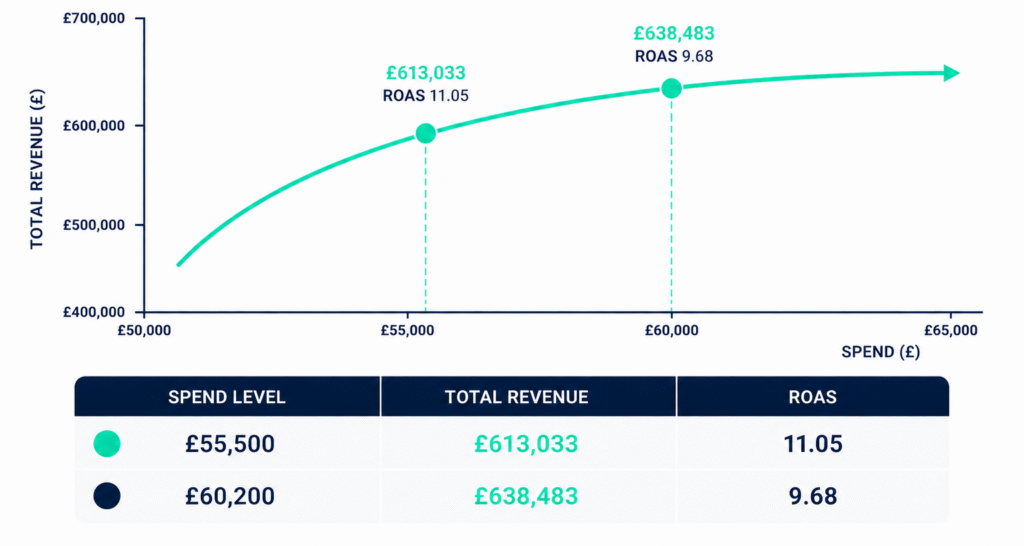
That incremental £4,700 in spend generates approximately £25,000 in additional revenue. But the curve has begun to flatten, meaning the model is signalling that further increases beyond this point will see diminishing returns accelerate. The recommendation isn’t just “spend more”; it’s “spend this much more, and here’s exactly where the efficiency starts to erode.”
This is the kind of decision-support that Ruler’s MMM is designed to surface. Not just what’s working, but how hard you can push it before the returns stop justifying the investment.
Consider Ruler if
- You’re running spend across multiple channels and struggling to understand which ones are genuinely driving revenue
- Your tracking has become unreliable due to cookie restrictions, consent drop-off, or iOS changes
- You want to move beyond last-click attribution without losing the granular journey data your team relies on day-to-day
- You need a budget optimisation recommendation you can actually act on — not a model output that requires a data scientist to interpret
- You’re managing a combination of digital and offline spend and need a unified view of performance
Pricing
Prices for Ruler’s MMM depend on your website traffic and the features you need, including product tier, data volume, and integrations. We recommend booking a demo to get a personalised quote based on your specific setup.
💡 Important note: Prices for Ruler’s MMM depend on your website traffic and what features you need (product, data, integrations), so it’s best to contact us for a personalised quote. You can do that by simply booking a demo here.
Abode Mix Modeler
Adobe Mix Modeler an enterprise-grade MMM solution built for organisations that need to measure how marketing activity drives business results at scale. Operating within the Adobe Experience Platform, it uses machine learning and privacy-safe aggregated data to assess the incremental impact of both online and offline channels, paid media, owned channels, TV, and more. It also supports scenario planning, letting teams simulate budget shifts and forecast outcomes before committing spend.
Its biggest strength is ecosystem integration. If your organisation already runs Adobe Analytics, Customer Journey Analytics, or Real-Time CDP, Mix Modeler slots in cleanly and lets you combine MMM outputs with broader customer data for more informed decisions.

Where it falls short
The Adobe ecosystem is both its strength and its limitation. Teams not already invested in Adobe’s stack will find the integration benefits largely inaccessible, and the platform carries enterprise pricing to match. Setup and onboarding can be lengthy, and the tool is less suited to smaller teams looking for quick time-to-insight without significant technical resource.
Consider Adobe Mix Modeler if
- You’re already running Adobe Analytics or Real-Time CDP and want MMM natively connected to that data
- You need enterprise-grade scenario planning and forecasting
- You have the internal resource to implement and maintain a platform of this complexity
Pricing
Adobe Mix Modeler is part of the Adobe Experience Platform, which is enterprise-priced and quote-based. Expect significant investment, this is not a tool aimed at SMBs or mid-market teams without dedicated analytics resource.
Cassandra
Cassandra uses machine learning to analyse your historical data and build a custom media plan that continuously optimises for ROI. Unlike many MMM platforms where implementation is a months-long project, Cassandra claims a three-week onboarding timeline, making it one of the faster options in the market for teams that need results quickly. It also supports real-world testing of different marketing mixes, so recommendations aren’t purely model-driven.

Where it falls short
Cassandra is a newer entrant and its track record across diverse industries is less established than legacy players like Nielsen. Teams with complex, multi-market setups may find the platform’s speed advantage comes at the cost of model depth. Independent validation of its claimed ROI improvements is also limited.
Consider Cassandra if
- Speed to insight is a priority and you can’t afford a lengthy implementation
- You want a tool that blends modelling with real-world mix testing
- You’re a growth-stage business looking for MMM without the enterprise overhead
Pricing
Cassandra operates on a custom pricing model. Contact their team directly for a quote based on your data volume and requirements.
Google’s Meridian
Meridian is Google’s open-source MMM framework, built to replace LightweightMMM. It models how your full marketing mix, including paid channels, owned media, and offline activity, contributes to business outcomes, with budget planning tools built in. Google also plans to enrich Meridian with its own reach, frequency, and search query volume data, giving it a unique data advantage for teams running significant Google media.

Where it falls short
Like Robyn, Meridian is a technical tool, it requires data science resource to implement and isn’t designed for self-serve use. It’s currently in beta, so access isn’t universal and the feature set is still maturing. Teams with heavy spend outside Google’s ecosystem may also find the platform’s native data integrations less relevant.
Consider Meridian if
- You have data science resource and want a rigorous, customisable open-source framework
- Google channels make up a meaningful portion of your media mix
- You want to take advantage of Google’s proprietary reach and frequency data as it becomes available
Pricing
Free and open-source. Currently in beta, access may require an application.
Keen
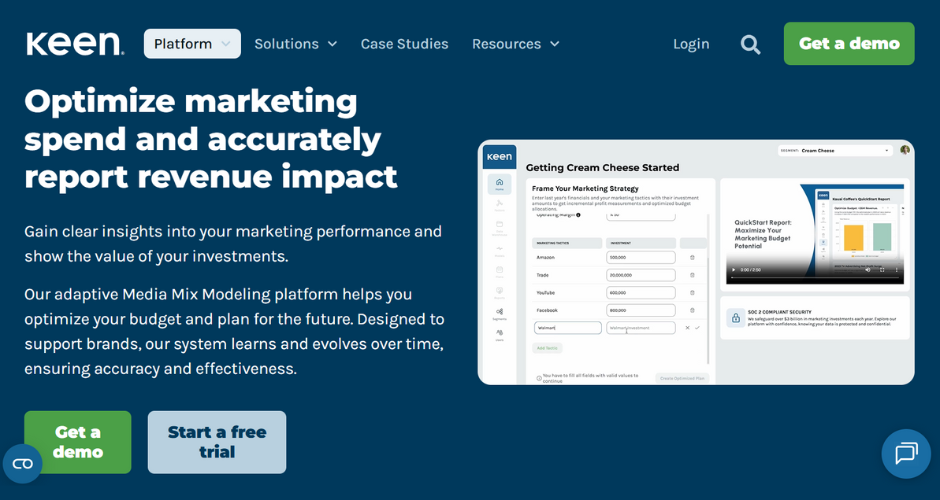
Keen‘s decision system is built around revenue forecasting across your full channel mix. The platform combines your historical data with over 40 years of marketing research and a decade of cross-industry metadata to build a model calibrated to your business. It lets you simulate revenue outcomes across different budget levels and forecast potential ROI from new channels before you commit spend to testing them.
Where it falls short
Keen’s value proposition leans heavily on its proprietary metadata — which is a strength if it’s relevant to your category, but harder to validate independently. The platform is better suited to teams who want model-driven recommendations than those who want to interrogate or customise the underlying methodology. Smaller teams may find the platform’s scope more than they need.
Consider Keen if
- Revenue forecasting across scenarios is your primary use case
- You want to evaluate new channel investments before committing budget to tests
- You’re comfortable with a model-driven approach and don’t need to customise the methodology
Pricing
Custom pricing based on business size and requirements. Contact Keen directly for a quote.
Leavened
Leavened is a marketing measurement platform built by practitioners with backgrounds in both marketing and analytics. It focuses on making MMM faster, more transparent, and more actionable, addressing the frustrations teams commonly run into with traditional approaches, such as slow turnaround, high cost, and outputs that are hard to act on. The platform uses non-cookie technology and supports real-time adjustments based on consumer behaviour data.

Where it falls short
Leavened is a relatively newer platform without the brand recognition of enterprise incumbents. Teams looking for a proven track record across large-scale, multi-market implementations may want to pressure-test the platform’s capabilities carefully before committing. Documentation and third-party reviews are more limited than for established players.
Consider Leavened if
- You’ve been frustrated by slow, opaque MMM processes and want something more agile
- Transparency in measurement methodology matters to your team or clients
- You’re a mid-market business looking for a practical alternative to enterprise MMM
Pricing
Custom pricing. Contact Leavened directly for details.
Maximus
Maximus is built in R and uses machine learning and statistical methods to analyse historical data, attribute sales contributions by channel, and forecast future performance. It offers both automated and manual modelling options, with a recommendation engine to help identify the best-fit model for your data. Users can compare models side by side, adjust variables, and group inputs into categories like media, promotion, and seasonality. Outputs are presented in tabulated reports or visual charts.

Where it falls short
Being R-based, Maximus is primarily a tool for analysts rather than marketers. Without technical resource, you’ll struggle to get value from the platform independently. It’s also less well-known than comparable tools, making it harder to benchmark or find community support. Teams without existing R capability should look elsewhere.
Consider Maximus if
- Your team has R proficiency and wants flexibility in model building and comparison
- You need granular control over variable grouping and model configuration
- You want a tool that supports both automated and manual modelling workflows
Pricing
Contact Maximus directly for pricing information.
Meta’s Robyn
Robyn is a free, open-source MMM tool built by Meta’s Marketing Science team. It uses automated machine learning to analyse large advertising datasets, identify diminishing returns by channel, and surface budget optimisation recommendations. As it’s open-source, teams with data science resource can inspect, customise, and extend the model to fit their specific setup.
Where it falls short
Robyn requires meaningful technical capability to run. There’s no managed interface, you’ll need R experience and data science resource to implement, maintain, and interpret outputs. It’s also built primarily around digital and direct response data, making it less suited to brands with significant offline or traditional media spend. Also, while it’s free to use, the internal resource cost of running it is not.
Consider Robyn if
- You have in-house data science capability comfortable working in R
- Your media mix is predominantly digital and direct response
- You want a transparent, customisable model you can fully own
Pricing
Free and open-source. Internal implementation and maintenance costs apply.
Nielsen
Nielsen is one of the most established names in marketing measurement. Their MMM offering draws on decades of data and sophisticated modelling to help clients assess the impact of their investment, identify what’s working, and adjust budgets accordingly. Automated systems and integrations mean clients can get ROI insights in weeks rather than months, with tailored simulations to support strategic planning and budget optimisation.

Where it falls short
Nielsen’s scale and heritage come with enterprise-level pricing and processes. Smaller and mid-market teams will likely find it inaccessible. The platform is not designed for self-serve use and typically involves a managed service engagement, which limits how quickly teams can iterate or respond to changing data. Flexibility and speed can be trade-offs for the depth of methodology on offer.
Consider Nielsen if
- You’re an enterprise brand with significant media spend across multiple markets
- You need a proven, credible MMM methodology that can withstand scrutiny from senior stakeholders
- You’re comfortable with a managed service model and longer implementation timelines
Pricing
Enterprise pricing, quote-based. Nielsen is not a self-serve platform — expect a managed engagement with pricing to reflect that.
Orbit
Orbit is an open-source time series forecasting library developed by Uber’s data science team. It uses Bayesian statistics to model time series data, allowing users to incorporate prior knowledge, such as the expected uplift from a seasonal campaign, directly into the forecast. While not a dedicated MMM platform, it’s used by data science teams to model the relationship between marketing inputs and business outcomes over time.
Where it falls short
Orbit is a library, not a product. There’s no interface, no onboarding, and no support, it’s a building block for teams who want to construct their own measurement framework rather than a ready-to-use MMM solution. Without significant data science resource and modelling expertise, it’s not a realistic option. It also lacks the channel-specific features, budget optimisation tools, and reporting outputs that purpose-built MMM platforms offer.
Consider Orbit if
- You have a strong data science team that wants low-level control over your forecasting methodology
- You’re building a custom measurement framework and need a robust Bayesian time series component
- You’re comfortable with the trade-off between flexibility and the overhead of building and maintaining your own tooling
Pricing
Free and open-source.
Is Ruler the marketing mix modelling tool you’re looking for?
Increasing privacy regulations, browser restrictions, and privacy-conscious users have made marketing measurement more complex.
MMM helps you understand the big picture of your marketing efforts, even with limited data. It considers all marketing channels and their interactions to show the true impact on your revenue.
If you’re still feeling intimidated by MMM, don’t be. Tools like Ruler simplify the process, providing clear insights you can use to make data-driven marketing decisions.
Want to learn more about Ruler? Book a demo and see how it can validate the impact of your marketing efforts and help you increase revenue.

Marketing mix modeling software FAQs
MMM software works by applying statistical methods like multivariate regression to measure the impact of different marketing channels on business outcomes. It looks at both internal factors (like spend and pricing) and external ones (like seasonality or market trends). This gives you a clearer picture of what’s working and helps guide smarter marketing investment decisions.
The best MMM tool depends on your budget, data maturity, and volume of marketing activity. Some tools suit enterprise brands with large media spends, while others are designed for mid-market use. Ruler Analytics is a strong choice if you need a mix of statistical rigour, clear outputs, and flexibility across both online and offline channels.
Companies like Google and Meta offer their own MMM products. Third-party providers vary widely in capability and cost. Ruler Analytics is one option that combines machine learning with media modelling to help businesses understand the real value of their marketing efforts, online and offline, without relying on platform-reported conversions alone.
There are many advantages of using MMM software. First, it’s privacy-compliant and doesn’t rely on cookies or user-level tracking. It includes online and offline activity, seasonal effects, and external variables. A key strength is its ability to show diminishing returns, so you can see where spend starts to lose impact and adjust accordingly.
MMM platforms typically use machine learning to assess how different marketing inputs affect business results. They account for diminishing returns and seasonal effects. Tools like Ruler Analytics also offer a budget optimiser that recommends the best spend allocation by channel, helping you get more value from the same budget.