

There’s a point a lot of marketing teams reach where the attribution picture is solid for the channels you can track, but the moment the measurement brief gets bigger, offline conversions, upper-funnel brand spend, a budget recommendation that needs to hold up in front of a CFO, you start to feel the limits of what your current tool was built to do.
HockeyStack is a capable product. It’s purpose-built for B2B SaaS and technology companies with account-based GTM motions, and for that specific context it does a lot of things well. But if you’re asking questions it wasn’t designed to answer, it makes sense to look around.
Are you finding it hard to measure channels that don’t produce a click? Or being asked to model what happens if you reallocate budget, and realising your current tool can’t get you there? Those are the questions that tend to kick off a proper evaluation. If you’re in that phase, this post is designed to help.
Why look for a HockeyStack alternative?
As measurement needs grow, a few recurring themes tend to push teams to look beyond what HockeyStack was designed to do. Understanding which of these applies to your situation is probably the most useful thing you can do before evaluating alternatives.
The MMM layer isn’t fully auditable. HockeyStack includes MMM as part of its AI modelling layer, but the outputs aren’t independently auditable in the same way a full MMM product would be. From what we’ve seen and from conversations with marketers who’ve used it, it’s more of a black box. That’s not inherently a problem, but it does matter when you need to walk a CFO or a board through the methodology behind a budget recommendation. If stakeholder trust and transparency around modelling decisions are important to your business, it’s worth thinking about carefully.
There’s no blended MTA and MMM model. HockeyStack doesn’t have a published methodology that combines click-level attribution with regression-based modelling. MTA and MMM tell you different things, and most platforms make you choose one. If you’re trying to bridge granular channel-level data with board-level budget strategy, that’s a gap.
No budget optimisation or forecasting. HockeyStack is a strong measurement and intelligence platform. It’s not positioned as a forecasting tool. There’s no diminishing returns modelling, scenario planning, or marginal ROAS analysis. If you’re trying to use your measurement data to build forward-looking budget recommendations, you’ll be doing that work outside the platform.
Related: How marketing mix modelling transforms budget planning
Pricing requires a sales conversation. HockeyStack doesn’t publish pricing openly. Based on third-party sources including G2, plans start from around $2,200/mo. For teams that want pricing transparency before committing to a demo process, that’s a friction point worth knowing about.
5 HockeyStack alternatives worth considering
The tools below cover a mix of use cases, some are true attribution alternatives, others solve related problems. We’ve added notes on where each one works well and where it doesn’t, so you can quickly filter what’s actually worth a demo.
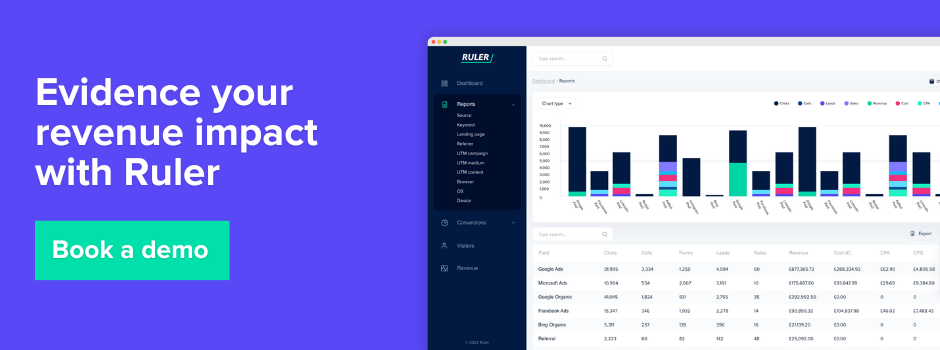
1. Ruler Analytics
What we designed Ruler to do
Ruler was built for businesses with complex, multi-touchpoint customer journeys, across any industry, business model, or channel mix. Where HockeyStack was designed with a specific customer in mind, Ruler was designed to work regardless of who that customer is.
The core problem we kept running into was that MTA and MMM tell you different things, and most platforms make you choose one. MTA gives you granular, session-level channel data. MMM gives you a statistically modelled view of what’s actually driving revenue, including channels that don’t produce clicks. Neither is complete without the other. So we built Ruler to do both, and to combine them into a single auditable output.
Key features
- Multi-touch attribution. First-party, deterministic click tracking across all channels with six attribution models: first touch, last touch, position-based, time decay, data-driven attribution (DDA), and impression-based. Built on first-party cookies, UTMs, click IDs, referrers, and session data, tied to real user journeys, not modelled estimates.
- Marketing mix modelling. Probabilistic MMM using multivariate regression across up to 30 variables. The outputs are auditable. You can see the model, interrogate it, and use it to build a budget case that stakeholders can actually follow. That matters when you’re in front of a CFO explaining why you’re recommending a 30% shift in channel spend.
- Blended DDA model. Our proprietary data-driven attribution model combines MTA and MMM outputs to redistribute credit to upper-funnel channels that click-based attribution typically undervalues. One platform, one source of truth, bridging granular channel data with board-level strategy.
- Offline conversion tracking. Phone calls, form fills, live chat, and offline deal closes, all tied back to the originating marketing source. If someone sees your paid social ad, searches your brand three days later, calls your sales team, and closes six weeks after that, we can attribute that revenue correctly across every stage.
- CRM enrichment. Ruler enriches lead and opportunity records inside your CRM with marketing attribution and source data. When a sales rep opens a contact record, they can see exactly which campaign, keyword, or ad brought that person in. That information travels with the contact, inside the tool your commercial team already uses.
- Budget optimisation and forecasting. MMM-driven diminishing returns curves, scenario planning, and forward forecasting built in. Rather than just telling you what happened, it tells you what’s likely to happen if you shift budget from one channel to another. The tools you need to walk into a budget meeting with forward-looking analysis, not just historical reporting.
- Upper-funnel and impression-only channel measurement. MMM specifically models TV, radio, OOH, and other channels that don’t produce click-level data. You can understand the contribution of a podcast sponsorship or a billboard campaign without a UTM parameter.
Why users choose Ruler over HockeyStack
The decision usually comes down to one of a few things. Either the business has meaningful offline revenue that HockeyStack simply can’t capture. Or the team needs to present modelling outputs to senior stakeholders and needs something auditable rather than AI-generated. Or the channel mix has grown to include brand, TV, or OOH spend that requires a different measurement methodology altogether.
Ruler also works outside the B2B SaaS world. For ecommerce, lead gen, mixed models, or agencies working across verticals, HockeyStack wasn’t designed for those contexts, Ruler was.
For teams where every meaningful conversion is a digital touchpoint and the business is purely B2B SaaS with an ABM motion, HockeyStack’s account intelligence features are genuinely strong. But based on the calls we have with marketers switching tools, the moment you need auditable modelling, call tracking data, or budget forecasting, Ruler is the more complete option.
Pricing
Ruler’s pricing scales with monthly unique visitors and is fixed for 12 months, so growth in your audience doesn’t automatically trigger a pricing conversation.
💡 Pro Tip
You can book a demo to see how Ruler Analytics compares with HockeyStack. While HockeyStack combines attribution, product analytics, and website analytics in a single platform, Ruler focuses on marketing attribution, offline conversion tracking and marketing mix modelling, helping businesses accurately measure which marketing activities drive conversions, opportunities, and closed revenue across the entire customer journey.
Book a demo of Ruler
2. Adinton
Where we’ve seen it do well
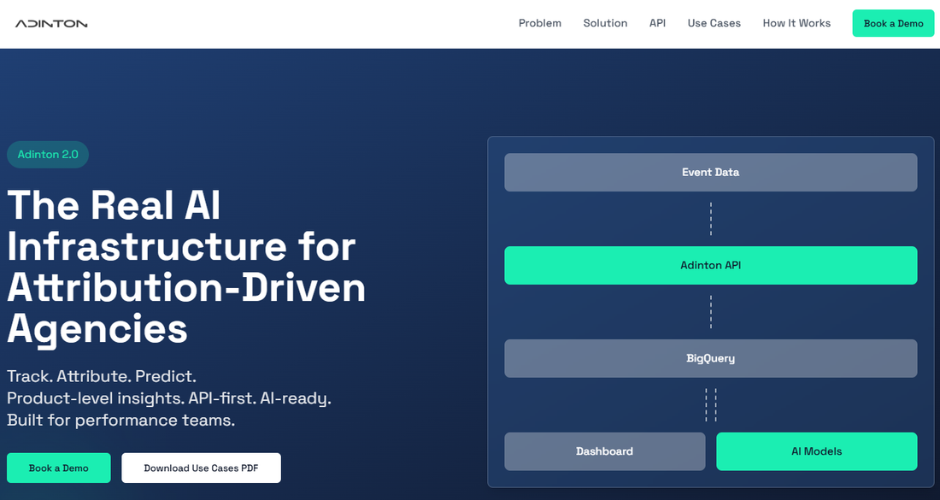
Adinton is an attribution and bid management platform that combines multi-touch attribution with automated bid optimisation. We’ve seen it work well for performance marketing teams that are heavily focused on paid search and paid social, and want attribution and bidding decisions to sit closer together.
The integration between attribution data and automated bid adjustments is one of the things that differentiates it from more purely analytical tools. For teams where the majority of spend is in paid channels and reducing manual bid management overhead is a priority, it’s worth a look.
Where we’ve seen the limitations
Adinton is fairly narrowly focused on paid digital channels. It’s not built for businesses with complex offline sales journeys, longer B2B sales cycles, or measurement methodologies beyond click-based attribution. There’s no MMM layer, no offline conversion tracking, and it’s not particularly designed for account-based models. For teams where the marketing mix goes beyond paid search and social, the coverage tends to feel thin.
Pricing
Adinton’s pricing is not fully transparent and is generally quoted on request based on data volume and requirements. Entry-level plans are reported to start around €200–€300/mo for smaller accounts, with enterprise pricing negotiated directly.
4. AppsFlyer
Where we’ve seen it do well
AppsFlyer is one of the leading mobile measurement partners in the market, and if your business has a meaningful mobile app component, it’s hard to find something that does mobile attribution as well. From conversations with app-first companies, AppsFlyer’s strength is in the depth of its mobile measurement, SKAdNetwork for iOS, deep linking, fraud detection, and an extensive library of ad network integrations. For mobile gaming, fintech apps, and consumer apps where the majority of conversions happen in-app, it’s a well-established and widely trusted choice.
Where we’ve seen the limitations
AppsFlyer is fundamentally a mobile attribution tool. If your business is web-first, B2B, or lead gen with a long sales cycle, it’s not designed for your context. There’s no MMM capability, no meaningful offline conversion tracking for non-app journeys, and the web analytics layer is secondary to the mobile product. We’ve spoken to teams who’ve tried to use AppsFlyer to cover web-based attribution and found it a frustrating fit. Pricing is also based on attributed events, which can scale significantly for high-volume businesses.
Pricing
AppsFlyer’s pricing is based on attributed events (conversions). There’s a free tier covering up to 12,000 conversions per month. Paid plans start around $0.05–$0.07 per attributed event for larger volumes, with custom enterprise pricing above certain thresholds.
4. Thoughtmetric
Where we’ve seen it do well
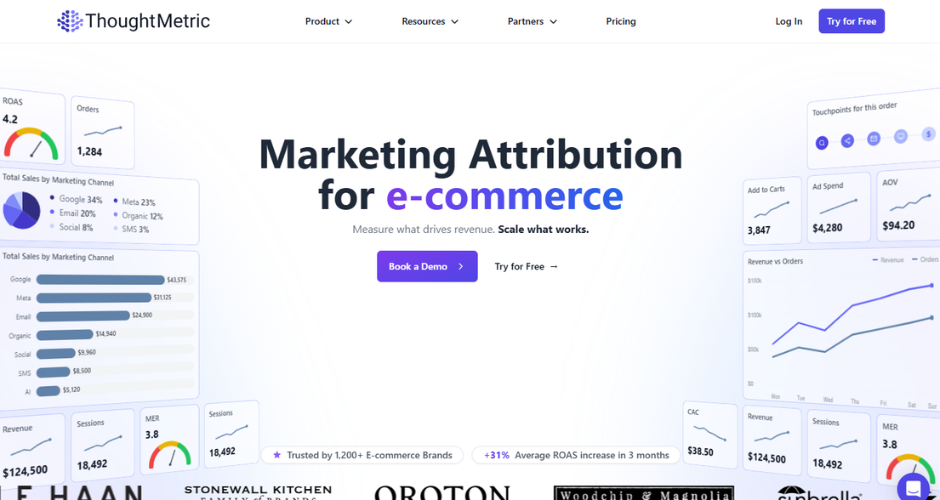
The brands that get the most out of Thoughtmetric tend to share a pretty specific frustration, iOS changes hollowed out their pixel data, and Meta’s self-reported ROAS stopped feeling like a number worth trusting. The server-side tracking approach is the right architecture for where things are heading; browser-level attribution is only going to get messier, so building around that constraint rather than patching over it is the smarter call. Setup on Shopify is quick enough that you’re not burning a week on implementation, and the dashboard doesn’t try to overwhelm you. For a DTC brand that just wants cleaner first-party data and an alternative to taking Meta’s word for it, it does the job.
Where we’ve seen the limitations
Step outside DTC eCommerce and the gaps show up quickly: offline conversions aren’t well supported, B2B lead tracking and CRM enrichment aren’t what it was built for, and there’s no MMM capability or upper-funnel budget planning.”It’s a newer platform, and that shows in places — some of the deeper analytics functionality that more established tools have had years to build out simply isn’t there yet.
Pricing
Every plan includes the full platform, no gated features, no premium add-ons. Cost scales purely on monthly pageviews, starting at $99/month for up to 50,000 pageviews, $199/month for 100,000, and $299/month for 200,000. If you go annual, that entry price drops to $83/month. There’s also a free trial on every plan, and if you exceed your pageview limit two months running, they’ll flag it and work with you on an upgrade rather than hitting you with a surprise bill.
5. Triple Whale

Where we’ve seen it do well
Triple Whale is an ecommerce analytics and attribution platform purpose-built for DTC brands, primarily those running on Shopify. If that’s your context, it’s one of the more thoughtfully designed tools on this list for that specific use case. From conversations with ecommerce marketers, Triple Whale’s strength is in bringing together ad spend, revenue data, and attribution in a single dashboard that’s genuinely usable for teams running Meta, TikTok, and Google at scale. The creative analytics features, showing which ad creatives are actually driving revenue rather than just engagement, come up regularly as something teams find genuinely useful.
Where we’ve seen the limitations
Triple Whale is very Shopify and DTC-specific. Outside of that context, the fit degrades quickly. It’s not designed for B2B, long sales cycles, or businesses where offline conversions are part of the revenue picture. There’s no MMM capability, and the attribution models are primarily last-touch or custom rule-based rather than probabilistic. For brands that have grown to the point where they need to model TV spend, brand investment, or incrementality more rigorously, Triple Whale starts to hit its ceiling. It’s also primarily focused on US-based DTC brands, which is worth noting if you’re operating in the UK or elsewhere.
Pricing
Triple Whale’s pricing is based on your Shopify store’s annual revenue. Plans start at around $129/mo for stores under $1M GMV, scaling to $279/mo for stores up to $10M GMV, with custom pricing for larger brands.
Choosing the right tool
Every tool on this list was built with a particular kind of business in mind. The most useful thing you can do before committing to a demo process is get clear on which measurement gap is actually costing you, whether that’s offline revenue that isn’t being attributed, a budget conversation you can’t currently support with data, or a channel mix that’s grown beyond what click-based attribution can see.
That gap is your filter. Run the list through it and one or two options will stand out pretty quickly.
If Ruler ends up on your shortlist, we’re happy to walk through what it would look like for your specific setup, channels, conversion types, reporting needs. Book a demo to see how it works in more detail.