
For Shopify-native DTC brands spending heavily on Meta and Google, Triple Whale does a lot of things well. Clean dashboard, fast setup, strong creative analytics, and an AI assistant in Moby that genuinely helps with day-to-day questions.
But from the feedback we’ve gotten from marketers evaluating attribution tools, Triple Whale isn’t always the right fit. Sometimes businesses have outgrown it. Sometimes they were never quite the target customer to begin with.
Sales cycles that don’t end at a checkout, channels that don’t produce clicks, tech stacks that don’t run on Shopify, these are the situations we hear about regularly, and they’re the situations that tend to send people looking for alternatives.
Why people start looking for Triple Whale alternatives
Before getting into the tools themselves, it’s worth being clear about the gaps people typically run into with Triple Whale, because the right alternative depends a lot on which gap you’re actually trying to close.
The journey doesn’t end at a checkout. Triple Whale’s attribution is built around eCommerce transactions in Shopify. If your conversion is a form fill, a phone call, a booked demo, or a deal that closes in a CRM 30, 60, or 90 days later, Triple Whale doesn’t see it. For B2B teams, SaaS companies, or any business with a meaningful sales process, that’s not a small gap, it’s essentially the entire measurement problem.
Spend on channels outside the main three. TV, radio, out-of-home, podcast sponsorships, display, YouTube brand campaigns, Triple Whale’s attribution coverage outside Meta, Google, and TikTok is limited. As more brands invest in upper-funnel activity, that becomes an increasingly expensive blind spot.
Not on Shopify. Triple Whale was built around Shopify’s data structure. Non-Shopify platforms can connect, but the depth and reliability of data reduces noticeably. WooCommerce, Magento, custom-built stores, or hybrid models with both eCommerce and lead gen revenue streams tend to hit friction fairly quickly.
Need to plan forward, not just report backward. Businesses need tools that help them plan ahead, not just explain the past. Triple Whale’s forecasting capabilities are useful for short-range planning, but as the questions become more strategic, like how returns change when budget shifts toward brand, or where Meta spend begins to hit diminishing returns, the limitations start to show.
Related: How marketing mix modelling transforms budget planning
Triple Whale was designed for a specific customer and it serves that customer well. The point is just to be clear about which of these gaps matters to you, because the right alternative is different depending on the answer.
5 Triple Whale alternatives reviewed for 2026
Some alternatives in this list cover similar ground with a different approach, others solve problems Triple Whale wasn’t built for. For each one, we’ve tried to be straight about where it tends to work well and where we’ve seen it fall short in practice
Ruler Analytics
What we designed Ruler to do
Ruler was built for businesses where the journey from first touch to closed revenue is longer, messier, and harder to track than a single session checkout. Multi-touch attribution, marketing mix modelling, offline conversion tracking, CRM enrichment, across any business model, any channel mix, any tech stack.
The core idea is simple. If revenue lives in a CRM or revenue platform rather than a cart, your measurement platform needs to follow that journey all the way to closed revenue, not just to the first digital conversion event.
Key features
- Offline conversion tracking. Ruler tracks phone calls, form fills, and live chat and connects every one of them back to the originating marketing source. If someone found you through paid search, came back through branded organic a fortnight later, called your team, and converted in a sales conversation, we attribute that correctly across every touchpoint. Based on the conversions we’ve tracked, this is often where the biggest attribution gaps actually sit for B2B and lead gen businesses, not in the digital path, but in what happens after the lead is handed to sales.
- CRM enrichment. Ruler pushes source and attribution data directly into your CRM at the lead level. So your sales team sees where every lead came from, and your marketing team can report on revenue rather than just leads or MQLs.
- Multi-touch attribution across six models. Linear, time decay, first touch, last touch, position-based, and data-driven. Plus our own DDA and impression model that reallocates credit to upper-funnel channels like TikTok and Instagram that don’t drive clicks but contribute influence.
- Marketing mix modelling. Ruler’s MMM is built on a data-scientist-designed modelling framework using ML trained on high-quality first-party data. AI is layered on top to surface and explain insights rather than drive the modelling itself, the distinction matters when you’re using outputs to justify budget decisions. The MMM layer models impression-only and offline media using probabilistic multivariate regression, which means you can get a genuine read on what a radio campaign or OOH burst contributed even without a UTM parameter in sight.
- Scenario planning and diminishing returns. Diminishing returns curves show you where additional spend stops generating proportional return on a channel-by-channel basis. Scenario planning lets you model budget reallocation before you commit to it. Marginal ROAS analysis tells you the incremental return on the next pound you spend, not just the average return on what you’ve already spent. From the conversations we have with marketing teams, these are the outputs that tend to hold up in board-level budget discussions in a way that standard attribution reports don’t.
- Platform agnostic by design. Ruler works across any eCommerce platform, CRM, or tech stack. Salesforce and a custom storefront, HubSpot and WooCommerce, or something more bespoke, the integration is built to flex.
Why users choose Ruler over Triple Whale
The clearest reason we hear is the offline and CRM gap. If your revenue closes in a sales conversation rather than a cart, Triple Whale simply doesn’t see it. Ruler does. Beyond that:
- Businesses spending on TV, radio, OOH, or any channel without click data can model contribution through MMM. Triple Whale’s attribution outside the major social platforms is minimal.
- Non-Shopify businesses avoid the integration friction and reduced data depth that comes with Triple Whale’s Shopify-centric architecture.
- Teams that need to make a statistical case for budget decisions, diminishing returns, scenario planning, marginal ROAS, get the analytical depth to have that conversation.
- Ruler’s traffic-based pricing works well for businesses with lower visitor counts but high-value conversions. Triple Whale’s GMV-based pricing means high-revenue stores pay more regardless of measurement complexity.
Pricing
| Pricing info | Ruler Analytics |
| Pricing basis | Monthly unique visitors |
| MTA entry | From £199/mo |
| MTA mid-tier | From £1,249/mo |
| MMM | From £999/mo |
| MTA + MMM | From £1,499/mo |
| Seats | Unlimited, no extra cost |
💡 Pro Tip
You can book a demo to see how Ruler Analytics compares with Triple Whale. While Triple Whale focuses heavily on eCommerce-first, ad-platform dashboards (like Meta and Shopify performance), Ruler goes deeper on full-funnel attribution, connecting every conversion, online and offline, back to the exact channels and campaigns that generated revenue, giving you a more complete, cross-channel view of marketing impact beyond just online store data.
Book a demo of Ruler
Adinton
Where we’ve seen it do well
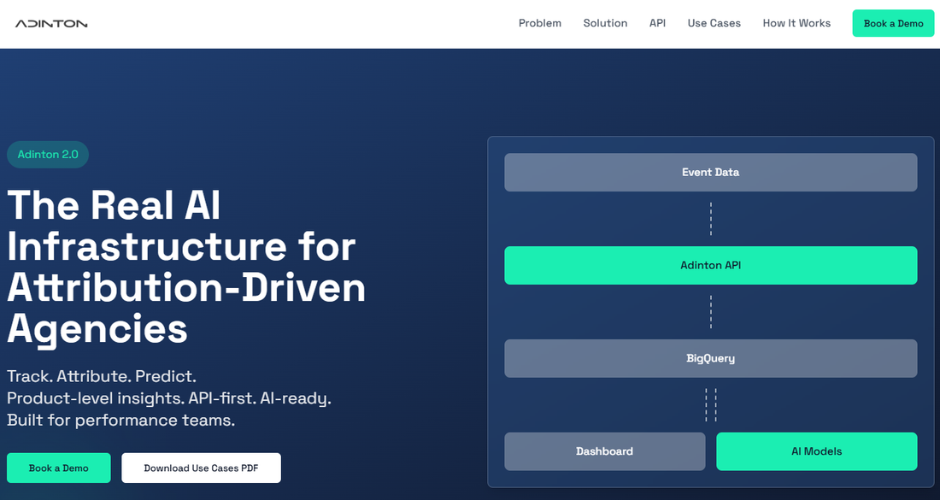
Adinton is a European attribution platform with a reasonably long track record, it’s been around since 2013, which is worth noting in a category where new tools come and go. From what we’ve seen, it tends to suit mid-sized eCommerce businesses looking for multi-touch attribution with a relatively straightforward setup.
It covers the core attribution models and has some algorithmic attribution capability that goes beyond basic last-click. For teams that need more than last-touch but don’t have the complexity of an enterprise measurement stack, it can be a workable option. It also has some bid optimisation features built in, which means it can connect attribution data back to ad platform decisions without requiring a separate tool.
Where we’ve seen the limitations
Adinton’s integration ecosystem is narrower than the larger platforms. For businesses with more complex tech stacks, particularly non-standard CRMs or custom-built platforms, setup can require more manual effort than the initial pitch suggests.
Offline conversion tracking is limited. If leads move through a sales process outside digital touchpoints, the attribution picture gets incomplete fairly quickly. The product hasn’t evolved as visibly as some competitors in recent years. We don’t hear it come up often from teams evaluating for MMM or advanced planning capability.
Pricing
Adinton doesn’t publish pricing publicly. You’ll need to contact them directly for a quote, worth doing early in an evaluation so cost doesn’t become a late-stage surprise.
Segmetrics

Where we’ve seen it do well
Segmetrics is built specifically for information businesses, online courses, and subscription or membership models, and that focus shows. It does a good job of connecting marketing source data to lifetime value rather than just first-purchase revenue.
That’s actually a genuinely useful framing for subscription businesses, where the initial transaction can be a poor proxy for the value a customer ultimately generates. Segmetrics lets you track cohorts of customers back to their originating marketing channel, which changes the attribution conversation from “which channel drives purchases” to “which channel drives high-LTV customers.”
It integrates well with common email marketing platforms and funnel tools, which makes sense given its target audience.
Where we’ve seen the limitations
Segmetrics is quite niche. If you’re not running an info product, a course business, or a subscription model, it probably isn’t the right fit, and the feature set reflects that.
It’s not built for complex multi-channel B2B journeys.
Phone tracking, CRM enrichment, and offline attribution are not where this tool plays. For a team that needs to attribute across a longer sales cycle or model upper-funnel spend, you’d run out of capability fairly quickly. MMM is not part of the offering. Planning and forecasting beyond basic cohort analysis isn’t what Segmetrics is for.
Pricing
Segmetrics publishes pricing on a tiered model starting around $299/month, scaling based on contacts and features. Worth checking their current pricing page as tiers do get updated.
Thoughtmetric
Where we’ve seen it do well
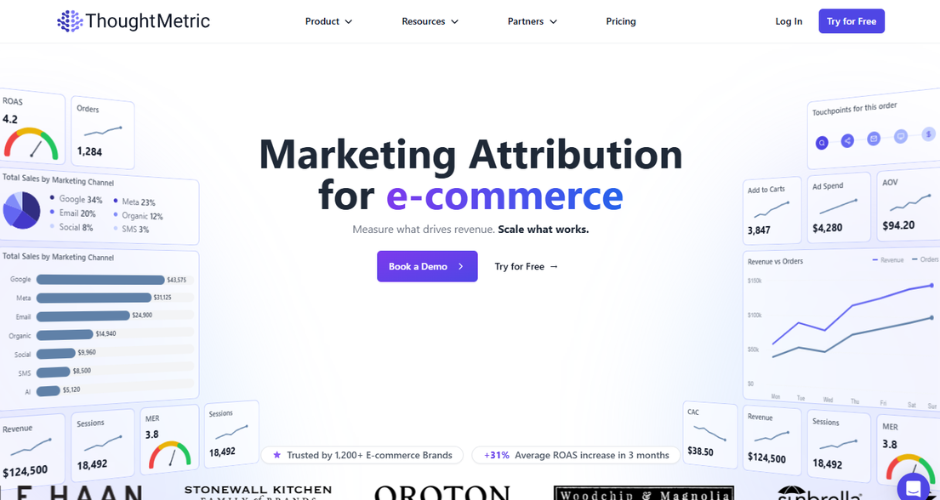
Thoughtmetric positions itself as a privacy-focused, cookieless attribution platform, and that’s genuinely the use case it seems to resonate with most. From what we’ve seen, it tends to attract eCommerce teams frustrated with data loss from iOS privacy changes and looking for a cleaner first-party alternative to platform-reported numbers.
Setup is relatively fast for a Shopify store, and the dashboard is clean. For a DTC brand that primarily wants an alternative to trusting Meta’s own reported ROAS, it covers the basics.
The server-side tracking approach is worth noting, it’s more robust than pixel-only solutions in a world where browser tracking is increasingly constrained.
Where we’ve seen the limitations
Thoughtmetric is fairly squarely aimed at the same eCommerce DTC audience as Triple Whale. If you’re evaluating Thoughtmetric as a Triple Whale alternative, you’re mostly comparing within the same category rather than stepping outside it.
Offline conversion support is minimal. Sales-cycle attribution, CRM enrichment, B2B lead tracking, these aren’t what the platform was built for. MMM is not part of the offering. Upper-funnel modelling and budget planning aren’t in scope. The platform is newer, which means the product is still maturing in places. Some of the more advanced analytics features that longer-established platforms offer aren’t there yet.
Pricing
Thoughtmetric pricing is usage-based, starting around $50/month for smaller stores and scaling with order volume. Publicly available on their website.
Wicked Reports
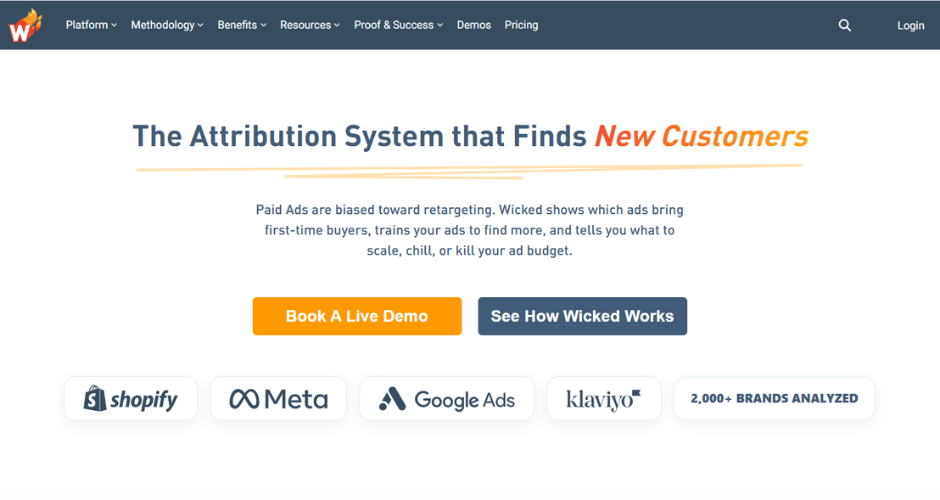
Where we’ve seen it do well
Wicked Reports has been around for a while and has a reasonably established base among direct response marketers and agencies running paid acquisition for mid-market businesses. From the conversations we’ve had, it tends to come up most often with teams running complex funnel structures across email, paid social, and paid search.
It does a decent job of stitching together multi-touch journeys that include email sequences, something a lot of attribution tools handle poorly because email clicks often lose attribution context. For businesses where email is a significant part of the acquisition and re-engagement mix, that capability matters. It also integrates with a reasonable range of CRMs and has some longer-lookback window capability, which is useful for products with longer consideration periods.
Where we’ve seen the limitations
Wicked Reports’ UI is functional but dated. It’s not the kind of dashboard that’s easy to hand to a CFO or a board and have it speak for itself, it tends to require interpretation from someone who knows the tool well.
The platform has historically required some meaningful setup effort, particularly around UTM hygiene and ensuring consistent tagging across channels. Teams that don’t have clean tracking practices already in place can find that it surfaces confusion rather than clarity initially.
Offline conversion tracking exists but is limited compared to platforms built specifically around that use case. MMM and advanced planning capability aren’t part of the offering. Like most multi-touch attribution tools, it tells you what happened rather than helping you model what to do next.
Pricing
Wicked Reports uses a tiered pricing model based on ad spend tracked, starting around $250/month. The pricing structure means costs can scale significantly at higher spend levels, worth modelling out before committing to an annual plan.
Want to talk through what would actually fit?
If you’re evaluating and you’re not certain which problem you’re solving, we’re happy to have that conversation. We’ll ask the right questions and be honest about what fits, including whether Ruler genuinely makes sense for your situation or whether something else would serve you better. Book a demo with the team to get started.