


When marketing growth flatlines, the limiting factor is often reach rather than effort.
Many teams execute consistently. They publish newsletters, maintain social channels, write blogs, and run email campaigns. Content calendars are full, and activity levels are high. Despite dedicated effort and full content calendars, monthly lead volumes remain unchanged, creating barriers to growth objectives.
In most cases, the challenge is not poor marketing execution, it is a distribution gap. More often, it is an overreliance on marketing activity without sufficient attention to distribution and audience expansion. As a result, marketing efforts circulate within a limited in-market audience.
This means only a small proportion of potential buyers are being addressed. Typically, a minority of the market is solution-aware and ready to purchase, while the majority are problem-aware but unfamiliar with available solutions. When marketing focuses only on the former group, growth potential becomes constrained.
This creates a natural ceiling. If lead generation is fixed and churn remains constant, revenue expansion slows. Long-term growth requires increasing the number of people entering the funnel, not only improving conversion within it.
Over time, the effect compounds. While one organisation concentrates on in-market demand, competitors that invest in broader awareness build relationships with future buyers earlier in their decision process. This eventually influences downstream performance, even in lower-funnel channels.
We discuss:
- Where teams typically focus their efforts
- How to identify if your performance is being impacted
- How to build an effective full-funnel marketing strategy
- Real-world example of a full-funnel marketing approach
Where teams commonly concentrate effort
Many marketing teams follow patterns of activity that appear productive but deliver limited momentum. The structure is consistent across sectors.
First, teams concentrate on lower-funnel channels. This often includes search advertising, retargeting, email campaigns to existing contacts, and social content distributed to current followers. These tactics perform an essential role, but they primarily reach audiences already aware of the brand or actively searching for solutions. Industry research indicates that many B2B organisations allocate the majority of their marketing budgets to these lower-funnel activities.
Alongside this, teams equate visible activity with progress. Publishing blog content, sending newsletters, and maintaining a regular social presence all represent valuable work. However, when total monthly reach remains modest, overall market exposure stays limited. Building meaningful awareness requires reaching substantially larger audiences over time.
Lastly, measurement frameworks tend to focus on immediate response metrics. Clicks, opens, and conversions provide useful insight, but they reflect behaviour from a narrow segment of the potential market. When these metrics stabilise, it may signal that existing reachable audiences are saturated rather than that total market opportunity is exhausted.
This operating model often leads to predictable constraints. Lead volumes stabilise, spend concentrates on competitive lower-funnel inventory, and exposure to new audiences remains limited. Growth ambitions become harder to achieve without expanding total reach.
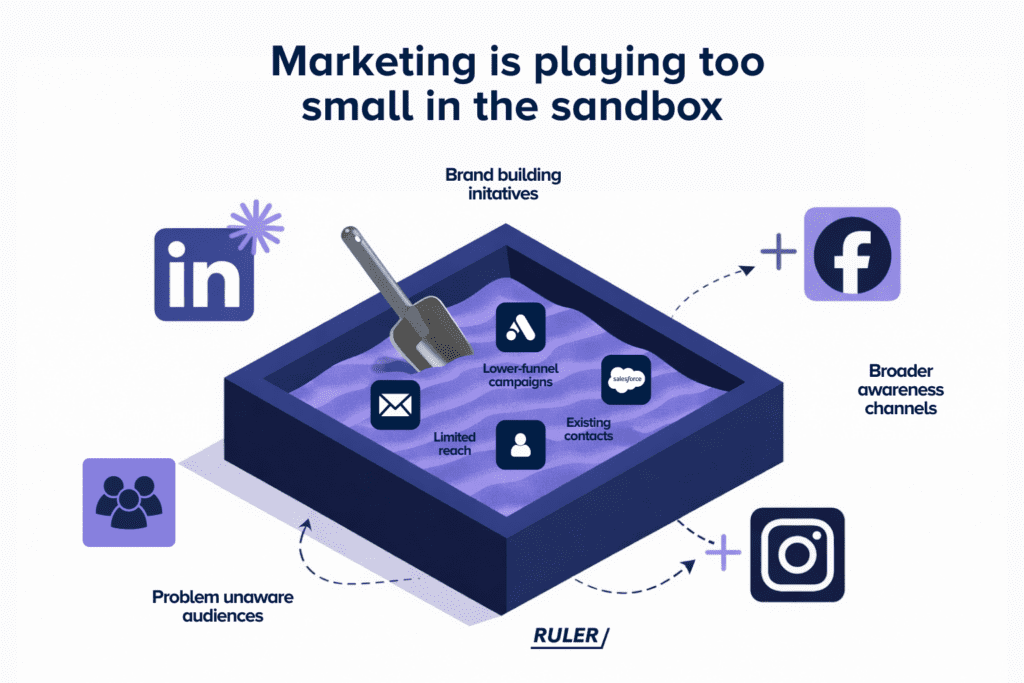
The important context is that teams operating in this way often demonstrate strong execution discipline. They produce thoughtful content, run structured campaigns, and maintain consistent delivery. The opportunity lies not in working harder, but in widening the field of engagement to include earlier-stage audiences and future buyers.
How to see if this is affecting your marketing
Understanding whether limited visibility or inflated performance metrics are constraining your growth starts with examining how revenue is measured and attributed across your systems. Several practical checks can help identify gaps that may be masking underlying issues.
Compare revenue sources across systems
Begin with your primary source of truth for revenue, such as your CRM, subscription platform, or ecommerce backend. This data reflects actual transactions and customer value.
Next, compare these figures with what is reported in analytics platforms like Google Analytics.
Discrepancies between these systems are common, but the size of the gap is what matters. If analytics data consistently underreports or overattributes revenue compared to backend systems, it may indicate incomplete tracking or attribution blind spots.
Review revenue and conversions reported by ad platforms
Ad platforms report conversions and revenue independently, often using their own attribution logic. Aggregate the total revenue and conversions reported across all paid media platforms and compare this total to your actual revenue.
If the summed revenue significantly exceeds what your business has truly generated, this suggests a high level of duplicated conversions and overlapping credit across channels. In these situations, reported return on ad spend (ROAS) is often inflated, creating a misleading picture of performance and efficiency.
Evaluate the scale of the discrepancy
Some level of mismatch is expected in multi-channel marketing environments. However, when gaps are large or growing over time, it becomes increasingly difficult to make confident investment decisions. Budget allocation, channel prioritisation, and growth forecasts may all be based on distorted signals.
When these discrepancies become material, it is often a sign that existing measurement approaches are no longer sufficient for the complexity of the marketing mix. At that stage, more advanced attribution and measurement frameworks can provide clearer visibility into what is genuinely driving incremental growth.
The objective is not perfect alignment across platforms, but a level of clarity that allows marketing performance to be evaluated with confidence and decisions to be made based on reliable, end-to-end data.
Building a strategy and measurement for sustainable traction
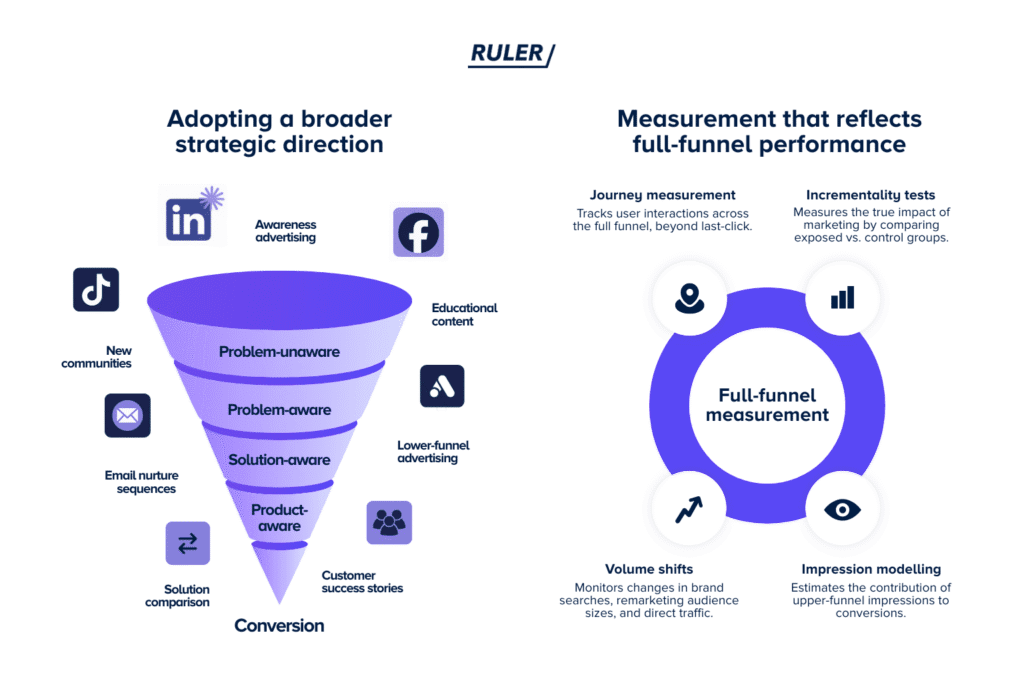
Overcoming a plateau in marketing performance usually requires adjustment in both strategy and measurement. Moving from a lower-funnel approach to a full-funnel model allows organisations to create content and campaigns that support every stage of the buyer journey.
1. Adopting a broader strategic direction
Engaging problem-aware audiences, not only solution-aware buyers, expands future demand. Many potential customers experience the challenges a product or service addresses, but lack clarity on root causes or available solution categories. Content that explores specific pain points, how they appear in daily operations, and how they relate to familiar tools or processes helps bridge this gap.
In analytics, for example, content designed solely for audiences searching for attribution software reaches a limited segment. Content that examines common difficulties with web analytics platforms, paid media reporting, or marketing return on investment speaks to a wider audience. This approach connects existing frustrations to a broader category of solutions.
Awareness also grows through education. Articles, videos, and social content that explain problems in new ways help audiences reframe familiar challenges. The aim is to guide readers from recognising an issue to understanding that structured solutions exist. Consistent exposure across multiple touchpoints supports this process.
Effective distribution reinforces visibility. This may include remarketing to prior content viewers, matched-audience campaigns on professional and social platforms, structured email nurture sequences, organic social reach, and partnerships that introduce content to new communities. Repetition across channels supports recall and recognition.
As awareness activity expands, downstream channels benefit. Upper-funnel engagement builds larger remarketing audiences, increases branded search interest, drives more direct traffic, and improves performance in conversion-focused campaigns. Awareness, consideration, and conversion activity function as a connected system rather than separate efforts.
2. Measurement that reflects full-funnel performance
Traditional performance metrics focus on immediate response and direct conversion. While valuable, they can provide limited insight into early-stage influence. Full-funnel marketing requires measurement frameworks that capture the complete customer journey.
Reach and impressions become central indicators. Understanding how many individuals see brand content over time provides a practical measure of awareness growth. Many organisations operate at relatively modest monthly reach levels. Expanding total exposure supports long-term pipeline development.
Related: How to measure top of the funnel marketing and brand awareness
Journey measurement also plays an important role. Measurement that connects early interactions with later conversions offer a more complete view of marketing contribution. This includes recognising the influence of upper-funnel impressions and engagements rather than focusing solely on the final interaction or click before conversion.
Related: The role of impression attribution in marketing measurement
Leading indicators help assess progress before lead volume shifts. These include growth in total reach, rising engagement with educational content, expanding remarketing audiences, increased branded search activity, and higher direct website visits. Together, these signals reflect widening market presence.
Incrementality analysis further clarifies impact. This examines whether awareness activity introduces new audiences or simply redistributes existing traffic across channels. Understanding incremental reach helps refine investment decisions and creative approaches.
A full-funnel approach also requires time and patience. Awareness-building activity does not deliver immediate conversion uplift in the same way as lower-funnel campaigns. However, sustained execution leads to broader addressable audiences, stronger remarketing pools, and improved conversion performance over time, as more buyers become familiar with the brand and its category.
Real-world example implementing full-funnel marketing
A common scenario involves B2B organisations generating consistent but capped lead volumes. In one such case, a company maintained steady results through content marketing, email campaigns, and social posting, yet struggled to grow beyond a fixed monthly lead count.
They had plateaued at around 40 leads per month. Their organic search traffic was steady but not growing, social media reached the same audience of followers, and email campaigns went to existing contacts. They were essentially marketing to an audience of a few thousand people, over and over. The followed the following framework to
Strategic changes:
- They started creating content around pain points rather than just solution features, focusing on problems their target audience experienced with tools they already used (like Google Analytics frustrations, Facebook attribution challenges, or Excel reporting headaches)
- They invested in amplifying this content through paid channels to reach cold audiences, not just remarketing to people who already knew them
- They built matched audience campaigns on LinkedIn and Meta to reach lookalikes of their best customers
- They created email nurture sequences specifically for people discovering them for the first time through awareness content
Measurement changes:
- They started tracking total monthly impressions as a key metric, aiming to grow from 50,000 to 500,000+
- They implemented attribution that connected upper-funnel touchpoints to eventual conversions, rather than just crediting the last click
- They looked at audience growth metrics: remarketing pool size, email list growth from content, branded search volume increases
Over the following quarters, they saw their addressable audience expand significantly. Their remarketing audiences grew from hundreds to thousand, and branded search volume increased. Most importantly, their bottom-funnel channels started performing better because more people were entering the funnel aware of who they were and what they did.
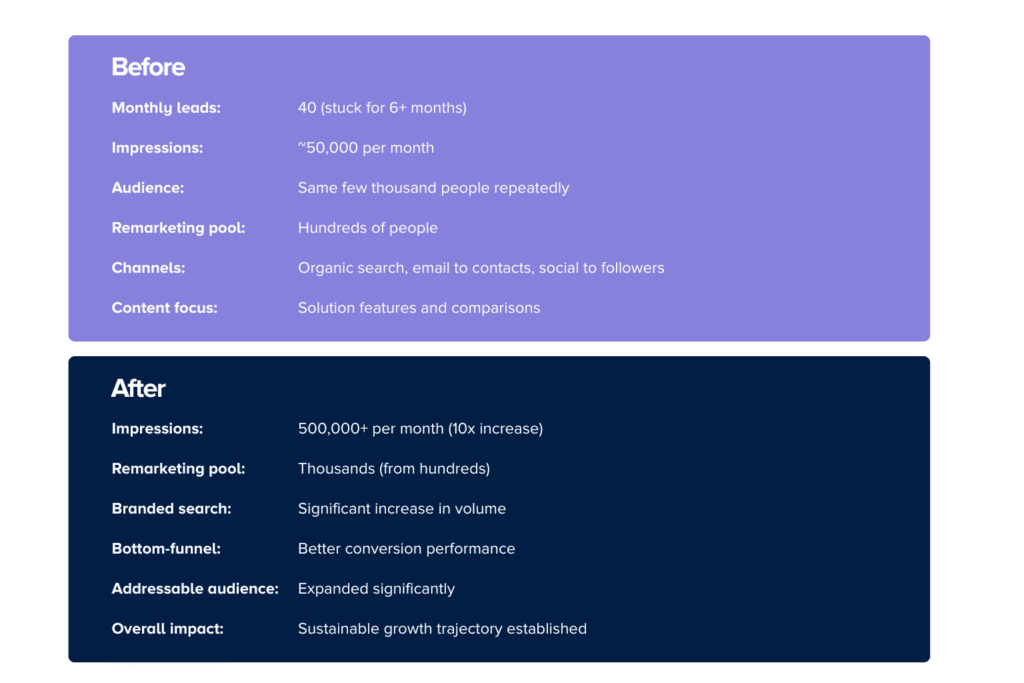
The lesson wasn’t that their previous marketing was wrong, it was that they needed to expand beyond marketing only to people already in-market.
By building awareness with their audience that was problem-aware but not solution-aware, they created a much larger pool of potential buyers to nurture toward conversion.
Final thoughts on full funnel marketing
If your marketing has plateaued and you’re struggling to get more leads, the solution probably isn’t just working harder at what you’re already doing.
It’s about reaching beyond the small in-market audience you’re currently targeting.
Full-funnel marketing means creating content for people at every stage of awareness, sharing it so new audiences see it, and measuring success not just by immediate conversions but by how your overall audience grows over time.
The companies that get past growth plateaus aren’t always the ones with the best product or the biggest budget.
They’re the ones that figured out how to connect with people even before those people realised they were looking for a solution.