Login
Book a Demo

Ad platforms double counting conversions is one of the most widespread and expensive measurement problems affecting marketing teams.
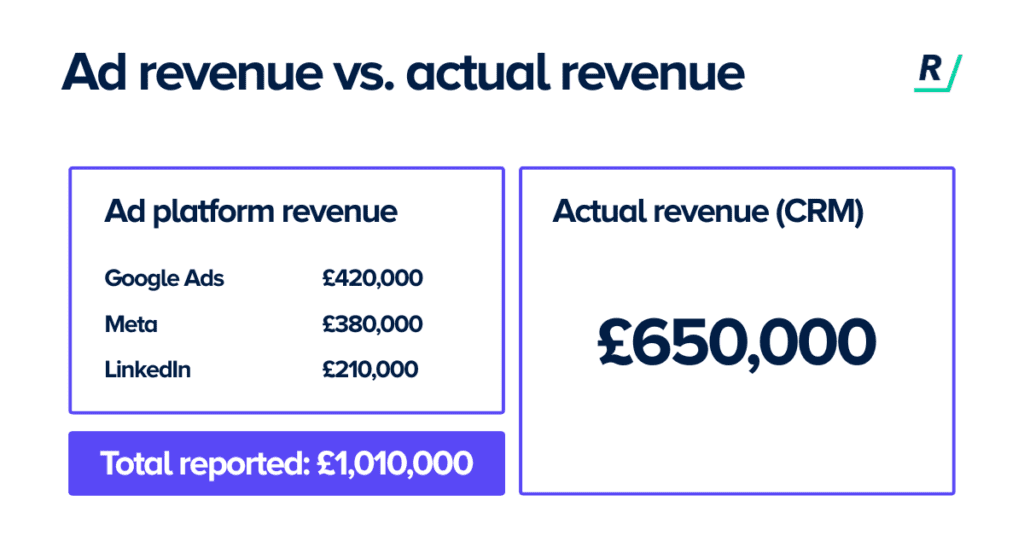
When you open your ad dashboards, Google Ads reports 80 conversions, Meta Ads Manager shows 65, and Microsoft Advertising claims another 30, which on paper adds up to 175 conversions.
However, when you cross-check this against your backend data, you find that only 95 actual sales were recorded, revealing an 84% overcount that has a direct impact on how marketing budgets are allocated.
Double-counting conversions is a pervasive but often overlooked issue in digital marketing, arising when multiple platforms claim credit for the same conversion due to differences in tracking logic and attribution models.
While each platform is reporting accurately according to its own methodology, the combined effect inflates key performance metrics, such as return on ad spend (ROAS) and cost per acquisition (CPA), making underperforming channels appear more profitable than they actually are and skewing budget allocation decisions.
In this article, we explore how to identify double-counted conversions and outline practical steps to address them effectively.
We discuss:
Key takeaways
Ad platforms count conversions independently, the same sale can be claimed by Google Ads, Meta, and Microsoft Ads simultaneously.
When combined platform conversions significantly exceed actual backend revenue, cross-platform duplication is almost certainly the cause.
Double-counting inflates reported ROAS and hides your true cost-per-acquisition, sometimes by close to 2x.
The most common causes are missing transaction IDs, incorrect conversion counting settings, and pixel plus server events firing without deduplication logic.
Your CRM or e-commerce backend is your only reliable source of truth, platform dashboards are directional signals, not budget decisions.
Each ad platform operates its own measurement system in complete isolation. Google Ads tracks conversions from Google clicks. Meta tracks conversions from its Pixel and Conversions API. Microsoft Ads does the same. None of them share data or cross-reference each other by default.
So when a customer clicks a Google Search ad on Monday, sees a Meta retargeting ad on Wednesday, and buys on Friday, all three platforms can claim that sale. Google says it happened because of the Search ad. Meta says it happened because of the retargeting ad. Microsoft, if there was a touchpoint there too, may claim it as well.
This is structural. It isn’t a bug or a configuration error. It’s simply how each platform’s measurement model works, they each measure within their own ecosystem, and they have every incentive to do so.
There is also a second layer of overlap involving view-through conversions.
Some platforms count a conversion if a user simply saw an ad, even without clicking, and later purchased through a different channel. A customer who clicked a Google Search ad and saw a Meta display ad in the same day can trigger a reported conversion in both systems.
We reviewed conversion data across a range of e-commerce accounts and found that when you aggregate all platform-claimed conversions and compare them against actual backend revenue, the gap is rarely small.
In many cases, platforms were collectively claiming 30–50% more conversions than actually occurred.
Here’s where double-counting stops being a data problem and becomes a budget problem.
Your ROAS figures are built on those conversion numbers. If actual sales are 95 but combined platform reporting shows 175, your ROAS looks almost twice as strong as it actually is.
Related: What is Google ROAS and why you need to be cautious
And because ad platforms use conversion data to optimise bidding, they’re bidding more aggressively than they should, pushing up costs based on performance signals that don’t reflect reality.
The downstream effects compound quickly:
We worked with an e-commerce business scaling Facebook spend based on a reported ROAS of 7–8x. When we compared platform-claimed conversions against actual backend orders, Facebook was over-attributing by roughly 40%.
Their true cost-per-acquisition was almost twice what the platform showed. Redistributing budget to channels with cleaner attribution improved overall margin without increasing total spend.
You don’t need specialist tools to get a first read on whether this is happening.
Pull actual revenue from your backend. Your CRM, Shopify dashboard, or e-commerce system is your source of truth. Note total transactions and revenue for the last 30 days.
Compare against Google Analytics. How closely does GA4’s reported revenue match your backend? A gap of more than 10–15% suggests tracking issues worth investigating.
Add up all platform-claimed conversions. Pull conversions from every active ad platform for the same period. If the combined total significantly exceeds actual transactions, 30% or more is a common signal, cross-platform duplication is almost certainly present.
Audit your tag setup. Open Google Tag Manager and list every tag firing on your thank-you or order confirmation page. Cross-reference against active conversion actions in Google Ads and GA4. If the same purchase event maps to multiple primary conversion actions, you’re double-counting within a single platform.
Check your Meta event IDs. If you’re running both the Pixel and Conversions API, confirm event IDs are consistent between the two. Mismatched IDs mean Meta can’t merge duplicate events, which inflates your purchase count.
Not all conversion duplication is the same. Some of it comes from technical mistakes in your tracking setup that can be resolved with relatively straightforward changes. But some of it is structural, baked into how ad platforms measure independently, and no amount of tag fixing will solve it. It helps to know which is which.
Related: Why GA4 and ad platform data don’t match and what to do
Generally, these errors are fixable. Cleaning them up will give you more reliable numbers within each platform and is worth doing regardless of anything else.
The important caveat is that even with a technically clean tracking setup, you will still see conversion totals that exceed your actual sales when you look across platforms together.
As we discussed earlier, each platform has its own measurement logic, its own attribution windows, and its own definition of what counts as a conversion.
Google Ads measures from Google clicks. Meta measures from Meta touchpoints. When a customer interacts with both before buying, which is common, both platforms record the conversion legitimately within their own system.
Neither is wrong by its own rules. But together they’re overcounting.
This is the structural overlap problem, and it doesn’t go away when your tags are clean. It requires a different approach entirely.
The goal here isn’t perfect data, that’s not realistic. The goal is data you can make confident decisions with.
The result is a single view of performance that works from what actually happened, with the gaps modelled rather than ignored.
When reconciliation is in place and attribution is deduplicated, a few things shift quickly.
The gap between marketing’s reported results and finance’s view of revenue stops being a surprise. Budget conversations become more straightforward because everyone is working from the same numbers. And channel investment decisions are made with more confidence because you know what’s actually driving sales, not what each platform is claiming credit for.
The business we referenced reallocated a meaningful portion of budget away from channels that had appeared strong but were largely benefiting from attribution overlap. Organic search and email, which had been under-invested because they don’t self-report ROAS the way paid platforms do, turned out to be significantly more valuable once duplication was removed.
None of this requires a complete overhaul overnight. Start with the reconciliation, backend revenue versus combined platform totals. The gap you find will tell you how urgently the rest needs addressing.
If you want to see how a unified measurement layer works in practice, book a demo with Ruler Analytics and we’ll show you exactly how to build a view of performance your whole business can trust.
Conversion duplication happens when the same sale or lead is counted as a conversion by more than one ad platform, or more than once within a single platform. Because each platform tracks independently, a customer who touched multiple channels before buying can trigger a reported conversion in Google Ads, Meta, and Microsoft Ads simultaneously, even though only one sale occurred.
The most common fixes are: setting purchase conversion actions to “one per click” rather than “every”, adding unique transaction IDs to your conversion tag so page reloads don’t recount the same order, and auditing Google Tag Manager to confirm only one conversion tag fires per event on your thank-you page.
Usually caused by: conversion counting set to “every” rather than “one per click”, missing transaction IDs that allow page reloads to generate duplicates, multiple conversion actions firing for the same purchase, or view-through conversions being counted alongside click-based ones.
Pull total conversions from every ad platform for a set period and compare the combined total against actual transactions in your backend or CRM. If the combined total significantly exceeds real sales, 30% or more is a common signal, cross-platform duplication is likely.
Attribution overlap refers to multiple channels receiving credit for the same conversion, each claiming it legitimately from their own measurement perspective. Double counting can refer to that cross-platform overlap, or to a technical error where a single platform counts one event more than once. Both inflate reported metrics, but they require different solutions.