
Media planning tools and software reviewed to improve budget allocation efficiency.
From what we’ve seen across the teams and agencies we speak with, the challenge isn’t usually about strategy. It’s about data.
Budgets are being allocated across more channels than ever before, the signals coming back are noisier and less complete, and the tools that were supposed to make sense of it all are either too simplistic or too technically demanding to be useful day-to-day.
That’s the gap media planning software is supposed to fill. The best tools in this space help teams answer two deceptively simple questions: where should we put our money, and is what we’re doing actually working?
Below, we’ve reviewed the tools worth knowing about in 2026, across a range of use cases, budget levels, and team sizes.
Here’s what we’ll cover:
- How we describe media planning tools
- What we recommend looking for in media planning software
- Best media planning software reviewed 2026
- Why we’ve seen media planning tools grow in popularity
💡 Pro Tip
Most teams are planning media with an incomplete picture. Cookie restrictions, consent drop-off, and platform overclaiming mean your analytics layer is showing you less than it used to, and last-click is filling in the gaps badly. Ruler’s MMM models channel contribution across digital and offline spend without relying on cookies or user-level tracking, and surfaces budget recommendations you can act on.
Book a demo to learn more.
How we describe media planning tools
Media planning tools are platforms, frameworks, or software solutions that help marketing teams decide how to allocate spend across channels, audiences, and time periods, and then measure whether those decisions delivered.
The category is broader than people expect. At one end, you have lightweight templates and channel-level dashboards. At the other, you have full statistical modelling environments that quantify channel contribution and simulate budget scenarios before a single pound or dollar moves.
What they share is the intent, which is to bring structure and evidence to decisions that have, historically, been made on instinct, convention, or whoever in the room argued most convincingly.
A useful media planning tool should be able to tell you not just what you spent, but what it was worth, and ideally, what you should do differently next time.
What we recommend looking for in media planning software
The tools we find most valuable in this space tend to share a few qualities that aren’t always obvious from a demo or a feature list. Here’s what we’d encourage teams to pressure-test before committing.
Cross-channel visibility, not just cross-channel reporting: There’s a meaningful difference between a tool that aggregates channel data and one that helps you understand how those channels interact. Look for platforms that model channel relationships, not just stack them side by side.
Offline and online in the same view: If you’re running any combination of TV, radio, out-of-home, and digital, and most substantial media budgets do, you need a tool that can hold all of it together. Models that only handle digital spend will systematically misattribute performance to the channels they can see.
Scenario planning that’s actually usable: Forecasting features are only valuable if they surface decisions you can act on. We’ve seen too many tools produce beautifully rendered scenario outputs that require a data scientist to interpret before anything happens. The best tools close that gap.
Integration without friction: A tool that sits outside your existing stack creates a data movement problem. Look for clean connections to your ad platforms, CRM, and analytics tools, ideally with enough flexibility that you’re not re-exporting CSVs every week just to run a report.
Best media planning software for 2026 reviewed
Here’s our curated list of media planning tools, based on our experience, conversations with marketing teams we work with, and insights gathered from online reviews.
- Ruler Analytics
- Analytics Partners
- Circana Marketing Mix
- Google Analytics Scenario Planner
- Meridian by Google
- Nielsen
- Robyn by Meta
Ruler Analytics
Ruler offers two distinct measurement products: multi-touch attribution built on first-party tracking, and marketing mix modelling for strategic, channel-level budget decisions. For media planning specifically, the MMM solution is where most of the heavy lifting happens, though the fact that both live in the same platform is a genuine advantage teams tend to appreciate once they’re up and running.
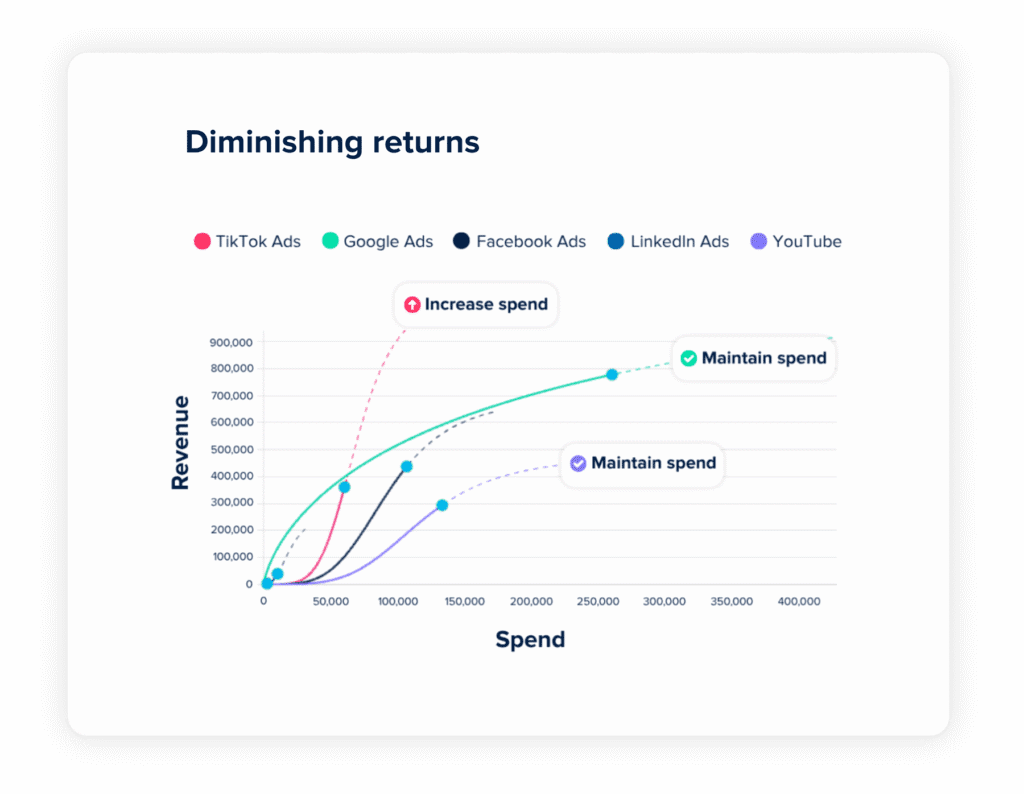
Ruler’s MMM uses machine learning to quantify how each channel in your media mix is contributing to revenue, incorporating both digital and offline activity, paid search, paid social, TV, radio, display, into a single model. It doesn’t rely on cookies or user-level tracking, which means the outputs don’t degrade as consent rates fall or browser restrictions tighten.
What we’ve designed it to solve
We built Ruler’s MMM because, from the conversations we’ve had and the accounts we’ve worked with, there’s a persistent gap in how marketing teams measure media performance. The tracking layer shows an increasingly incomplete picture, iOS changes, consent drop-off, ITP, cookie deprecation, while the platforms themselves are incentivised to overclaim. Last-click attribution papers over the problem rather than solving it.
At the same time, the alternatives, traditional MMM consultancies, open-source frameworks like Robyn or Meridian, either require significant investment or meaningful data science resource to operationalise. Neither option suits the growth-stage or mid-market teams that need this kind of measurement most.
Ruler is designed to sit in between, statistically rigorous channel-level measurement that doesn’t require a modelling team to run, delivered inside the same platform where teams are already doing journey-level analysis.
Where we see it work best
From the accounts we’ve analysed and the use cases we hear most often, Ruler’s MMM tends to deliver the clearest value in a few specific situations.
Related: How marketing mix modelling transforms budget planning
It performs particularly well for agencies managing multi-channel campaigns across a mixed media portfolio, where transparent and explainable measurement matters to clients. B2B and lead generation businesses also tend to get strong signal from it, the kind of businesses where the sales cycle stretches across weeks or months and involves multiple touches that last-click will never credit fairly.
And for retailers or ecommerce brands running a combination of paid social, paid search, TV, and seasonal promotions, understanding channel interaction rather than just channel performance is often where the interesting decisions live.
Example of Ruler in action
Here’s a real example drawn from within Ruler’s platform. A Facebook prospecting campaign is running at £55,500 in spend, generating £613,033 in revenue, a ROAS of 11.05x. Ruler’s Budget Optimiser recommends increasing spend to £60,200. At that level, projected revenue rises to £638,483, with ROAS adjusting to 9.68x.
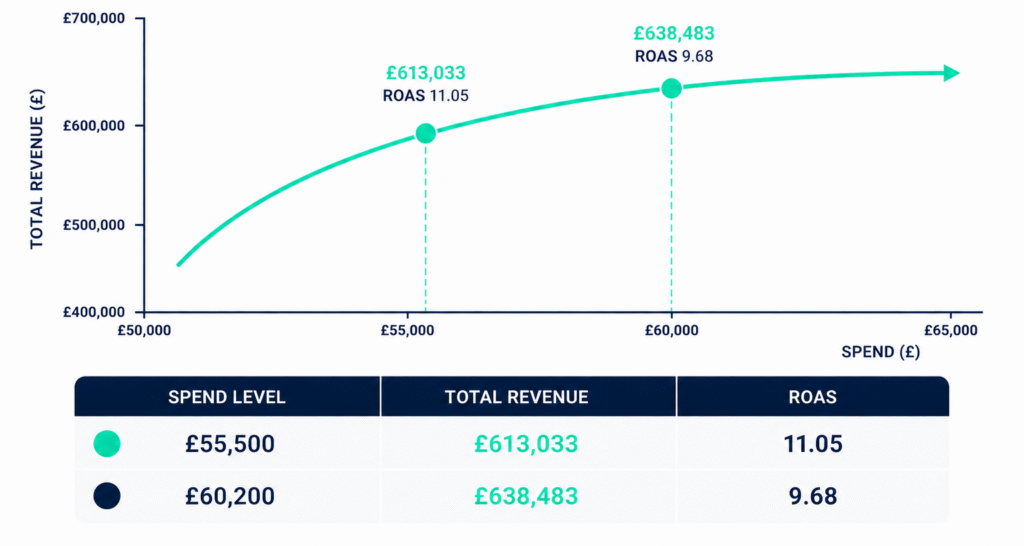
That incremental £4,700 in spend generates approximately £25,000 in additional revenue. But the curve has begun to flatten, the model is signalling that further increases beyond this point will see diminishing returns accelerate. The recommendation isn’t simply “spend more.”
It’s “spend this much more, and here’s exactly where the efficiency starts to erode.”
That’s the kind of decision support Ruler’s MMM is designed to surface. Not just what’s working, but how hard you can push it before the returns stop justifying the investment.
Consider Ruler if
- You’re running spend across multiple channels and struggling to identify which ones are genuinely moving revenue
- Your tracking has become unreliable due to cookie restrictions, consent drop-off, or iOS changes
- You want to move beyond last-click attribution without losing the granular journey data your team relies on day-to-day
- You need a budget optimisation recommendation you can actually act on, not a model output that requires a data scientist to interpret
- You’re managing a combination of digital and offline spend and need a unified view of performance
Pricing
Pricing depends on your website traffic, product tier, data volume, and integrations. We recommend booking a demo to get a personalised quote based on your specific setup.
💡 Pro Tip
Want to learn more about Ruler and the services we offer? Book a demo to see Ruler in action and discover how it helps prove marketing’s impact on revenue, reduce diminishing returns, and assist with budget scenario planning.
Book a demo of Ruler
Analytics Partners
Analytics Partners, now part of Ipsos, brings a consulting-led approach to media mix modelling and marketing measurement. The platform, known as Catalyst, is built around what they call a Unified Marketing Measurement methodology, combining MMM with multi-touch attribution into a single, harmonised view of channel performance.
Where it shines
The platform is particularly strong for large, multi-market enterprises with complex media mixes spanning broadcast, digital, and in-store. The Ipsos acquisition has deepened the research and audience insight layer, giving clients access to attitudinal and behavioural data alongside the modelling outputs. For brands that need a credible, defensible methodology, one that will hold up in front of a CFO or board, the pedigree here carries weight.
Where it falls short
This is an enterprise-grade, consulting-engagement model. Implementation timelines can be lengthy, the cost structure reflects that scope, and smaller or faster-moving teams will likely find the pace of iteration slower than they need. Self-serve access is limited; you’re largely working with the Analytics Partners team rather than running the model yourself.
Consider Analytics Partners if
- You’re a large enterprise with significant multi-market media investment
- You need a unified view of MMM and MTA from a single methodology
- You have the budget and runway for a managed engagement
Pricing
Enterprise pricing, quote-based. Contact Analytics Partners or Ipsos directly for a scoping conversation.
Circana Marketing Mix

Circana (the company formed from the merger of IRI and NPD Group) offers marketing mix modelling as part of a broader market intelligence platform, with particular depth in consumer packaged goods, retail, and fast-moving consumer categories.
Where it shines
Circana’s strength is in the data. The combination of point-of-sale data, panel data, and media inputs means their models are unusually well-calibrated for brands selling through retail channels, where the path from media exposure to purchase is indirect and often invisible to digital attribution tools.
If you’re a CPG brand trying to understand what your trade promotions, TV buys, and in-store activity are actually contributing relative to each other, Circana’s depth here is hard to match.
Where it falls short
The platform is purpose-built for CPG and retail. Brands outside those categories will find fewer native data integrations and less contextually relevant benchmarking. Like other enterprise MMM providers, the model operates on a managed service basis, which limits the speed with which teams can iterate.
Consider Circana if
- You’re a CPG, retail, or FMCG brand with significant trade and media investment
- You need a model that can incorporate point-of-sale and panel data alongside media spend
- You’re looking for category-level benchmarking, not just your own performance metrics
Pricing
Enterprise, quote-based. Scope and pricing vary significantly by data volume and category.
Google Analytics Scenario Planner
Google Analytics 4’s scenario planner is less a standalone media planning tool and more a forecasting feature embedded within the GA4 interface. It uses your historical traffic and conversion data to project future performance under different conditions, useful for rough planning, less useful as a strategic allocation framework.
Where it shines
For teams already living inside GA4, the scenario planner requires no additional setup, no new data pipeline, and no separate contract. It gives a reasonably accessible way to model “what if traffic increases by 20%” or understand the projected revenue impact of a planned campaign. For early-stage businesses or teams without dedicated analytics resource, that accessibility matters.
Where it falls short
The scenario planner works with what GA4 can see, which is increasingly incomplete as tracking signals shrink. It doesn’t model cross-channel contribution, doesn’t incorporate offline spend, and isn’t designed to help you decide how to allocate budget across media. It’s a forecasting aid, not a media planning platform. Teams looking for genuine channel-level measurement will outgrow it quickly.
Consider it if
- You’re early-stage and need a lightweight forecasting capability without additional tooling
- You want a rough sanity check on campaign projections within an existing GA4 setup
- You’re not yet running complex multi-channel media mixes that require more rigorous modelling
Pricing
Included with Google Analytics 4. Free.
Meridian by Google
Meridian is Google’s open-source MMM framework, built to replace the earlier LightweightMMM. It’s designed to model how a full marketing mix, paid channels, owned media, offline activity, contributes to business outcomes, and includes budget planning tools alongside the core modelling capability. Google has also indicated plans to enrich Meridian with proprietary reach, frequency, and search query volume data, which would give it a meaningful data advantage for teams with significant Google media investment.
Where it shines
For teams with genuine data science resource, Meridian is a rigorous, customisable, and transparent framework. Being open-source, teams can inspect the model, modify assumptions, and extend it to fit their specific setup, something that’s impossible with black-box enterprise platforms. The planned Google data integrations could make it particularly powerful for advertisers where Search and YouTube represent a substantial portion of the media mix.
Where it falls short
Meridian is a technical tool. Without a data scientist comfortable working in Python, it’s not a realistic option. It’s also still in beta, meaning access isn’t universal and the feature set is still evolving. Teams running significant spend outside Google’s ecosystem will find the native data integrations less directly relevant.
Consider Meridian if
- You have in-house data science capability and want a rigorous, customisable open-source framework
- Google channels make up a meaningful share of your media investment
- You’re comfortable with the implementation and maintenance overhead of an open-source tool
Pricing
Free and open-source. Currently in beta, access may require an application. Internal implementation costs apply.
Nielsen
Nielsen is one of the oldest and most recognisable names in media measurement. Their MMM offering draws on decades of cross-category data and a sophisticated modelling methodology, helping brands assess channel contribution, identify performance drivers, and make the case for budget decisions to senior stakeholders.
Where it shines
The depth of Nielsen’s historical data and the credibility of their methodology is genuinely difficult to replicate. For enterprise brands with significant media investment across multiple markets, particularly where broadcast and offline channels carry real weight, Nielsen’s modelling has a robustness and defensibility that newer entrants can’t easily match. Automated systems and integrations mean clients can receive ROI insights in weeks rather than the months that traditional MMM once required.
Where it falls short
Scale and heritage come with enterprise processes and enterprise pricing. Smaller and mid-market teams will find the platform largely inaccessible, not just on cost, but on operational fit. This is a managed engagement model, you’re working with Nielsen’s team, not running the model yourself. That limits how quickly teams can iterate as campaigns evolve. Flexibility and speed are the trade-offs for the methodological depth on offer.
Consider Nielsen if
- You’re an enterprise brand with substantial multi-market media spend
- You need a credible, proven methodology that can withstand scrutiny from finance and senior leadership
- You’re comfortable with a managed service model and longer implementation cycles
Pricing
Enterprise, quote-based. Not a self-serve platform. Expect a managed engagement with pricing to reflect the scope.
Robyn by Meta
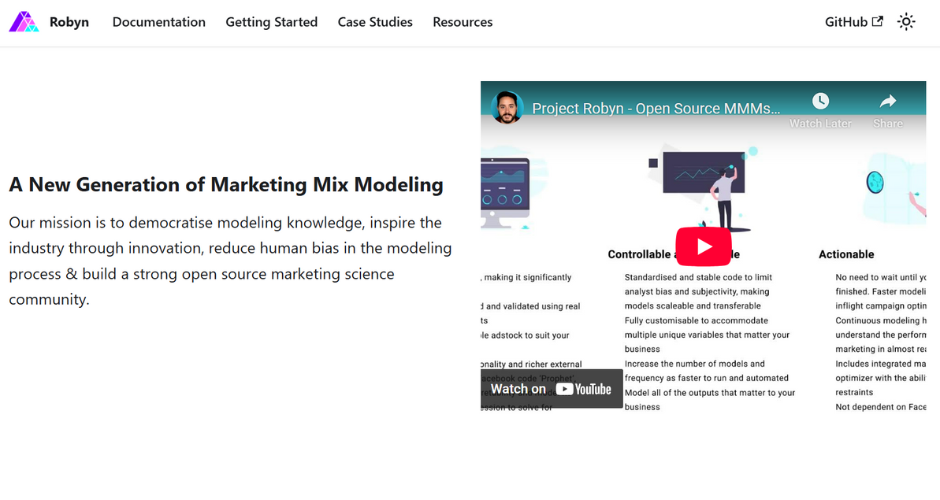
Robyn is Meta’s free, open-source MMM framework, built and maintained by their Marketing Science team. It uses automated machine learning to model channel contribution, identify the point of diminishing returns for each channel, and surface budget optimisation recommendations. Teams with data science resource can inspect and customise the methodology to fit their setup.
Where it shines
For technically capable teams, Robyn offers something that most enterprise platforms don’t: complete transparency into the model and the freedom to customise it. It’s free, which removes the cost barrier that typically makes MMM inaccessible to smaller or growth-stage businesses, provided you have the R proficiency to run it. The automated feature selection and diminishing returns modelling are genuinely sophisticated, and a strong user community has built up around it.
Where it falls short
The “free” framing can be misleading. Robyn requires meaningful R proficiency to implement, maintain, and interpret, the internal resource cost is real, even if the licence isn’t. It’s also primarily built around digital and direct-response data, making it less well-suited to brands with significant offline or traditional media investment. And because there’s no managed interface or support function, troubleshooting falls entirely on the team running it.
Consider Robyn if
- You have in-house data science resource comfortable working in R
- Your media mix is predominantly digital and direct-response
- You want full transparency and control over your measurement methodology
- You’re comfortable with the overhead of building and maintaining your own modelling environment
Pricing
Free and open-source. Internal implementation and maintenance costs apply.
Why we’ve seen media planning tools grow in popularity
The interest in more rigorous media planning software isn’t coming from nowhere. From the conversations we have with marketing teams and the patterns we see in the accounts we work with, a few things have driven the shift.
The measurement foundation has become less reliable. Browser restrictions have shortened the lifespan of first-party cookies to as little as 24 hours in some environments. Third-party cookies are effectively gone. Consent rates are declining, and ad blockers are mainstream. The cumulative effect is that the analytics layer most teams rely on is showing them a progressively smaller share of what’s actually happening. When your measurement is incomplete, your media planning decisions are too.
Channels have multiplied, but clarity hasn’t followed. Budgets that once sat across three or four channels are now spread across eight or ten, with offline and digital activity running simultaneously and interacting in ways that channel-level dashboards struggle to capture. The question “what’s actually driving revenue?” has become harder to answer, and the tolerance for gut-feel answers has dropped.
Platform-reported metrics are increasingly contested. Every ad platform measures its own performance, and almost every platform claims credit for the same conversions. Blended ROAS can look healthy while actual revenue growth has stalled. The teams we speak with are increasingly sceptical of self-reported numbers from channels with an obvious incentive to overstate contribution.
The cost of a wrong budget call has risen. As marketing budgets face greater scrutiny, the pressure to demonstrate that spend is going to the right places, and to back that up with something more robust than last-click attribution, has intensified. Media planning tools that provide defensible, model-backed recommendations have moved from a “nice to have” to a genuine operational need for teams that need to justify decisions upward.
The tools in this roundup represent different positions on the spectrum between accessibility and analytical rigour. The right fit depends on your team’s technical capability, the complexity of your media mix, and how quickly you need to be able to act on what the model tells you.
Finding the right media planning tool
There’s no single platform that’s right for every team. What we’ve found, though, is that the questions worth asking before committing are fairly consistent: Can it handle everything we’re actually spending on, including offline? Can we act on what it tells us without a specialist to translate the output? And will it still be reliable in a year’s time, as tracking signals continue to erode?
If your team is navigating those questions and looking for a measurement solution that’s both statistically rigorous and operationally accessible, Ruler’s MMM is worth a look. Book a demo and we’ll walk through what it could tell you about your specific media mix.