
More and more of your customers’ research is happening inside AI tools rather than on the open web, and most marketing measurement has no way of seeing it.
Last year, we found that 35% of leads were attributing themselves directly to AI tools when asked how they’d heard about a business, and that sits almost entirely outside what most measurement setups can see.
When those interactions do eventually lead to a conversion, they tend to get folded into direct traffic or branded search, and the actual influence behind the decision disappears from the report entirely.
Traditional tracking was built around clicks, sessions and referral data, and that model is starting to strain under the weight of how people actually search now.
In this post, we want to look at why that’s happening, what it means for attribution, and how marketers can adapt without throwing out everything they’ve built so far.
We discuss:
- How AI is disrupting traditional tracking
- Where we think traditional tracking falls short
- The rise of zero click searches
- Our approach to measurement in the AI era
Pro Tip
If you’re worried your measurement setup is missing more of the customer journey than it used to, book a demo with Ruler and we’ll show you how first-party tracking and statistical modelling can work together to close that gap.
How AI is disrupting traditional marketing tracking
Most digital measurement has historically been built around observable interactions. Someone clicks a link, a UTM parameter tells you where they came from, a cookie follows them across a session, and eventually that trail connects to an online conversion such as a form fill.
It’s a model that works well when the customer journey happens in a browser and leaves a click behind at every step, and for the best part of two decades that assumption has more or less held up.
Search engines returned a list of links, people clicked through to compare their options, and a referral or a UTM parameter gave you a reasonably reliable breadcrumb trail back to the source.
The trouble is that a growing share of research and discovery now happens somewhere that model can’t reach. Asking ChatGPT to compare options in a category, reading a synthesised answer inside Google’s AI Overview, or getting a recommendation from Perplexity may lead to a click, but it can also happen without generating a referral header or anything else a tracking script can pick up.
The AI tool has already done the comparison work that used to require several separate website visits, so by the time a prospect does land on your site, if they land on it at all, they may already have formed most of their opinion of you. That compresses a journey that used to leave several trackable touchpoints into a single, often untrackable, moment of exposure.
It’s also worth saying that this isn’t only about search. The same pattern shows up whenever a conversational AI tool is used to research a purchase, whether that’s asking for recommendations, summarising reviews, or comparing pricing across providers.
Each of those interactions can shape a decision just as much as an advert or a blog post might, but from a measurement point of view they’re largely invisible, because the AI tool sits between the person and the open web rather than sending them out into it
Where we think traditional tracking falls short
We still think GA4 and click-based attribution have a place, and in our own research 90% of respondents told us GA4 is their go-to marketing tool, so it clearly isn’t going anywhere soon. Where we think it falls short is in what it was ever designed to measure.
GA4 attributes based on sessions and last meaningful click, which means it has no real mechanism for crediting an interaction that happened inside an AI answer with no link attached. A ChatGPT conversation that prompts a branded search a few days later will simply get logged as branded search or direct, with nothing to suggest the AI conversation was the actual reason behind it.
It also doesn’t account for impression-based influence more broadly, so campaigns and content that shape a decision without earning a click tend to be undervalued, with the eventual conversion often falling back to direct traffic or branded search instead.
That’s not a new problem exactly, upper-funnel activity like display, CTV and PR have faced the same issue for years, with credit routinely flowing to whichever channel happened to be there for the final click rather than whichever one actually built the intent.
What’s changed is the scale of it. AI-generated answers have made this considerably more common, because so much of the research phase, the comparing, the shortlisting, the reading of reviews, can now happen entirely within a conversational interface before a person ever opens a browser tab with your website in it.
There’s a compounding effect here too. Because GA4 and similar platforms can only report on what they can see, the reporting itself starts to reinforce a skewed picture of what’s working.
Channels that generate a lot of clickable, trackable activity look increasingly effective by comparison, simply because they’re easier to measure, while channels that build awareness through AI-mediated discovery look weaker than they really are, purely as an artefact of measurement rather than actual performance.
We know from our own data that 64% of respondents base the majority of their marketing decisions on data in analytics, so when that data is systematically missing a growing chunk of the journey, the decisions built on it start to drift further from what’s actually happening.
The rise of zero-click search
Zero-click search deserves its own section here because it’s really the mechanism behind everything else in this piece.
Search engines have been answering more questions directly on the results page for years, through featured snippets, knowledge panels and instant answer boxes, but AI-generated summaries have extended that behaviour considerably further.
Industry research over the past year has put the share of Google searches ending without any click anywhere from around 6 in 10 to well over 8 in 10, depending on the study and how AI Overviews are counted, and the figures climb sharper still inside more conversational AI search experiences.
Whatever the precise number on any given month, the direction is consistent, and it’s upward. A user can now get a fully formed answer, a product comparison or even a recommendation without visiting a single website, which means the moment your brand actually influences someone might never register in your analytics at all.
For marketing measurement, that’s the real disruption, not that AI exists, but that a meaningful and growing share of the customer journey is happening in a space that traditional tracking was never built to see.
What we recommend looking for in marketing measurement
Based on the conversations we’re having with marketing and data leaders navigating this shift, we think the answer isn’t one tool or one metric, it’s combining two approaches that cover different parts of the problem.
First-party tracking to capture and connect the AI-driven traffic that does reach your website, and statistical modelling to estimate the influence of the exposure that doesn’t.
Used together, they give you a more complete picture than either one on its own, which matters given that 28% of marketers already cite siloed data as an obstacle to effective marketing measurement, and fragmented AI traffic threatens to make that worse rather than better.
First-party tracking helps measure the AI traffic you can see
When someone does click through from ChatGPT, Perplexity, an AI Overview citation or any other AI-powered experience, first-party tracking is what turns that click into something useful.
Let’s use Ruler, for example. Ruler’s first-party JavaScript tag tracks calls, form submissions, live chat and other conversions, following the full customer journey from first visit through to revenue, and because it’s first-party it isn’t degraded by the same privacy changes that have hit third-party cookie based tracking.
That means referrals and clicks from AI platforms can be captured and matched to CRM records in the same way as any other channel, so you can see not just that AI-sourced traffic arrived but what it actually turned into further down the funnel, whether that’s a form submission, a phone call, or a sale that only closes weeks later.
In practical terms, this means a visit that arrives with a referral source of chatgpt.com or perplexity.ai doesn’t just get logged as an unusual line in a traffic report and forgotten about. It gets treated as a genuine channel in its own right, one that can be followed through to whatever it eventually produces.
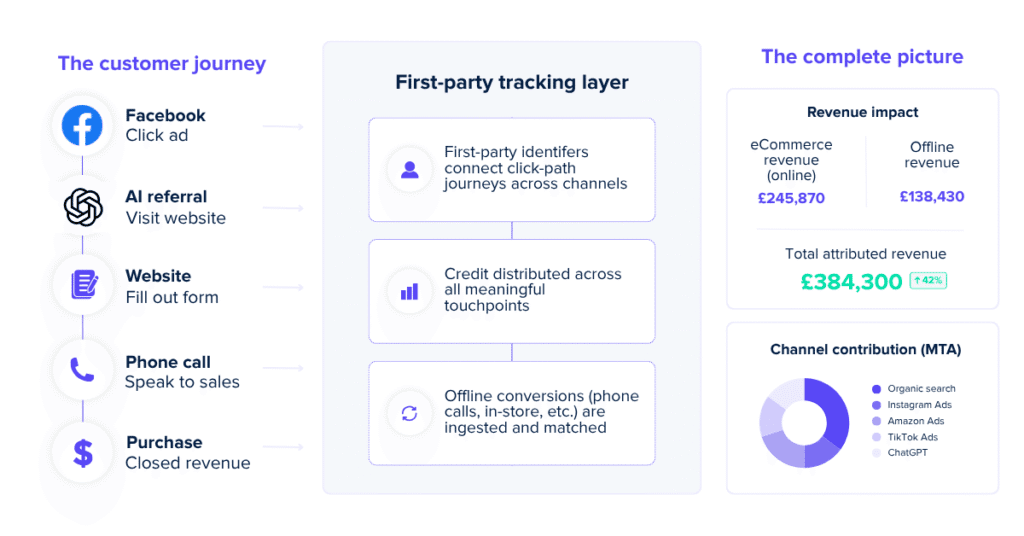
Over time, that builds up a real picture of how AI-driven traffic behaves compared with search, paid social or email, whether it converts at a higher or lower rate, and whether the leads it produces turn into the kind of revenue worth investing more in.
Just as importantly, it puts AI and search traffic alongside every other discovery channel in one view rather than treating it as something separate to squint at in isolation.
But first-party tracking cannot measure every AI interaction
We want to be honest about the limits here, because first-party tracking, however well implemented, can only ever measure the interactions that leave a trace.
If someone reads about your brand inside an AI-generated answer and doesn’t click through immediately, choosing instead to search your brand name directly a few days later or walk into a branch in person, no amount of tracking sophistication is going to connect those dots on its own.
That’s simply outside what click and session-based methods were built to do, no matter which vendor’s script is running on the page.
This is exactly the kind of gap that has always existed for upper-funnel, impression-based marketing, and AI-generated search results have just made it considerably larger and more common than it used to be.
Marketing mix modelling can help measure the impact of zero-click search and AI
This is where marketing mix modelling earns its place alongside first-party tracking rather than instead of it.
Rather than relying only on clicks, MMM treats visibility itself as a marketing variable.
Things like organic search visibility, search impressions, AI Overview appearances, AI brand mentions, AI recommendation share, branded search volume, direct traffic and website visits can all be modelled alongside paid media, seasonality and promotions to understand their statistical relationship with sales.
Instead of asking which individual click a sale should be credited to, the model asks a different and, we’d argue, more useful question, which is what happens to sales when visibility in these areas goes up or down, once every other variable has been accounted for.
This matters because a brand can appear in an AI answer or a search result without earning a click, and that exposure can still shape a branded search, a website visit or a purchase days or weeks later.
A click-based model would credit that entire journey to whichever channel triggered the final click, usually branded search, and stop there.
A marketing mix model, by contrast, can pick up AI visibility as a variable in its own right, and if branded search and conversions consistently rise in the weeks after AI visibility increases, that relationship becomes measurable, even though no individual click ever tied the two together.
MMM won’t tell you the individual customer’s path the way a click-based tool might, and it’s worth being upfront that it works at an aggregate level rather than a person-by-person one.
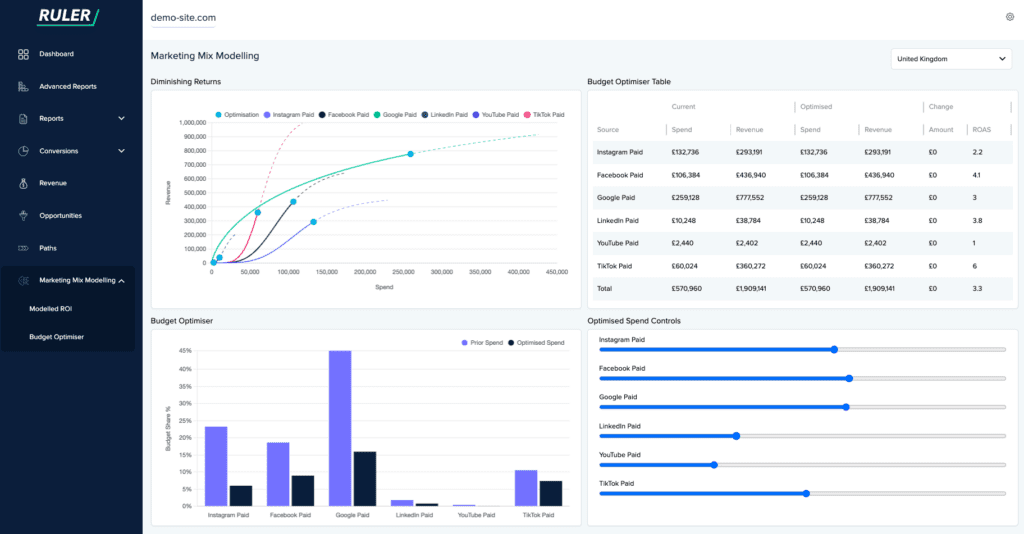
What it can do is estimate the incremental value that search and AI visibility are contributing overall, including delayed effects a last-click model would never pick up, using data that doesn’t rely on tracking an individual user across devices, platforms or AI tools at all.
For a lot of the marketing leaders we speak to, that combination, first-party tracking for what’s visible and statistical modelling for what isn’t, is starting to feel less like a nice-to-have and more like the only realistic way to keep a full picture of performance as more of the journey moves into AI-generated experiences.
Building a more complete view with Ruler
None of this means traditional tracking has stopped being useful, or that GA4 has become obsolete.
It means the picture it gives you is incomplete in a specific and growing way, and that gap is only going to widen as AI search continues to take on more of the research and discovery work that used to happen through a series of clicks.
Ruler combines first-party tracking across every conversion type, multi-touch attribution, and marketing mix modelling in one platform, so you’re not choosing between measuring what you can see and estimating what you can’t, you’re doing both together and letting each one cover the other’s blind spots.
If you’d like to see what that looks like against your own data, book a demo with our team and we’ll walk through how a more unified approach to measurement could work for you.