Login
Book a Demo

With stricter privacy rules limiting data tracking, digital marketers are turning back to marketing mix modelling tools and software to ensure clear visibility into marketing effectiveness.
With browsers blocking trackers and limiting third-party cookies and privacy laws multiplying, marketers are struggling to track users and measure campaign success.
Traditional tracking is crumbling, leaving marketers in a quandary.
They need new ways to navigate these murky waters, and marketing mix modelling presents itself as the answer.
Even tech giants like Google and Meta are recognising its potential.
In this article, we delve deep into the realm of marketing mix modelling, exploring the latest tools, software, and methodologies that are shaping the world of marketing measurement.
Here’s what we’ll cover:
💡 Pro Tip
Browser restrictions and privacy regulations are getting tighter, but that doesn’t mean marketing measurement has to suffer. We’re leading the way with innovative cookieless solutions like marketing mix modelling to ensure you get the insights you need without compromising privacy.
Skip to learn more about Ruler’s MMM or book a demo to see it in action.
Marketing mix modelling (MMM) is a powerful statistical analysis tool that acts like a control panel for your marketing.
It analyses a bunch of variables giving you a clear picture of how each channel impacts your bottom line.
These variables typically include:
By using techniques like multivariate regression, MMM goes beyond just showing you what’s being spent, it reveals the interrelationships between your marketing efforts.
This allows you to see which channels are truly driving sales and which ones might be underperforming.
With these insights, you can optimise your marketing budget, allocate resources more effectively, and maximise your return on investment.
More importantly, MMM helps you predict the impact of future campaigns, allowing you to adjust the dials for optimal sales performance.
Marketing mix modelling might have its roots in the 1960s, but it’s experiencing a modern resurgence due to the complexities of today’s digital marketing landscape. Let’s break it down:
The days of relying on a single marketing channel for growth are over.
A whopping 73% of consumers juggle multiple channels throughout their shopping journey, according to Harvard Business Review.
This multi-channel reality leaves businesses overwhelmed by the sheer volume of data and struggling to understand which channels truly drive sales.
As campaigns balloon in complexity, the challenge of discerning each channel’s contribution becomes even more daunting.
By leveraging advanced analytics, MMM cuts through the clutter, revealing which channels deliver the biggest bang for your marketing buck and helping you unlock hidden synergies to optimise your marketing strategy for success.
Major web browsers like Safari and Firefox have already implemented measures to block third-party cookies, and Google Chrome is planning to offer users the option to block them as well.
This shift towards user privacy necessitates a focus on first-party data collected directly from visitors.
But, even first-party cookies face limitations.
Apple’s Intelligent Tracking Prevention (ITP) notably reduces the lifespan of first-party cookies in Safari, allowing them to be stored for only 1-7 days, depending on specific settings.
Consequently, users returning to a website after 24 hours are treated as new visitors, complicating the tracking of user behaviour over time.
Further complicating matters, regulatory frameworks such as GDPR and CCPA are heightening risks associated with cookie usage, with nations like Denmark, Belgium, and Germany adopting stringent legislation like the Telecommunications Telemedia Data Act.
These laws extend beyond third-party cookies, prohibiting the utilisation of any cookie without explicit user consent.
These challenges, compounded by Apple’s App Tracking Transparency (ATT) requiring developers to seek user permission before tracking activity across third-party apps and websites, have muddied the waters of marketing measurement.
Marketing mix modelling shines as a beacon of hope, bypassing the need for cookies and ensuring compliance with privacy regulations.
While restrictions on cookies have been a hot topic, a bigger challenge for marketers is the growing number of privacy-conscious users.
People are actively taking steps to block trackers and avoid being followed online.
Ad blockers are another tool in the user’s privacy kit. They not only stop annoying ads, but also make it harder for companies to collect data on users.
When you combine these trends with stricter browser settings and regulations like GDPR and CCPA, marketers have less data to track users and measure the success of their campaigns.
Given the complexities of tracking marketing impact across various channels, robust marketing mix modelling solutions are essential.
Below we’ve curated a list of the most innovative MMM tools for 2026 and beyond, perfect for both MMM newbies and those looking to boost their existing setup.
Let’s dive in.
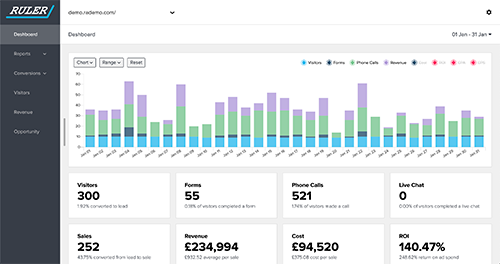
Ruler provides two core solutions focused on marketing mix modelling and multi-touch attribution. As this roundup focuses on marketing mix modelling, we’ll start there.
Ruler’s MMM uses machine learning to quantify the impact of each marketing channel on business outcomes.
It incorporates both online and offline activity, including TV, radio, and digital advertising, to provide a comprehensive view of marketing performance.
Unlike attribution models that rely solely on clicks, Ruler’s approach captures the broader influence of marketing across the entire customer journey. A key strength of Ruler’s MMM is its ability to identify the point of diminishing returns for each channel.
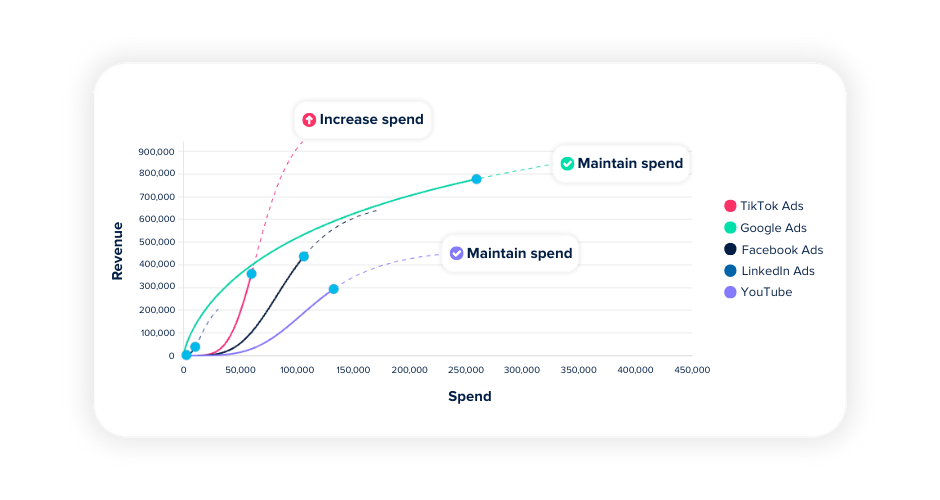
This allows marketers to understand precisely how incremental spend affects performance and where additional investment begins to lose efficiency.
Using these insights, Ruler’s Budget Optimiser recommends the optimal allocation of spend across channels, helping teams maximise ROI while avoiding wasted budget.
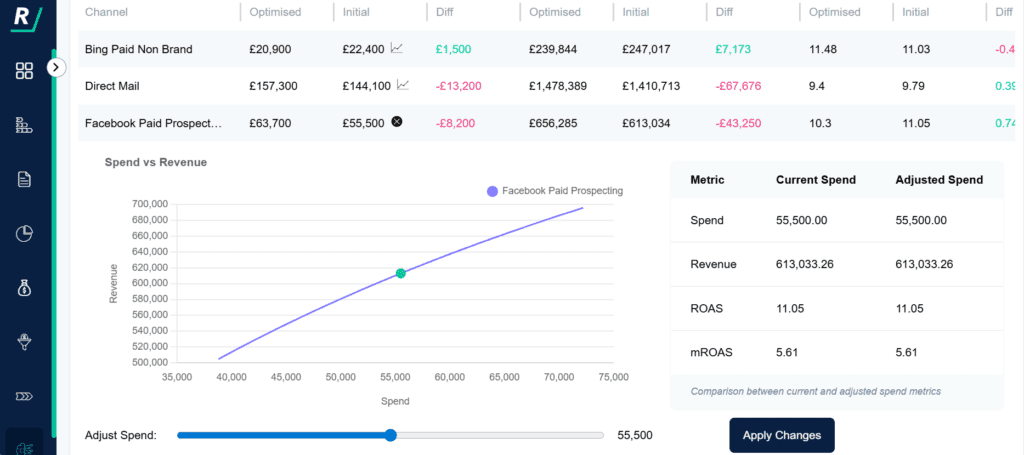
Ruler’s multi-touch attribution, meanwhile, provides a more detailed, user-level perspective.
It tracks the complete path a user takes before converting, starting with anonymous visits and connecting them to known leads through forms, calls, or live chats. The platform records traffic sources, page views, and on-site interactions to build a detailed picture of each journey.
Related: How to view full customer journeys with Ruler
This data integrates with your CRM and marketing platforms, revealing which sequences of touchpoints generate the highest-value leads.
Attribution insights can also be fed directly into ad platforms to optimise bidding, an increasingly valuable capability as measurement becomes more complex due to changes such as the decline of third-party cookies.
Together, these solutions deliver a holistic measurement framework. Marketing mix modelling provides strategic, long-term insight into how channels drive revenue over time, while multi-touch attribution offers granular visibility into the customer journeys that convert.
💡 Important note: Prices for Ruler’s MMM depend on your website traffic and what features you need (product, data, integrations), so it’s best to contact us for a personalised quote. You can do that by simply booking a demo here.
Adobe Mix Modeler is an enterprise-grade marketing mix modelling solution that helps organisations measure how different marketing activities impact business results over time.
Operating within the Adobe Experience Platform, it uses advanced machine learning and privacy-safe data to assess the incremental effect of both online and offline channels, including paid media, owned channels, and traditional advertising like TV.

Instead of relying on user-level tracking, it analyses aggregated historical data to reveal how marketing spend, seasonality, external factors, and market dynamics influence performance.
A major advantage is its integration with the Adobe ecosystem, connecting seamlessly with Adobe Analytics, Customer Journey Analytics, and Real-Time CDP. This enables marketers to combine MMM insights with broader customer data for smarter decisions.
Adobe Mix Modeler also supports scenario planning, allowing teams to simulate budget allocations and forecast their impact on key metrics.
Cassandra uses cutting-edge machine learning to analyse all your data and build a custom media plan that continuously optimises your return on investment.

Unlike other MMM tools that can take a long time to set up, Cassandra claims it can get you started in just 3 weeks. Plus, it helps you test different marketing mixes in the real world to see what works best.
Google launched a free tool called Meridian to replace LightweightMMM and track ad performance across all your channels. It’s even better than their previous option, offering more powerful features.
Meridian goes beyond just tracking – it analyses how all your marketing efforts, including ads, work together to boost sales and achieve your goals.
This translates to smarter media spending. Meridian even helps you plan your budget across channels more effectively.

To make things even better, Google plans to add its own data to the mix. This includes valuable insights like how many people saw your ads (reach) and how often they saw them (frequency) on YouTube, along with search query volume.
Meridian’s a beta program right now, so not everyone has access yet. But Google assures us it’ll be widely available soon.
Keen’s decision system empowers you to forecast future revenue performance across all marketing channels.
The platform claims to ensure a 25% enhancement in marketing-influenced revenue by incorporating your data and combining it with over 40 years of research and a decade of metadata.
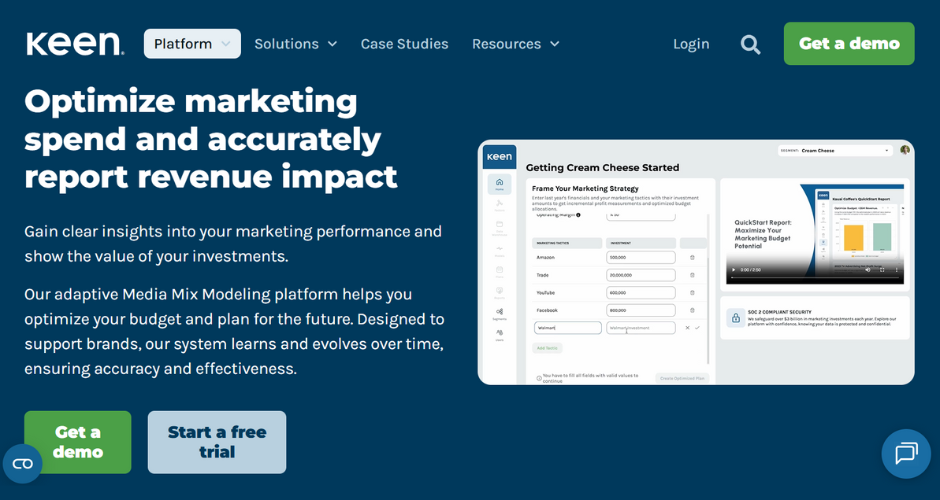
It constructs a robust marketing mix model tailored to propel your business forward, allowing you to unveil prospective revenue streams for your business across varying budget levels and anticipate potential ROI from investments in new channels before initiating testing.
Leavened is a marketing measurement technology company that was created by a team of experts in both marketing and analytics.
Their platform helps businesses increase their marketing return on investment (ROI) by streamlining the planning, measurement, and optimization processes based on consumer behaviour.

They address common frustrations in marketing measurement, such as time, cost, and lack of transparency, with their non-cookie technology tools that allow for real-time adjustments.
Developed in R and built by Sapience, Maximus harnesses machine learning algorithms and statistical methods to delve into historical data, assessing sales contributions and ROI for each activity while forecasting future outcomes.
It offers both auto and manual modelling options, supported by a recommendation engine for optimal fits.
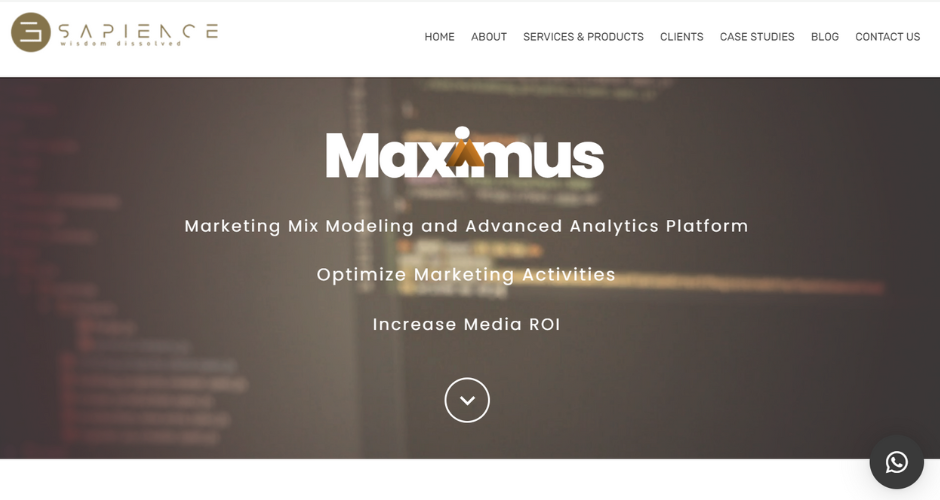
Users can effortlessly compare models, adjust variables, and categorise them into groups like media, promotion, and seasonality.
Results are presented in clear tabulated reports or visual charts, highlighting sales contributions effectively.
Meta’s Robyn is a free, open-source tool that uses artificial intelligence to unlock the secrets of your marketing data.
This powerful software is designed for businesses with extensive advertising data, especially those focused on digital and direct response campaigns.
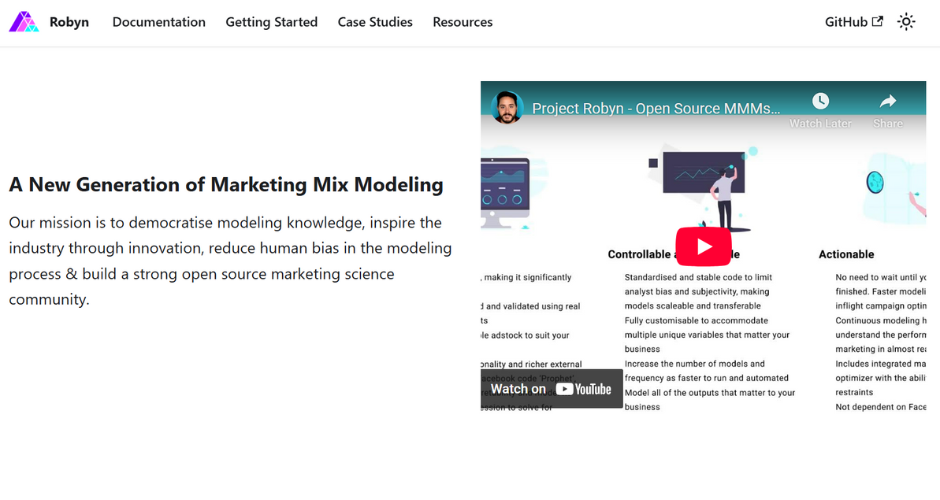
Robyn automates tedious tasks and delivers valuable insights into how your ads perform over time.
By analysing complex datasets, it helps you identify the most effective channels to reach your target audience, ultimately optimising your marketing campaigns for better results.
Nielsen marketing mix modeling empowers clients to assess their investment impact, identify effective strategies, and adjust budgets accordingly.
With sophisticated data models covering comprehensive and detailed information, it provides answers to vital marketing queries, ensuring confident decision-making for present and future campaigns.

Thanks to automated systems and seamless integration, clients gain valuable ROI insights in a matter of weeks. Tailored simulations aid in optimising the marketing mix and facilitating strategic planning in weeks that follow.
Uber’s Orbit serves as a versatile tool for predicting and analysing time series data. It’s crafted to tackle diverse time series challenges and accommodate various influencing factors.
Unlike conventional forecasting tools, Orbit employs Bayesian statistics, enabling the integration of prior knowledge to enhance forecast accuracy.
For instance, you might know that a certain marketing campaign typically leads to a rise in ridership.
Increasing privacy regulations, browser restrictions, and privacy-conscious users have made marketing measurement more complex.
MMM helps you understand the big picture of your marketing efforts, even with limited data. It considers all marketing channels and their interactions to show the true impact on your revenue.
If you’re still feeling intimidated by MMM, don’t be.
Tools like Ruler simplify the process, providing clear insights you can use to make data-driven marketing decisions.
Want to learn more about Ruler? Book a demo and see how it can validate the impact of your marketing efforts and help you increase revenue.