


We help customers implement marketing mix modeling every day at Ruler. We’re seeing stricter privacy rules limit data tracking, and digital marketers are turning back to marketing mix modeling to maintain clear visibility into marketing effectiveness.
Marketing mix modeling is making a comeback in the world of digital marketing.
From our experience as an MMM provider, we’re seeing marketers shift towards first-party, privacy-safe measurement as tracking becomes less reliable and third-party cookies are phased out. This makes it harder to measure the true effectiveness of marketing campaigns using traditional methods.
MMM is being rediscovered as a practical way to address these challenges. It uses aggregated first-party data to give a more complete, holistic view of marketing performance without relying on user-level tracking.
If you’re a marketer, now is the right time to understand how it works and start building it into your measurement approach.
Here’s what you’ll learn:
- What is marketing mix modeling
- How does marketing modeling work
- Why is MMM gaining popularity
- MMM compared to traditonal models
- How to get started with MMM
💡 Pro Tip
Tracking signals have become weaker, Journeys are more complex, and the tools most teams rely on were built for a world where clicks told the whole story.
MMM is gaining ground again because it fills the gaps that click-based measurement leaves behind. It accounts for channels that never get clicked, quantifies upper-funnel impact that usually goes unreported, and shows you where your budget is working and where it’s flattering to deceive.
Ruler offers MMM with multi-touch attribution so you’re not choosing between the two. You get the granularity of journey-level tracking and the structural view that only a statistical model can provide, built on your own verified, revenue-linked data rather than platform metrics that tend to overclaim.
If you’re heading into a budget review, trying to justify upper-funnel spend, or just suspicious that your current reporting isn’t telling you the full story, it’s worth seeing what the numbers actually look like.
Book a demo to see Ruler’s MMM in action
How we define marketing mix modeling
Marketing mix modeling (MMM) is a statistical tool that helps companies understand how each part of their marketing impacts customer behaviour, sales, and ROI.
It draws on multiple data sources simultaneously. Historical sales, media spend, pricing, seasonality, competitor activity, even macroeconomic signals like consumer confidence. It runs regression analysis across all of it to estimate how much each variable is contributing to outcomes.
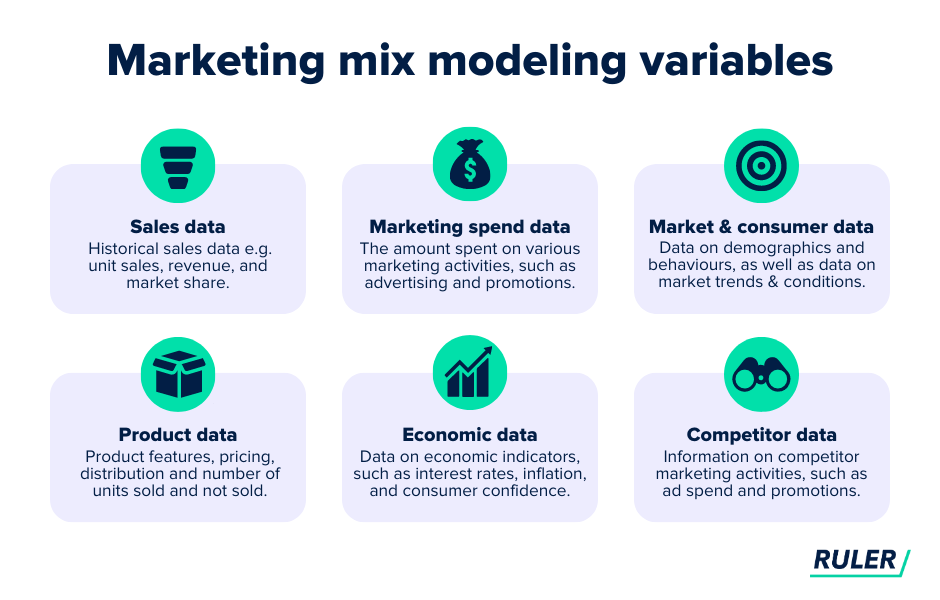
The term goes back to the 1960s, and MMM as a serious analytical discipline took off in the 1980s and 90s, largely in FMCG and big brand advertising.
Then digital tracking arrived and everyone assumed clicks were enough. Now, with Apple’s privacy updates, the decline of third-party cookies, and ad blockers everywhere, we’re back to needing something more robust.
What MMM gives you that click-based tracking doesn’t is a view of causation rather than correlation. It can account for things that never get clicked at all, like a TV ad somebody saw three weeks before they converted.
How does marketing mix modeling work?
Marketing mix modeling (MMM) uses multiple linear regression (MLR) to analyse the relationship between business results (like sales) and different marketing activities.
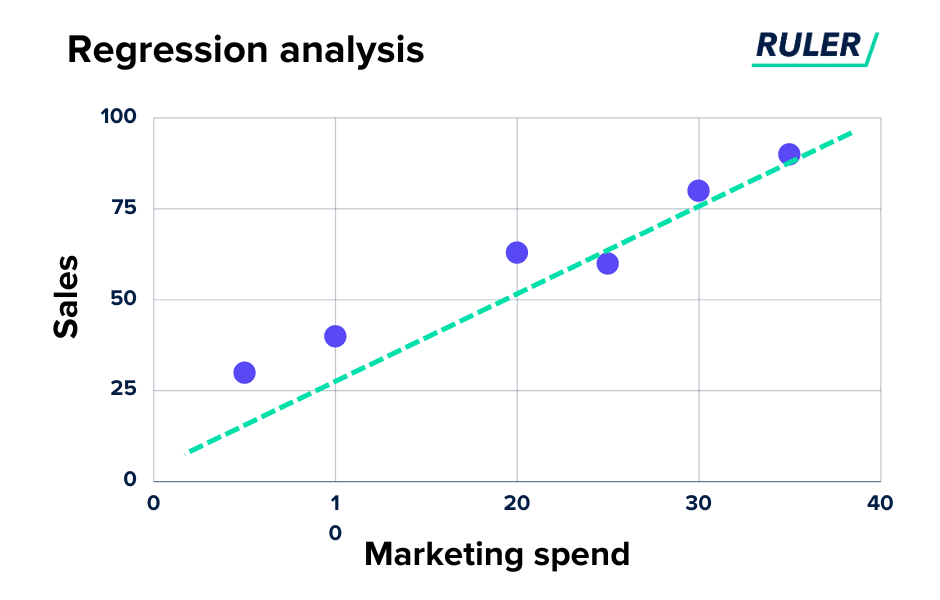
In MLR, you’re looking at how one or more independent variables (like advertising spend or price) impact a dependent variable (like sales or revenue). This helps estimate how changes in marketing tactics could affect future business outcomes.
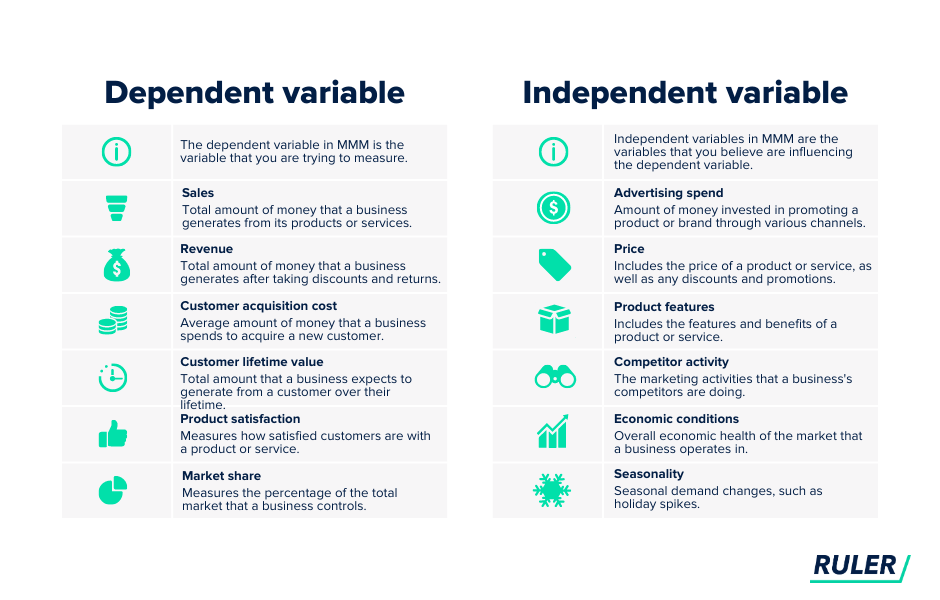
In MMM, the dependent variable is usually a business metric we care about, like:
- Sales volume – to see how different marketing activities influence sales.
- Revenue – to track how much money is being generated by sales.
- Market share – to understand the effect of marketing on your position in the market.
Independent variables in MMM are the marketing activities or factors that might drive those results, such as:
- Advertising spend – how much is invested in promotion across various channels.
- Price – to explore how price adjustments impact sales.
- Promotions – discounts, coupons, or offers that might boost sales.
- Distribution – product availability across different locations, which can influence sales.
While MLR is commonly used, other methods like time-series analysis, logistic regression, or even machine learning can be applied, depending on the needs of the analysis.
Why we’ve seen marketing mix modeling gaining popularity?
You probably already have tracking set up. Google Analytics, your ad platform dashboards, maybe some UTM reporting. So why bother with MMM on top of all that? Well, what you’re tracking and what’s actually happening are increasingly two different things.
Complex customer journeys. journeys have never been more fragmented. Someone browses an ad on Meta, searches on Google a week later, watches a review on TikTok, then converts through a branded search. Traditional click-based tools can’t stitch that together reliably, partly because of limited lookback windows and partly because so much of it goes untracked entirely.
Limited tracking signals. Tracking itself has gotten harder. Apple’s Intelligent Tracking Prevention means first-party cookies now last as little as one to seven days. App Tracking Transparency requires explicit permission before any cross-app tracking can happen. Plus, Google Analytics simply doesn’t capture things like ad impressions or the revenue impact of media spend.
Rise of privacy-conscious users. Ad blockers have become widespread, GDPR and CCPA have tightened what data can be collected, and users are more aware than ever of being tracked. The result is that the data coming into most marketing dashboards is less complete than it was five years ago, even if the dashboards themselves look just as confident.
MMM addresses most of these problems. It works at an aggregated level, doesn’t rely on individual tracking, and can factor in channels that click-based measurement ignores completely.
What we’ve seen from MMM compared to traditional models
We pulled the numbers below from Ruler’s MMM platform across a set of campaigns, and the gap between the traditional last click model is bigger than most people expect.
| Channel | Last Click ROAS | Data-driven impressionROAS | MMMROAS | MMM marginal ROAS |
| TikTok Prospecting | 0 | 2.86 | 2.1 | 1.4 |
| Facebook Prospecting | 0 | 2.55 | 4.1 | 2.6 |
| Instagram Prospecting | 0 | 2.35 | 2.3 | 1.2 |
| Google Pmax | 0.6 | 0.87 | 2.3 | 0.9 |
| Google Non Brand | 0.4 | 0.8 | 1.2 | 0.4 |
TikTok Prospecting shows a last-click ROAS of zero. Not because TikTok isn’t working, because it almost never gets the last click.
Facebook Prospecting tells a similar story, but in a different direction. A 2.55 ROAS in data-driven models, but a 4.1 in MMM. That’s because MMM picks up the halo effect that prospecting has across the funnel, things that click-based models simply can’t see.
Google Non Brand looks fine in last-click at 0.4, and it’s actually 1.2 in MMM. Still below the others, but the picture changes when you account for its role in pushing people over the line rather than introducing them to the brand.
Seeing data presented like this, we can pretty quickly identify where budget is being misallocated.
Channels that last-click ignores entirely are often doing more work than anyone realised, and channels that look strong in platform reporting are sometimes just hoovering up credit for conversions that were already going to happen.
How to get started with marketing mix modeling
To get started with MMM, you need to gather and organise your data, decide which models to use, and set up the system.
These steps typically include:
- Gathering data. To start with MMM, you need to collect data from your marketing and sales tools. This includes data on your marketing activities (e.g. media spending, ad campaigns), as well as business outcomes (e.g. sales, ROI, etc.)
- Setting up a MMM system. Once you have the data, you’ll need to set up the modeling system. This involves choosing the models you want to use, deciding on the metrics to track, and setting up the software.
- Analyse the data. This generally involves looking at the relationships between your marketing and business data and discovering insights about how your marketing activities impact your business outcomes.
- Adjust and optimise. Finally, use the insights from your analysis to adjust and optimise your marketing mix and maximise your return on investment (ROI).
These steps sound simple, but in practice, it’s quite difficult to set up successfully, especially if you’re new to the principle of marketing mix modeling.
Another option is to invest in an attribution and MMM solution. It’s less complicated and often more cost-effective than having to hire a statistician to build a marketing mix modeling system from scratch.
Take Ruler Analytics, for example.
Ruler takes the best of multi-touch attribution and marketing mix modeling to help you better understand your marketing performance and identify areas to prioritise.
It lets you see how all of your channels (online and offline) are performing and how well they can be attributed to conversions and sales.
How does Ruler’s attribution and marketing mix modeling work?
Ruler starts by tracking the entire customer journey at the visitor level on a first-party basis.
It captures the marketing source from each session, page views, UTM variables, Click IDs, and Cookie IDs which are then matched to a lead driven from a form, phone call or live chat.
Ruler passes the marketing source data you’ve captured on your leads to your CRM and other marketing tools. This allows you to enrich your leads and opportunities with attribution data so you can see exactly how your marketing impacts pipeline generation.
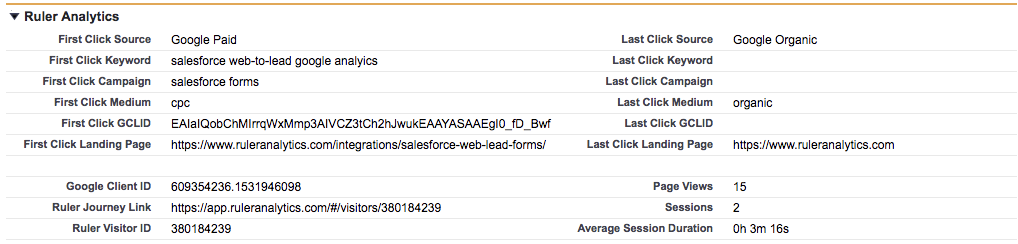
When a lead is marked as closed as won, the revenue data is sent back to Ruler. With revenue and opportunity data in Ruler, you can easily measure and validate the impact of your marketing sources, campaigns and keywords.
Now, let’s talk about its MMM.
Ruler uses marketing mix modeling alongside its multi-touch attribution to give you the bigger picture and help you understand the factors that affect your sales and ROI.
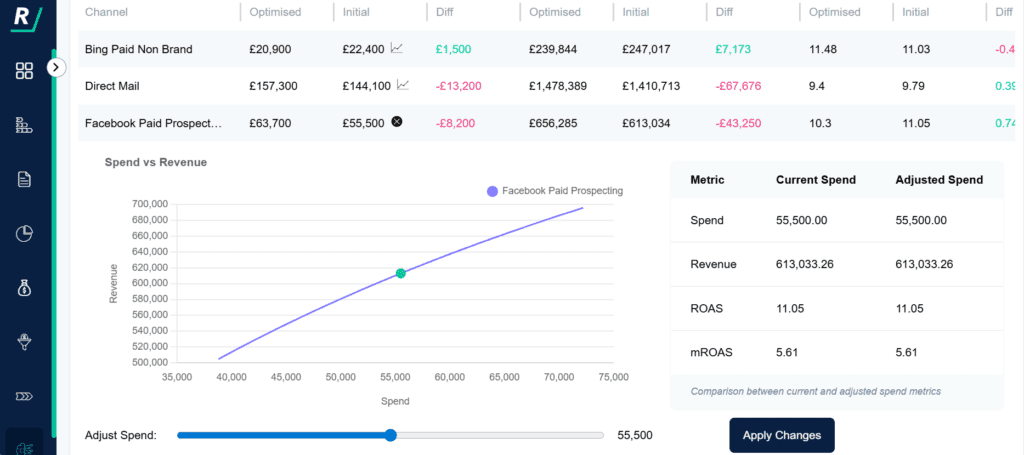
Here’s a breakdown of the five key features in Ruler’s MMM:
Impression attribution modeling
Most click-based tools like GA4 can’t measure zero-click media. Paid social, connected TV, audio ads, out-of-home. The spend is real but the contribution goes unreported, and channels that are genuinely influencing demand end up starved of budget because they can’t prove their value the way a search ad can.
Ruler solves this by combining three things that are usually kept separate: MTA data, impressions data, and MMM outputs. Together they form an attribution model that accounts for all marketing spend and engagement, not just the clicks.
Diminishing returns modeling
Ruler maps return curves for each channel, showing you where you still have headroom to grow and where you’re already past the point of efficient return.
Here’s a real example from our platform. A Facebook prospecting campaign was running at £55,500 in spend and generating £613,033 in revenue. That’s a ROAS of 11.05. The model recommended increasing spend to £60,200.
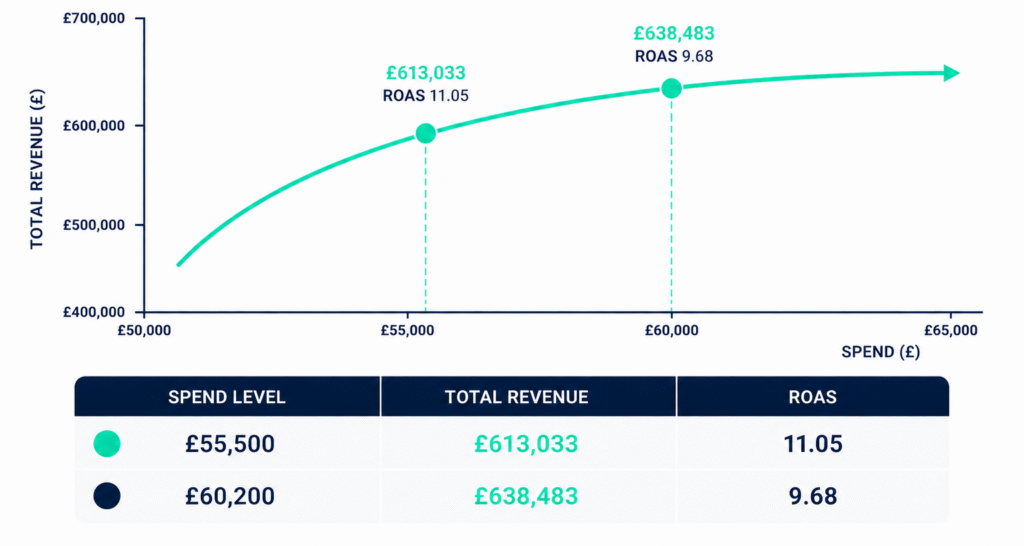
Revenue went up. To £638,483. But ROAS dropped to 9.68.
That extra £4,700 generated around £25,000 in additional revenue. Which sounds good, but the curve had already started to flatten, and the next increment would generate less still.
Seeing it laid out like this, we’d typically recommend reallocating that marginal spend to a channel with more headroom rather than continuing to push the same one.
Budget scenario planner
Ruler’s budget scenario planner lets you build multiple budget models side by side and see the projected revenue impact of each. A current plan versus a growth plan versus an efficiency plan, for example, all running simultaneously so you can compare them directly rather than toggling between tabs.
What makes it different from most forecasting tools is what it’s built on. It draws on your historical channel performance from Ruler tracking, attributed revenue by channel, CRM conversion rates, and funnel velocity data.
Not platform-reported metrics, which as we’ve shown above tend to overclaim, and not industry benchmarks that have nothing to do with your business. Your own data, modelled forward.
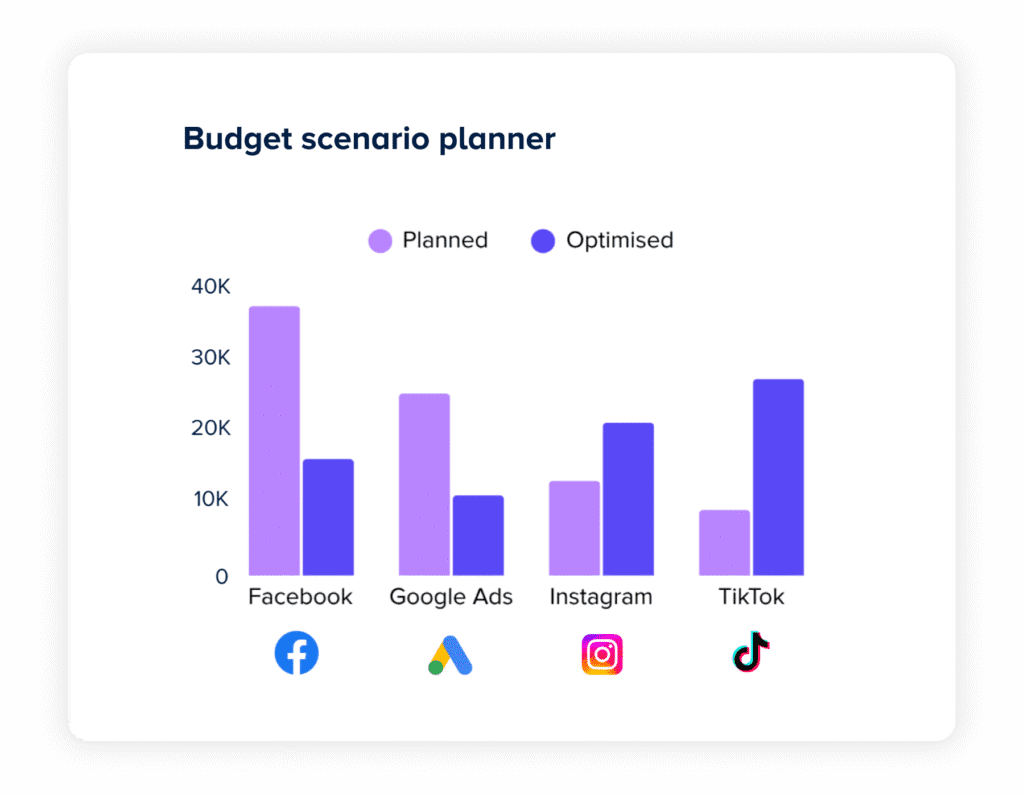
The scenario planner includes an AI media planner that lets you ask questions in plain language and get answers grounded in your actual data:
“I have a 10% budget cut coming. Where do I make it with the least damage to revenue?”
“My board wants 30% pipeline growth. What would it actually cost to achieve that at current efficiency?”
“If we shift £20,000 from Google Non Brand to Facebook Prospecting, what does the model predict?”
Book a demo of Ruler to see it in action for yourself here.
Need help getting started with marketing mix modeling?
With marketing mix modeling set up successfully, you’ll have data linking your sales to your marketing efforts.
You’ll be able to see a clear picture of your marketing wins (and losses), so you can improve and optimise your marketing strategy for maximum results.
If you’re looking for a marketing reporting system that unifies data across online and offline channels and links your conversions directly to revenue, then Ruler is for you.
It allows you to access revenue data and link it directly to your marketing activities without any of the headache of doing it yourself.

Marketing mix modeling FAQs
Marketing mix modeling is a statistical approach used to estimate the impact of different marketing activities on business performance. It uses historical data to isolate the effect of each channel, factoring in seasonality, pricing, and external influences to guide future media investment.
A marketing mix model uses statistical analysis to show how much each marketing channel contributes to sales or other outcomes. It separates marketing impact from external factors like seasonality and promotions, helping marketers optimise budget allocation across channels.
MMM works by using historical data and multivariate regression to estimate the influence of each channel on key outcomes. It controls for variables like pricing and seasonality to isolate marketing impact. The model can then predict future performance based on changes in spend or strategy.
A retail brand might use MMM to assess how paid search, TV, and radio contribute to sales. Ruler Analytics runs similar models but includes digital and offline data, such as impressions and revenue, to estimate true channel value and provide clear recommendations on where to adjust spend.
Media mix modeling focuses on the impact of paid media channels. Marketing mix modeling includes additional factors such as price, promotions, and external market conditions. MMM provides a broader view of what influences performance, not just media exposure.
You can build one in-house using regression models, or use an MMM tool like Ruler Analytics. Ruler’s platform automates data cleaning, modeling, and budget optimisation, offering statistically sound recommendations on where to allocate spend for better returns.