

How to Measure Top of the Funnel Marketing and Brand Awareness

We cover why measuring top-of-funnel and brand awareness activity matters, the challenges involved, and how to do it properly.
John Wanamaker’s century-old insight, ‘Half the money I spend on advertising is wasted; the trouble is, I don’t know which half,’ still rings true, especially for marketers focused on brand awareness and top of the funnel.
While some tools and platforms now track bottom-funnel conversions with increasing precision, upper-funnel measurement remains difficult without the right tools and systems in place.
Top-of-funnel, by nature, is hard to attribute. Yet without a clear view of how awareness builds and moves prospects into the funnel, marketing strategy risks being based on guesswork.
This guide breaks down how to measure top of the funnel and tackle the challenges of upper-funnel attribution with more clarity.
We discuss:
- What is top of funnel marketing?
- Top of the funnel metrics to measure
- Challenges of measuring top of the funnel
- Limitations of traditional measurement
- Measuring top of the funnel impact
💡 Pro Tip
Our methodology blends multi-touch attribution with techniques like incrementality testing and marketing mix modelling to give you a more complete, reliable view of what’s driving results. This allows you to make confident budget decisions, including for top-of-funnel activity. We’ve outlined the key steps in our marketing measurement framework to help you get started.
See the bigger picture with unified marketing measurement
What is top of funnel marketing?
Top of the funnel, also called TOFU, generally forms the first stage of the marketing funnel.
It essentially targets people who are not actively looking to buy. This group makes up around 95% of your potential audience.
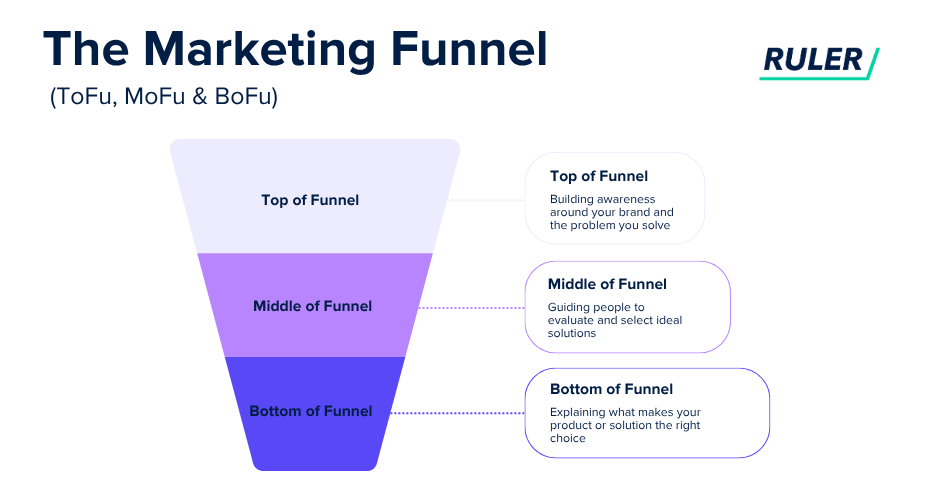
This could include those who haven’t heard of your brand, as well as existing customers who aren’t currently engaged.
The aim is to build mental availability, ensuring your brand comes to mind when a relevant need arises.
TOFU activity often differs from bottom-of-funnel (BoFu), which focuses on converting people who are already showing intent.
TOFU creates demand by increasing visibility and building credibility over time.
Common TOFU channels include brand advertising, thought leadership, and educational content. These help people understand who you are and where you fit, but don’t usually lead to immediate sales.
Its value tends to show up over time through improved mental recall and stronger performance further down the funnel, making TOFU efforts essential for long-term growth.
Key metrics for measuring top of funnel performance
Effective top of the funnel measurement starts with identifying the right signals.
Top-of-funnel marketing doesn’t rely on conversions alone, so the focus shifts to metrics that show visibility, engagement, and early intent. Below are some common examples:
Brand awareness metrics
- Aided brand recall: Measures whether people recognise your brand when shown a list.
- Unaided brand recall: Tests if people name your brand without prompts, stronger evidence of awareness.
- Brand consideration: Tracks if your brand is included in a buyer’s shortlist.
- Brand preference: Looks at whether people favour your brand over competitors.
- Share of voice: Compares how much your brand is talked about versus others in your category.
- Branded search volume: Shows how often people search for your brand by name, an indicator of demand.
Engagement metrics
- Time spent with content: Gauges how long users stay engaged with what you’ve published.
- Social media engagement rates: Measures likes, comments, and shares. Useful for tracking resonance.
- Video completion rates: Shows whether people watch your content to the end.
- Website exploration depth: Tracks how many pages people view, signals curiosity or interest.
Leading indicators
- Organic search volume growth: Reflects rising interest in your brand or products.
- Direct traffic increases: Suggests more people are seeking you out without using search or ads.
- Social media sentiment: Analyses the tone of brand mentions to assess perception.
- Email list growth rate: Indicates how many new people want to hear from you, often a result of TOFU activity.
Together, these metrics give a rounded view of top of the funnel performance, beyond impressions or reach alone.
The challenges of measuring top of the funnel
Measuring top of the funnel requires a different approach than traditional performance marketing metrics.
Unlike performance marketing at the bottom of the funnel, upper funnel activity rarely delivers immediate, measurable outcomes. The impact unfolds over time, often in ways that are hard to trace directly.
There are few reasons for this:
- Extended customer journey timelines that span weeks or months
- Multiple touchpoints across various channels and devices
- Difficulty connecting top of the funnel activities to revenue outcomes
On top of that, common measurement mistakes further blur the picture:
- Relying too heavily on last-click attribution, which undervalues TOFU impact.
- Ignoring view-through conversions (a key signal for brand influence).
- Using short attribution windows that miss delayed conversion paths.
- Failing to account for offline or untracked touchpoints.
- Not tying brand metrics (like awareness or consideration) back to revenue.
All of this makes it hard to quantify TOFU performance. But without that visibility, it’s nearly impossible to justify spend or scale what’s working.
The limitations of traditional measurement tools for measuring top of the funnel
Most marketers use tools like Google Analytics 4, CRM systems, ad dashboards, and eCommerce platforms to measure performance.
While useful for tracking conversions and managing campaigns, these tools fall short when it comes to top-of-funnel attribution.
Ad platforms like Google Ads and Meta operate with short attribution windows, typically 7-day click and 1-day view windows.
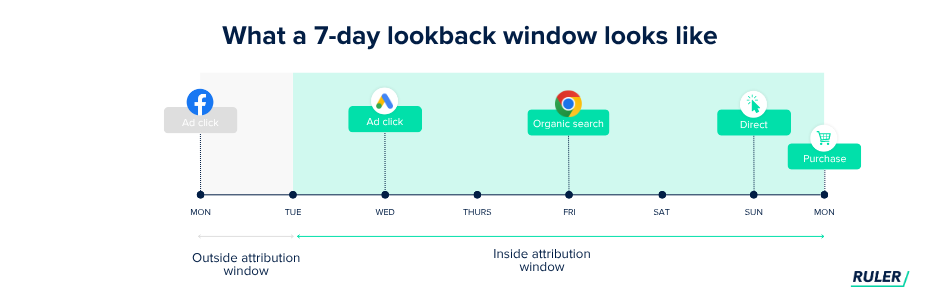
This creates a fundamental problem for TOFU attribution.
If your customer journey spans weeks or months (as many B2B journeys do, with an average of 60 touchpoints), these platforms miss the initial brand-building touchpoints that sparked the eventual conversion.
Google Analytics 4 introduces further complications. Its shift to a sample-based approach means reports are built on aggregated data rather than individual user tracking.
To make matters worse, GA4 cannot track personally identifiable information, creating a disconnect between marketing touchpoints and actual business outcomes.
When a user converts on your site, you can’t trace their journey back to the top-of-funnel marketing campaigns that initially introduced them to your brand.
Meanwhile, CRM systems capture detailed information about leads and customers but lack visibility into the marketing touchpoints that preceded conversion.
This creates silos where marketing teams can’t demonstrate the revenue impact of their marketing campaigns, while sales teams operate without understanding which marketing activities generate the highest-quality opportunities.
Measuring top of the funnel and impression-based activities with MMM
Top of the funnel is built through more than just clicks. Top-of-funnel activity often centres on exposure, not interaction.
Impressions from social media, display ads, connected TV, radio, and print all play a part.
So do offline efforts, trade shows, outbound sales, and even word-of-mouth referrals. These touchpoints rarely lead to an immediate conversion, but they influence buying decisions later.
Marketing mix modelling has regained prominence as the primary method for measuring top of the funnel and these impression-based channels.

First developed for analysing traditional media, MMM now offers a way to assess the combined effect of both digital and offline channels.
It uses statistical models, typically multivariate linear regression, to isolate the impact of each variable. These might include campaign spend, seasonal trends, competitor activity, and economic shifts.
MMM can evaluate up to 30 variables simultaneously, including:
- brand awareness metrics
- seasonality promotions
- competitor activity
- external factors.
By analysing aggregated data using techniques like multivariate linear regression, it identifies the incremental impact of different TOFU marketing efforts on revenue, providing a holistic view that encompasses both online and offline touchpoints.
Linking top of the funnel to revenue with first-party data attribution
Attributing revenue to top of the funnel efforts starts with the right data infrastructure.
Relying on platform-specific reports creates silos that miss the full picture. To measure top of the funnel activity accurately, businesses need a unified view of the customer journey that spans channels, sessions, and devices.
First-party data provides the foundation. By tracking user behaviour across multiple touchpoints, whether it’s an ad view, a website visit, or a form submission, businesses can map the path from initial awareness through to conversion.
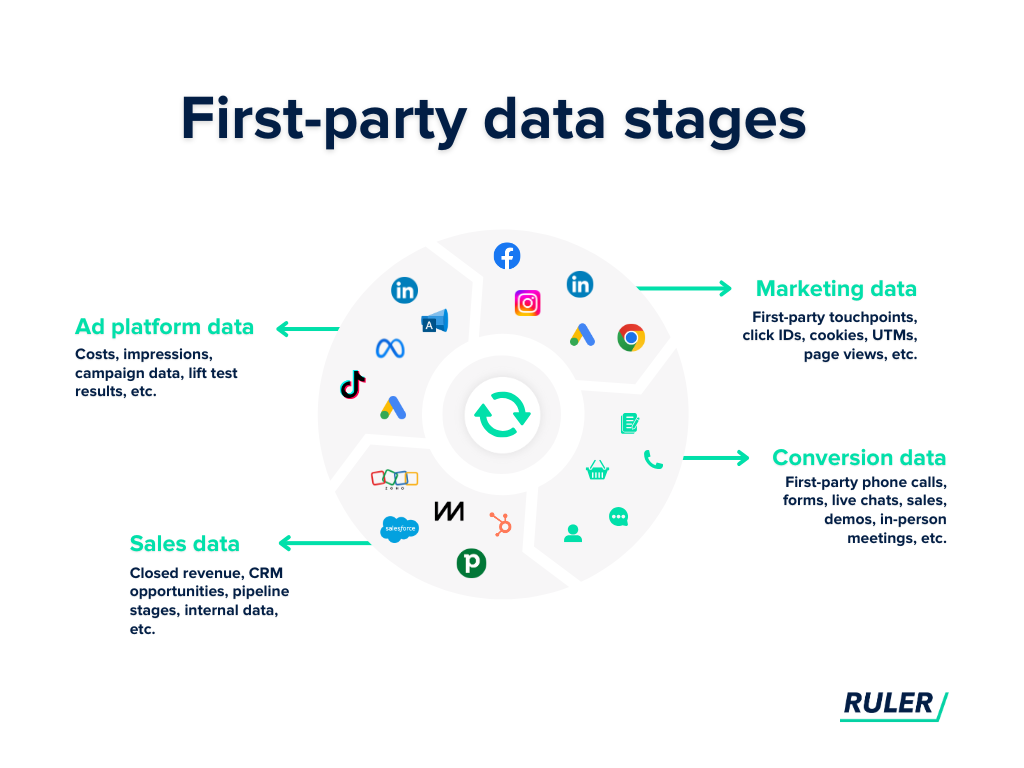
Enriching this data with CRM records allows marketers to link anonymous website activity to named leads, qualified opportunities, and closed revenue.
Traditional attribution models, like last-click, often ignore the role of early-stage marketing.
A social campaign might generate the first interaction, but when the user converts through organic search weeks later, that initial touchpoint is typically missed.
First-party data attribution corrects this by giving credit to the activities that begin the customer journey, not just those that finish it.
Unifying marketing measurement methods for better visibility
No single method can fully explain how top-of-funnel marketing drives revenue.
So far, we’ve discussed how marketing mix modelling captures the long-term impact of top of the funnel and how first-party data attribution connects individual journeys to outcomes.
Each has its strengths, but on their own, they leave gaps.
That’s why the most effective measurement strategies use triangulation. This combines multiple methodologies to get a more accurate, reliable view of what’s working.
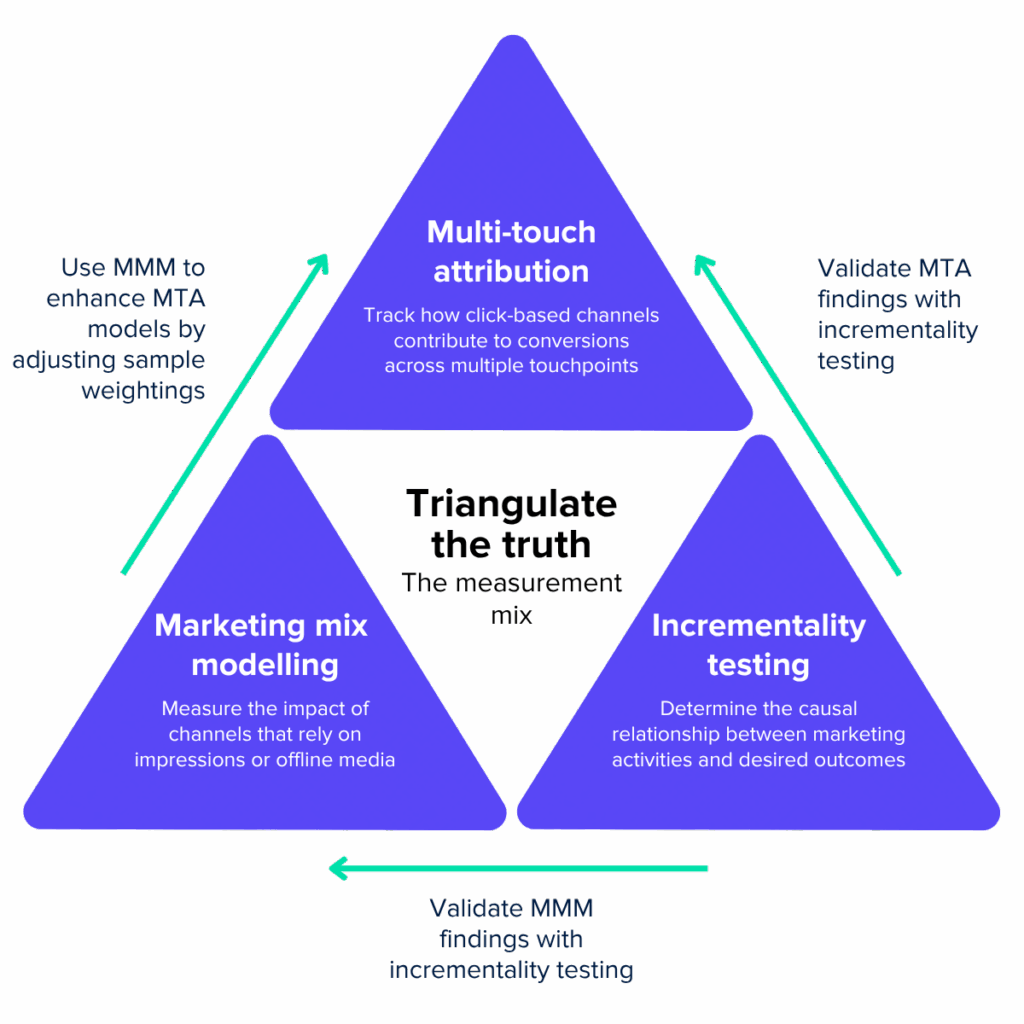
Multi-touch attribution tracks click-based interactions across the user journey. It gives detailed, real-time insight into how users engage with digital campaigns, valuable for optimising active TOFU efforts.
MMM, by contrast, looks at the broader picture. It includes offline channels, external factors, and non-click-based touchpoints, offering a long-range view of marketing effectiveness.
Marketing mix modelling offers a holistic view of all channels’ impact on business objectives, including top-of-funnel marketing and offline activities that don’t generate direct clicks.
To validate whether TOFU campaigns actually caused uplift (rather than simply coexisting with it), incrementality testing adds a third layer:
- Brand lift studies compare exposed and unexposed audiences to quantify changes in awareness, consideration, or intent.
- Econometric modelling links brand investments to business outcomes over time, while adjusting for external factors like seasonality and competition.
- Holdout testing deliberately excludes certain audiences to isolate the true incremental impact on conversions or revenue.
Taking it a step further, a DDA + Impression Model blends these approaches. It uses MMM-derived weightings to redistribute credit from bottom-funnel activities to top-of-funnel channels.
This often reveals that 50–95% of conversions should be attributed to awareness-building top-of-funnel marketing, rather than final-click touchpoints.
Activating measurement data for optimisation
Tracking top-of-funnel marketing performance is only useful if it informs decisions. Without activation, measurement is just reporting.
The goal is to use these insights to improve efficiency, targeting, and spend allocation across awareness campaigns.
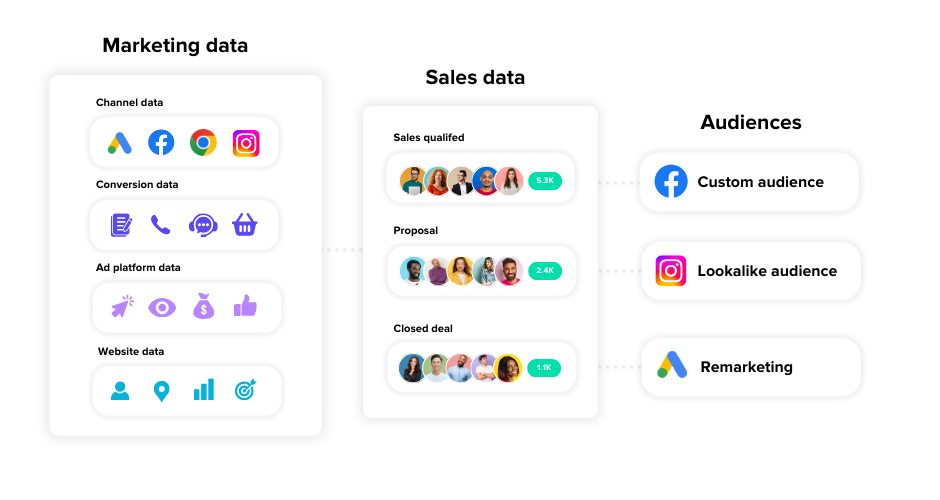
Some examples:
Platform optimisation: By sending conversion and revenue data back to advertising platforms through API integrations, you provide algorithms with the signals needed to optimise for true business outcomes rather than just clicks or form submissions in brand awareness and top-of-funnel marketing campaigns.
Budget allocation: MMM provides diminishing returns curves that show exactly where additional TOFU marketing spend will generate the highest ROI, enabling data-driven budget decisions rather than guesswork.
Audience refinement: First-party data enables sophisticated audience segmentation for measuring TOFU marketing effectiveness, allowing you to target prospects at different funnel stages with appropriate messaging while suppressing ads to existing customers.
Take the first step toward measuring top of the funnel
Measuring top-of-funnel marketing means moving beyond isolated metrics and adopting a structured, end-to-end measurement approach.
This shift demands stronger data systems and analytical rigour, but it’s necessary if you want a clear view of marketing’s true contribution.
Top-of-funnel isn’t about short-term wins. It’s about building the conditions for long-term growth.
With the right attribution and measurement in place, you can move from guesswork to clarity, ensuring that your early-stage marketing efforts are both accountable and effective.
As John Wanamaker famously put it, “Half the money I spend on advertising is wasted; the trouble is I don’t know which half.” With a sound measurement framework, you can finally start to find out.
Ruler helps you bring all the pieces together, giving clear visibility across your marketing funnel from top to bottom. To find out more, book a demo.