
If you’re using Dreamdata and starting to wonder whether there’s something better suited to where your business is heading, you’re not alone.
We talk to marketers at this crossroads fairly regularly, and more often than not, it’s not that Dreamdata is doing something wrong; rather, the business has grown beyond the context it was built for or isn’t the right fit to begin with.
Dreamdata is fundamentally a B2B revenue attribution platform, purpose-built for SaaS and technology companies with long sales cycles and digital-first buying journeys. If your business fits that profile exactly, it does that job well.
But the moment you’re operating outside it, different business model, offline sales motion, a channel mix that goes beyond trackable digital, the edges start to show.
We explore alternatives in the posts for businesses that need something better suited to their current needs.
Why look for a Dreamdata alternative?
Before getting into the tools, it’s worth understanding where Dreamdata tends to fall short. From the conversations we have with marketers, many of whom have been involved with Dreamdata, these are the patterns we see most often.
It’s built exclusively for B2B SaaS. As briefly mentioned, Dreamdata was designed with a very specific customer in mind, a B2B technology company with a digital-first buying journey, an account-based sales motion, and a CRM-driven revenue model. If that’s you, great. But if you’re running ecommerce, a mixed B2B/B2C model, lead gen across multiple verticals, or anything that doesn’t fit that narrow profile, the product starts to feel like a square peg.
There’s no offline conversion tracking. There’s no native offline conversion tracking in the sense of capturing things like phone calls or in-person interactions out of the box. Dreamdata is primarily focused on digital touchpoints fed through CRM and ad platforms. However, offline events like phone calls, meetings, or other assisted conversions can be included if they’re captured in your CRM or call tracking system and synced in as events. If those activities aren’t being properly tracked and passed into the system, then that portion of revenue won’t be attributed.
Related: How to approach to marketing mix modelling
No marketing mix modelling. Dreamdata’s measurement approach is MTA-only. That’s fine for companies where every meaningful touchpoint is digital and trackable. But as marketing budgets grow and channel mixes get more complex, TV, radio, OOH, sponsorships, brand investment, click-based attribution starts to undervalue upper-funnel activity. There’s no probabilistic modelling layer in Dreamdata to account for that.
Related: How to integrate offline data into your digital strategy & targeting
No budget forecasting or scenario planning. What we hear from marketers who’ve outgrown their attribution tool is usually some version of: “I can see what happened, but I can’t build a case for what we should do next.” Dreamdata doesn’t have MMM-driven diminishing returns curves, scenario planning, or forward forecasting built in. If you need to present a budget recommendation to a CFO, you’re doing that work elsewhere.
Pricing scales with tracked users. Dreamdata’s MTU-based pricing means costs go up as your tracked account volume grows. That can work fine at a fixed scale, but it creates unpredictability as the business grows, and we’ve spoken to teams who’ve hit surprising pricing conversations at renewal.
5 Dreamdata alternatives worth considering
The tools below cover a range of use cases, some are direct attribution alternatives, others solve adjacent problems. We’ve included honest notes on where each one works well and where it doesn’t, so you can narrow down what’s actually worth a demo.
1. Ruler Analytics
What we designed Ruler to do
Ruler was built for businesses with complex, multi-touchpoint customer journeys, across any industry, business model, or channel mix. Where Dreamdata was designed with a specific customer in mind, Ruler was designed to work regardless of who that customer is.
The core problem we kept running into was that MTA and MMM tell you different things, and most platforms make you choose one. MTA gives you granular, session-level channel data. MMM gives you a statistically modelled view of what’s actually driving revenue, including channels that don’t produce clicks. Neither is complete without the other. So we built Ruler to do both, and to combine them.
Key features
- Multi-touch attribution. First-party, deterministic click tracking across all channels with six attribution models: first touch, last touch, position-based, time decay, data-driven, and impression-based. The tracking is tied to real user journeys, not modelled estimates.
- Marketing mix modelling. Probabilistic MMM using multivariate regression across up to 30 variables. The model is auditable. You can see it, interrogate it, and use it to build a budget case that stakeholders can actually follow.
- Blended DDA model. Our proprietary data-driven attribution model combines MTA and MMM outputs to redistribute credit to upper-funnel channels that click-based attribution undervalues. One platform, one source of truth.
- Offline conversion tracking. Phone calls, form fills, live chat, and offline deal closes, all tied back to the originating marketing source. A prospect who clicked a paid social ad, did some organic research, called your team, and closed three weeks later in a CRM deal, we can attribute that revenue correctly across every stage.
- CRM enrichment. Ruler enriches lead and opportunity records inside your CRM with marketing attribution and source data. Sales reps can open a contact and see the full journey that brought that person in. That information travels with the contact.
- Budget optimisation and forecasting. MMM-driven diminishing returns curves, scenario planning, and forward forecasting built in. The tools you need to build a credible budget recommendation, not just a report on what happened.
- Upper-funnel and impression-only channel measurement. MMM specifically models TV, radio, OOH, and other channels that don’t produce click-level data. You can understand the contribution of a podcast sponsorship or billboard campaign without a UTM parameter.
Why users choose Ruler over Dreamdata
The decision usually comes down to one of a few things. Either the business has meaningful offline revenue that Dreamdata simply can’t capture. Or the channel mix has grown to include brand, TV, or OOH spend that needs a different measurement methodology. Or the marketing team needs to build a forward-looking budget case, not just a backward-looking attribution report, and Dreamdata doesn’t give them the tools to do that.
Ruler also works outside the B2B SaaS world. Ecommerce, lead gen, mixed models, agencies working across verticals, Ruler was designed to handle those contexts. Dreamdata wasn’t.
For teams where every meaningful conversion is a digital touchpoint and the business is purely B2B SaaS, Dreamdata does that particular job well. But based on the calls we have with marketers, the moment you need anything beyond that, offline data, probabilistic modelling, budget forecasting, Ruler is the more complete option.
Pricing
Ruler’s pricing scales with monthly unique visitors and is fixed for 12 months, so growth in your audience doesn’t automatically trigger a pricing conversation.
| Plan | Price |
| Entry | From £199/mo |
| Mid-tier | From £999/mo (includes MMM) |
| Blended MTA + MMM | From £1,499/mo |
Seats are unlimited at no extra cost.
2. Adinton
Where we’ve seen it do well
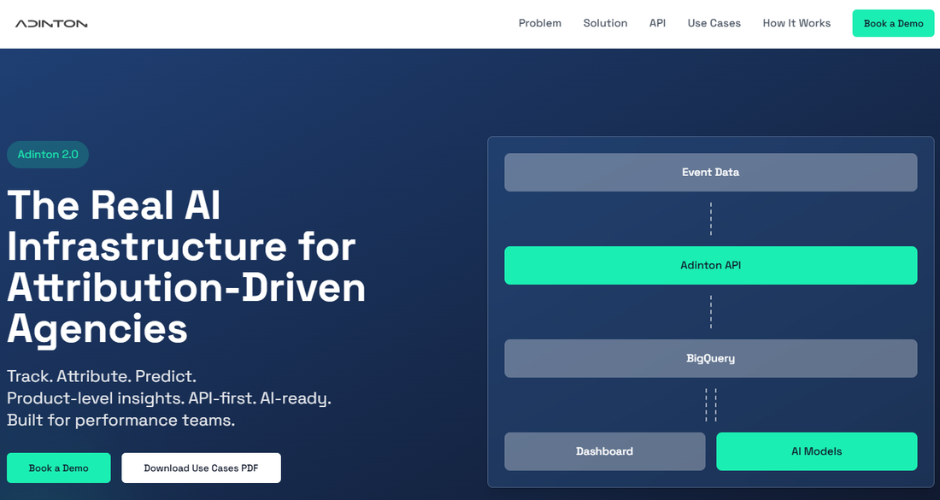
Adinton is an attribution and bid management platform that combines multi-touch attribution with automated bid optimisation. It works well for performance marketing teams that are running primarily search and paid social, and want attribution and bidding decisions to sit closer together. The integration between attribution data and automated bid adjustments is one of the things that differentiates it from more purely analytical tools. For teams that are heavily paid-channel focused and want to reduce the manual overhead of bid management, it’s worth a look.
Where we’ve seen the limitations
Adinton is fairly narrowly focused on paid digital channels. It’s not built for businesses with complex offline sales journeys or for measurement methodologies beyond click-based attribution. There’s no MMM layer, no offline conversion tracking in the way Ruler approaches it, and it’s not particularly designed for B2B account-based models or longer sales cycles. For teams where the marketing mix goes beyond paid search and social, the coverage tends to feel thin.
Pricing
Adinton’s pricing is not fully transparent and is generally quoted on request based on data volume and requirements. Entry-level plans are reported to start around €200–€300/mo for smaller accounts, with enterprise pricing negotiated directly.
3. AppsFlyer
Where we’ve seen it do well
AppsFlyer is one of the leading mobile measurement partners (MMPs) in the market, and if your business has a meaningful mobile app component, it’s hard to find something that does mobile attribution as well.
From the conversations we have with app-first companies, AppsFlyer’s strength is in its depth on mobile, SKAdNetwork measurement for iOS, deep linking, fraud detection, and the sheer breadth of ad network integrations it supports. For mobile gaming, fintech apps, and consumer apps where the majority of conversions happen in-app, it’s a well-established choice.
Where we’ve seen the limitations
AppsFlyer is fundamentally a mobile attribution tool. If your business is web-first, lead gen, or B2B with a long sales cycle, it’s not designed for your context. There’s no MMM capability, no meaningful offline conversion tracking for non-app journeys, and the web analytics layer is secondary to the mobile product.
We’ve spoken to teams who’ve tried to stretch AppsFlyer to cover web-based attribution and found it incomplete. It’s also worth noting that it can get expensive quickly once you’re at meaningful data volumes, AppsFlyer’s pricing is based on attribution events, which adds up for high-volume businesses.
Pricing
AppsFlyer’s pricing is based on attributed events (conversions). There’s a free tier covering up to 12,000 conversions per month.
Paid plans start around $0.05–$0.07 per attributed event for larger volumes, with custom enterprise pricing above certain thresholds. Costs can scale significantly for high-volume apps.
4. HubSpot Attribution
Where we’ve seen it do well
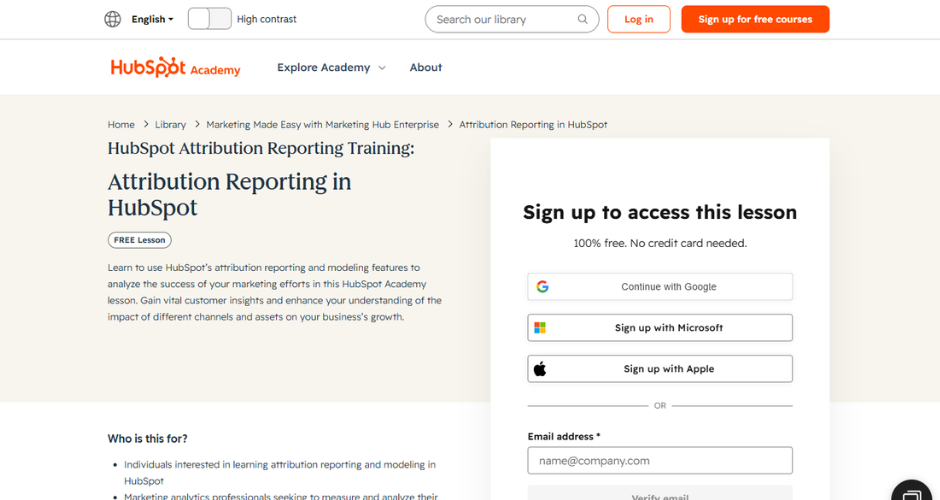
If you’re already a HubSpot customer using it as your CRM and marketing hub, HubSpot’s built-in attribution reporting is a reasonable starting point. It offers multi-touch models (first touch, last touch, linear, time decay, U-shaped, full-path) and ties attribution data to deals and revenue natively within the platform. For smaller B2B teams that don’t want another tool in the stack and just need baseline attribution on inbound channels, it can be enough. The fact that it’s already inside the CRM removes one integration headache.
Where we’ve seen the limitations
HubSpot attribution can answer basic channel questions, but it has a pretty low ceiling. From what we see, it struggles with anything that requires stitching together sessions across long time windows, it doesn’t handle offline conversions or phone call attribution, and there’s no MMM layer.
Attribution is also generally limited to HubSpot-tracked sources, which means any channel or touchpoint that doesn’t run through HubSpot’s tracking tends to get missed. For teams that want serious measurement, budget-level decisions, upper-funnel modelling, multi-session cross-device journeys, it tends to feel insufficient fairly quickly.
Pricing
HubSpot attribution features are available from the Marketing Hub Professional tier, which starts at around $800/mo (billed annually) for up to 2,000 marketing contacts. Costs scale significantly with contact volume. The full attribution reporting is part of the broader HubSpot subscription rather than a standalone tool.
5. Triple Whale
Where we’ve seen it do well
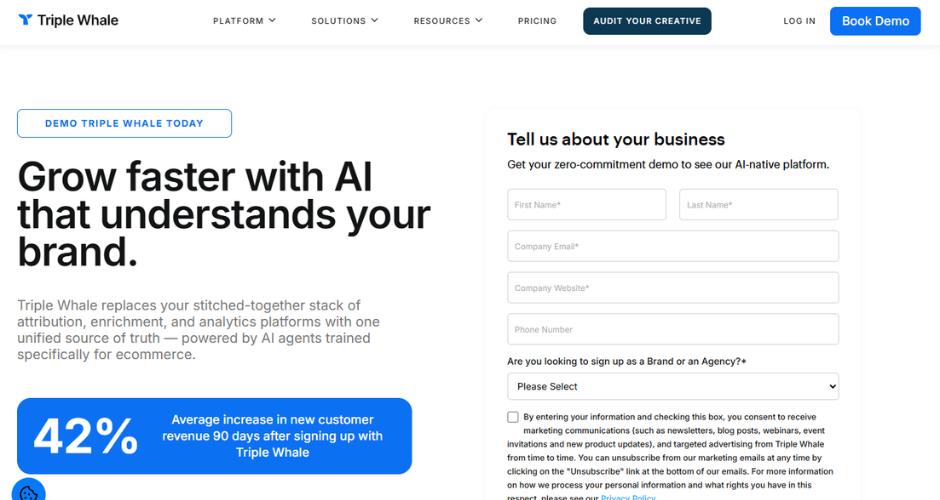
Triple Whale is an ecommerce analytics and attribution platform purpose-built for DTC (direct-to-consumer) brands, primarily those running on Shopify. If that’s your context, it’s one of the more thoughtfully designed tools in the market for that specific use case.
From conversations with ecommerce marketers, Triple Whale’s strength is in bringing together ad spend, revenue data, and attribution in a single dashboard that’s genuinely usable for the kind of teams running Meta, TikTok, and Google at scale. The creative analytics features, showing you which ad creatives are actually driving revenue rather than just engagement, come up a lot as something teams find genuinely useful.
Where we’ve seen the limitations
Triple Whale is very Shopify/DTC-specific. Outside of that context, the fit degrades quickly. It’s not designed for lead gen, B2B, long sales cycles, or businesses where offline conversions matter. There’s no MMM capability, and the attribution models are primarily last-touch or custom rule-based rather than probabilistic.
For ecommerce businesses that have grown to the point where they need to model TV spend, brand investment, or incrementality more rigorously, Triple Whale starts to hit its ceiling. It’s also primarily focused on US-based DTC brands, which is worth noting if you’re operating in the UK or elsewhere.
Pricing
Triple Whale’s pricing is based on your Shopify store’s annual revenue. Plans start at around $129/mo for stores under $1M GMV, scaling to $279/mo for stores up to $10M GMV, and custom pricing for larger brands. The higher tiers include more advanced attribution and analytics features.
Choosing the right tool
The honest answer is that the right Dreamdata alternative depends almost entirely on what’s actually driving you to look.
What we’d caution against is choosing a replacement that solves the immediate problem but inherits the same structural limitations. If you’ve outgrown click-based-only attribution, you want to make sure the next tool doesn’t just repeat that ceiling.
If you’re evaluating Ruler as part of this process and want to see how it would work for your specific channel mix, conversion types, and reporting needs, get in touch and we can walk through it. Book a demo to learn more about it.