
We discuss how wasted ad spend is created by breakdowns in tracking, attribution, and reporting, and how to identify and reduce it using more reliable measurement.
Marketing teams we talk to are trying to make good decisions with the information and data they have. The problem is that the data they have is often wrong, or at best, incomplete.
From the conversions we’ve tracked and the calls we’ve had with marketing teams across industries, a pattern keeps emerging. Spend is being allocated based on what platforms report, not what’s actually driving revenue. And the gap between those two things is wider than most people realise.
Based on our own data, 31% of marketers say proving ROI is their biggest challenge. And 28% say changes to tracking and data privacy make it even harder.
What we’ve found is that these aren’t separate problems. They’re symptoms of the same underlying issue, a breakdown in signal quality that distorts every budgeting decision downstream.
This guide is about recognising where that breakdown happens, understanding what it costs, and then working through practical steps to fix it.
- How we see marketers wasting ad spend
- What is the ultimate cost of wasted ad spend
- How to identify if you have a wasted budget problem
- Marketing mix modelling and diminishing returns
💡 Pro tip
Most wasted ad spend comes from siloed reporting across platforms and tracking limitations. Ruler unifies your marketing and revenue data so you can clearly evidence what’s driving true incremental impact, and where spend is being misattributed or wasted.
Book a demo to how it does it
How we see marketers wasting ad spend
Most wasted ad spend isn’t a result of bad decisions. It comes from blind spots in how performance is tracked, attributed, and interpreted.
Limited signals due to privacy changes. Apple’s App Tracking Transparency and the deprecation of third-party cookies have removed a lot of visibility. A meaningful proportion of conversions are now either untracked or underreported, and because the impact falls unevenly across users and browsers, the distortion in your performance data is hard to spot unless you’re actively looking for it.
Ad platform reporting that doesn’t tell the full story. Every platform uses its own attribution model, its own conversion windows, and its own rules for what counts. Because each one reports independently, the same conversion can be claimed multiple times across platforms. Your total reported conversions will almost always be higher than what actually happened, and your ROAS figures will look healthier than they are.
Too much weight on the last click. Last-click attribution gives full credit to the final touchpoint before conversion, which systematically undervalues everything that came before it. Awareness campaigns, prospecting, upper-funnel content, all of it gets passed over. Credit flows to branded search and retargeting because they sit at the end of the journey, not because they created the demand.
Missing revenue and conversion data. Conversion data being sent back to platforms slowly or incompletely leaves algorithms optimising from stale signals. Bidding drifts and campaigns start optimising toward proxies rather than actual revenue. Cost per lead can look stable while lead quality quietly falls.
Long sales cycles that attribution windows can’t cover. Default attribution windows of seven days or less don’t reflect how people actually buy when a decision takes weeks or months.
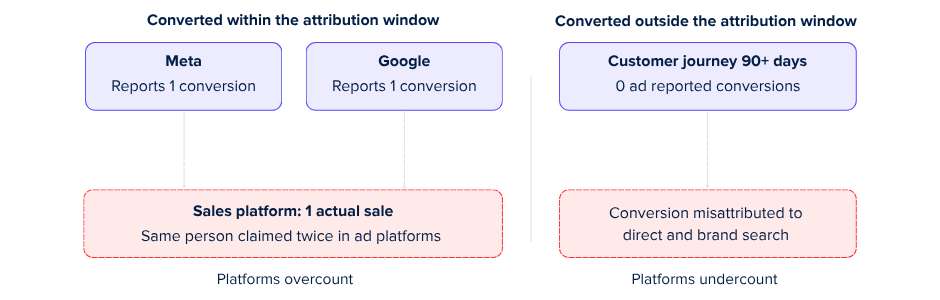
Early touchpoints fall outside the window and receive no credit, making upper-funnel campaigns look like they’re underperforming when the real issue is the measurement framework.
What is the ultimate cost of wasted ad spend
The true cost of wasted ad spend isn’t just the money lost, it’s the compounding impact it has on growth, decision-making, and how future budgets get allocated.
Misallocation of future budget. The immediate consequence of poor attribution is that budget moves in the wrong direction. Channels that appear to perform well get more money. Channels that are genuinely driving demand but don’t show up clearly in platform reports get cut or held flat. What we’ve found from calls with marketing teams is that this compounds quickly. Strong upper-funnel channels get underfunded. Weaker or already-saturated channels absorb more spend. And because the underlying data is skewed, each new budget decision reinforces the previous one. It creates a loop that’s genuinely difficult to break without stepping back and questioning the signals you’re optimising from.
Inflated confidence in growth. Wasted spend has a tendency to make performance look better than it is. ROAS appears healthy. Cost per acquisition looks stable. Revenue seems to be growing. What’s harder to see is how much of that apparent growth is coming from cannibalised demand or from conversions being attributed to channels that didn’t genuinely earn them. This isn’t a small issue. Based on the conversions we’ve analysed, only 64.4% of marketers are actually measuring revenue, which means a large proportion are making budget calls based on metrics that are at best proxies for the thing they actually care about.
Broken learning signals for ad platforms. Modern ad platforms are increasingly dependent on machine learning. And machine learning needs good feedback to improve. When the conversion signal is polluted, when it’s incomplete, delayed, or systematically skewed, the platform’s algorithms learn from that bad signal. They start optimising toward audiences and behaviours that look like conversions in the data but don’t represent genuine high-value customers in the real world. What reads as campaign efficiency is often just optimisation toward the path of least resistance, the easiest-to-track users rather than the most valuable ones. And this kind of drift happens gradually, which is exactly what makes it so hard to spot.
Reduced incremental growth. One of the patterns we see fairly consistently is teams inadvertently paying twice for the same customer journey. Prospecting or awareness activity creates the demand. Retargeting or branded search then captures it. And when the budget conversation happens, branded search looks like the winner because that’s where the attribution credit lands. The danger is that over time you end up funding only the channels that close, while systematically underfunding the channels that initiate. You’re not growing the pool of potential customers. You’re just getting more efficient at converting the ones who were already on the path.
Lost confidence in leadership. When marketing performance signals are inconsistent or hard to interpret, leadership gets cautious. Budget approvals become more conservative. Scrutiny increases. And the longer-term result is that teams become less willing to experiment, less able to make the case for new channels, and slower to move when opportunities do appear. We’ve seen this happen in organisations where attribution is genuinely broken. It’s not just a data problem. It starts affecting culture and decision-making speed in ways that are quite hard to reverse.
How to identify if you have a wasted budget problem
You can only identify wasted ad spend by comparing platform-reported performance against independent revenue and customer data.
Compare platform-reported conversions against your CRM or revenue data
The most direct diagnostic is also the simplest. Pull the conversions each platform claims for a given period, then cross-reference those numbers against the deals or purchases actually recorded in your CRM or commerce platform.
If there’s a significant gap, and there usually is, that gap tells you how much double-counting is happening and how far off-base your platform reporting is. It also tells you that your platforms are likely optimising toward a version of conversion that doesn’t match what’s actually happening in your business.
Implement first-party tracking at an individual level
The foundation of everything else is capturing what actually happens at an individual user level across the full journey. UTMs, click IDs, session data, page view sequences, all of it needs to be collected and stored in a way that persists across multiple visits and sessions.#
Related: 4 steps to create a first-party data strategy
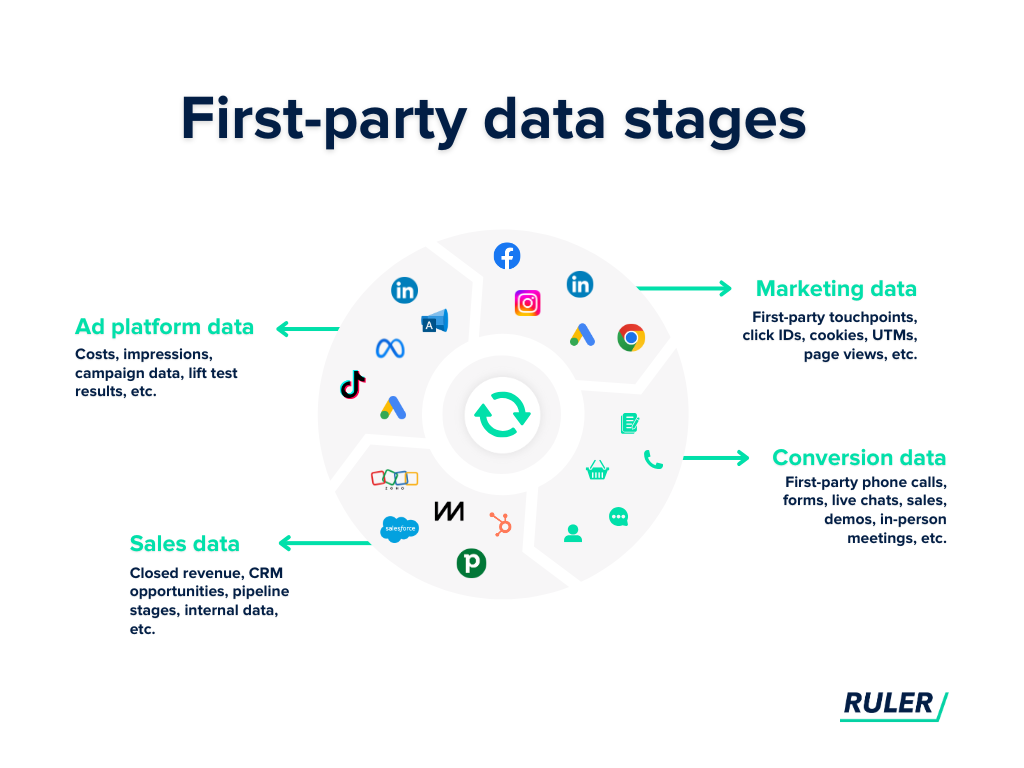
Most analytics tools aggregate this data or strip out individual detail before it becomes actionable.
What you need is tracking that keeps the individual journey intact. Which channel first brought this person to you, what they did across subsequent visits, and what eventually prompted the conversion. That granularity is what makes attribution meaningful rather than approximate.
Move beyond last-click attribution
Once you have reliable first-party data, you can start interrogating the full journey rather than just the last step. Multi-touch attribution models, even simple ones, give you a more accurate picture of which channels are contributing across the funnel and not just which channel happened to be there at the end.
What we’ve found from the conversions we’ve analysed is that this shift consistently changes how teams think about their upper-funnel spend. Things that looked like they were underperforming start looking quite different when you’re crediting them for the role they actually played.
Link your tracking to actual revenue
Marketing attribution helps prove ROI, which is something 44% of respondents in our research pointed to explicitly. And 25% said attribution is what justifies their digital spending. But attribution only does that job if it’s connected to actual revenue figures, not just conversion events.
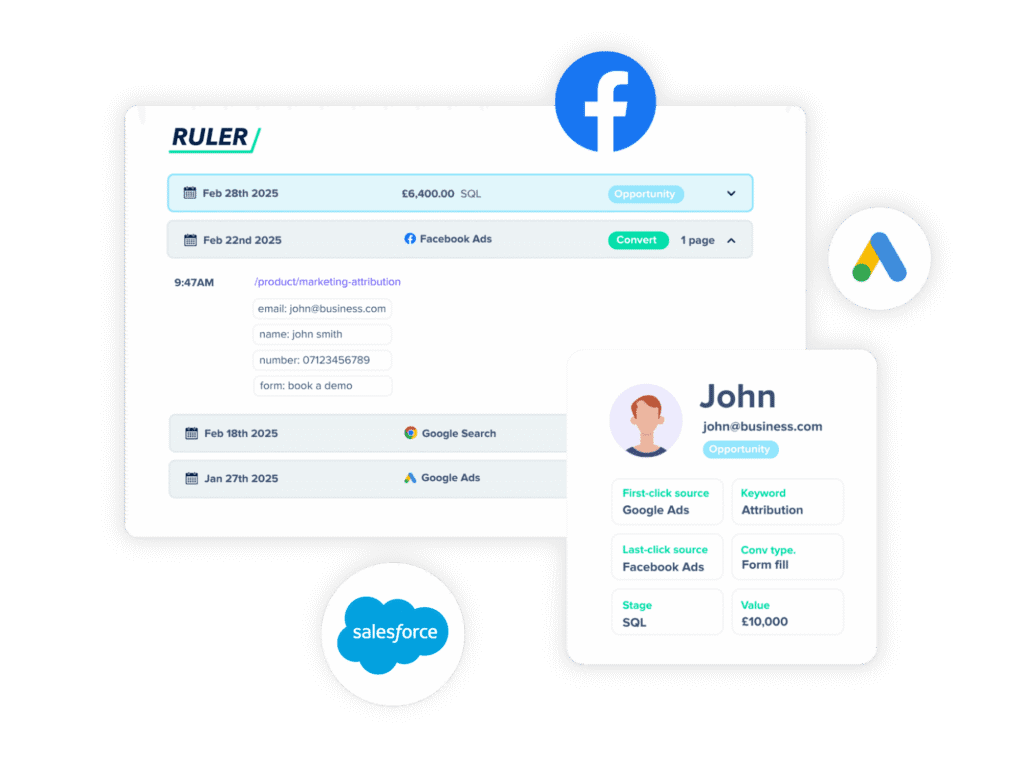
That means linking your tracking through to your CRM, your ecommerce platform, or wherever revenue is actually recorded. It means closing the loop between the marketing data and the financial data, so that the attribution model is working with real numbers rather than proxy metrics.
Send revenue signals back to ad platforms as offline conversions
Once you have that link in place, the next step is feeding it back. Offline conversion matching, where you send CRM-verified revenue data back to your ad platforms, gives the algorithms real signal to optimise from rather than the incomplete in-platform data they’d otherwise rely on.
Related: First-party data activation: A smarter path to better ad targeting
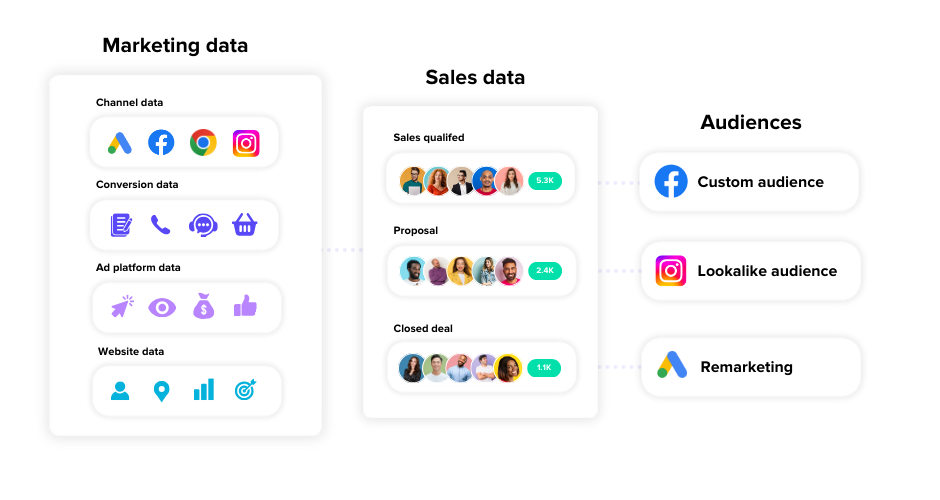
This is one of the more underused levers we see. The platforms can actually use this information to improve bidding and targeting. But only if you give it to them. And most teams aren’t doing this consistently.
Why marketing mix modelling shifts how you think about performance
There’s a limit to how far deterministic tracking can take you. It captures what it can measure. It doesn’t capture everything that influences outcomes.
Impression-based campaigns, connected TV, out-of-home, traditional media, seasonal market shifts, competitive activity, all of these things affect performance. None of them leave the kind of fingerprint that standard attribution can pick up. And if you’re only working with deterministic signals, your view of what’s driving your results is incomplete.
Marketing mix modelling adds another layer. Rather than tracking individual users, it models the relationship between spend inputs and revenue outputs over time, across all channels including the ones that don’t generate clicks. When there’s enough historical data to work with, it can surface patterns that attribution alone would never find.
We worked with a global travel brand that had been investing in Connected TV across two brands for several years. The team had conviction in the channel, but conviction wasn’t enough when it came under scrutiny from senior leadership.
CTV doesn’t generate clicks. It builds awareness gradually, in a way that influences behaviour downstream without leaving a fingerprint in standard attribution.
By running marketing mix modelling across 100 weeks of historical data, the model had enough range to detect the delayed, compounding effects of that brand-building activity. And it showed, concretely, what happened to revenue if CTV spend increased or was cut. When the model ran, the long-term brand awareness effects of CTV showed up clearly.
A positive ROAS, a meaningful headroom for further investment, and across a system that attributed $400 million or more in revenue across online and offline channels, CTV earned its place.
That’s the kind of visibility that deterministic tracking simply cannot provide.
Marketing mix modelling and diminishing returns
One of the most practically useful things MMM does is identify where diminishing returns begin. Every channel has a point at which additional spend stops generating proportional returns. Finding that point before you hit it is where a lot of efficiency gains actually live.
Related: How marketing mix modelling transforms budget planning
Here’s a real example drawn from within Ruler’s platform. A Facebook prospecting campaign is running at £55,500 in spend, generating £613,033 in revenue, a ROAS of 11.05x. Ruler’s Budget Optimiser recommends increasing spend to £60,200. At that level, projected revenue rises to £638,483, with ROAS adjusting to 9.68x.
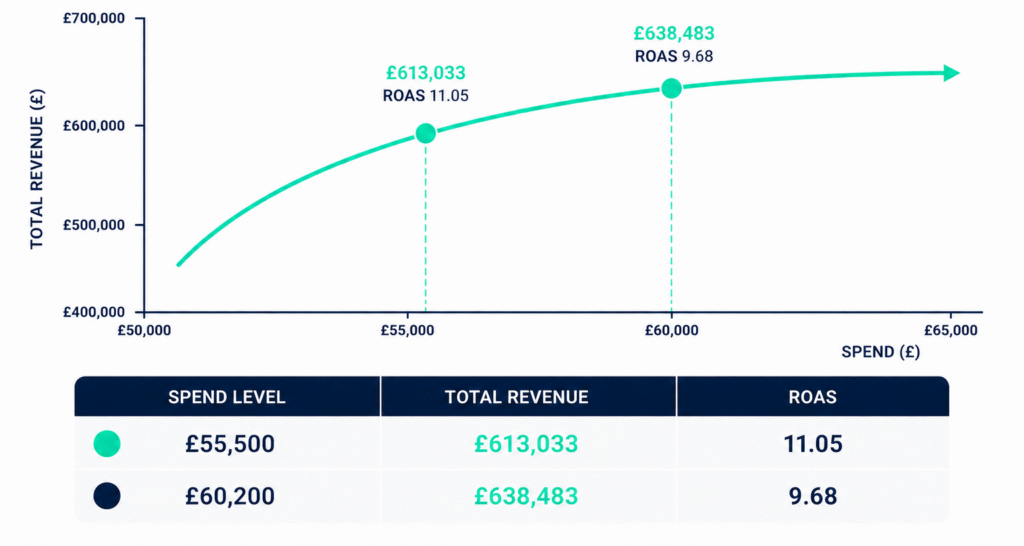
That incremental £4,700 in spend generates approximately £25,000 in additional revenue. But the curve has begun to flatten. The model is signalling that further increases beyond this point will see diminishing returns accelerate. The recommendation isn’t simply spend more. It’s spend this much more, and here is exactly where the efficiency starts to erode.
That’s the kind of decision support that changes how budget conversations happen. Not just what’s working, but how hard you can push it before the returns stop justifying the investment.
Ruler’s budget scenario planner brings this together by combining your tracked revenue, MMM outputs, and channel performance curves to model what happens as you shift spend across your mix.
Instead of relying on gut feel or platform-reported ROAS, you can test scenarios before committing budget. You can see what happens if you move £10,000 between channels, scale areas with headroom, or reduce spend where returns are flattening.
Take the first step in reducing ad marketing spend
The way we’d frame this is simple. Start with the signal, make sure what you’re tracking and reporting is reliable, build the model on top of that foundation, and then use it to make budget decisions you can actually defend.
Most of the waste we see in ad spend isn’t the result of bad intentions or careless decisions. It’s the result of teams working from incomplete information and not realising it. The platforms make it easy to feel confident, dashboards look clean, and the numbers move in the right direction.
But based on the conversions we’ve analysed and the teams we’ve worked with, what looks like performance and what is performance are often quite different things. Closing that gap is where the real efficiency gains are.
If you want to see how Ruler can help you track revenue back to source, reduce attribution gaps, and model your spend more accurately, get in touch with our team.