

How omnichannel marketing can support sustained growth when lead generation plateaus.
Many marketing teams operate with a high level of discipline and consistency. Newsletters are sent on schedule, social content is planned in advance, blog articles are published regularly, and email campaigns run continuously.
From an operational perspective, the marketing function appears healthy. Campaigns are live, processes are in place, and activity levels remain high. However, despite this sustained effort, lead volume often remains static over extended periods of time.
This situation is common across B2B organisations at various stages of growth. In most cases, it is not the result of poor execution, weak messaging, or insufficient effort. Instead, it reflects structural limitations in how marketing channels and touchpoints are integrated and coordinated.
This article explores why marketing performance can plateau even when best practices are followed, and how an omnichannel marketing strategy can help create seamless customer experiences, expand reach across multiple touchpoints, and support long-term growth.
What this article covers:
- Why marketing performance can plateau
- How channel fragmentation impacts marketing performance
- Where traditional marketing strategies tend to focus
- How omnichannel marketing supports growth
- How to measure performance across channels
Key takeaways
Many B2B organisations operate channels in isolation, creating disconnected customer experiences.
Concentrating investment in single channels without integration can limit growth potentialA significant portion of the market interacts with brands across multiple channels before converting.
Omnichannel marketing expands reach and creates cohesive experiences by coordinating across touchpoints.
Measurement frameworks should reflect the complete customer journey across all channels, not only individual channel performance.
Why marketing performance can plateau
When marketing leaders observe that lead generation has stabilised, the root cause is often related to channel fragmentation and integration rather than tactical execution.
Many commonly used channels operate independently, with separate strategies, messaging, and metrics. Email campaigns reach existing contacts with one message, social content delivers different messaging to followers, display advertising targets website visitors with varying creative, and search advertising operates with its own keyword strategy and landing pages.
These channels play an important role in capturing demand. However, when they function in silos, they create a disjointed experience that reaches only a limited portion of the total addressable market in a meaningful way.
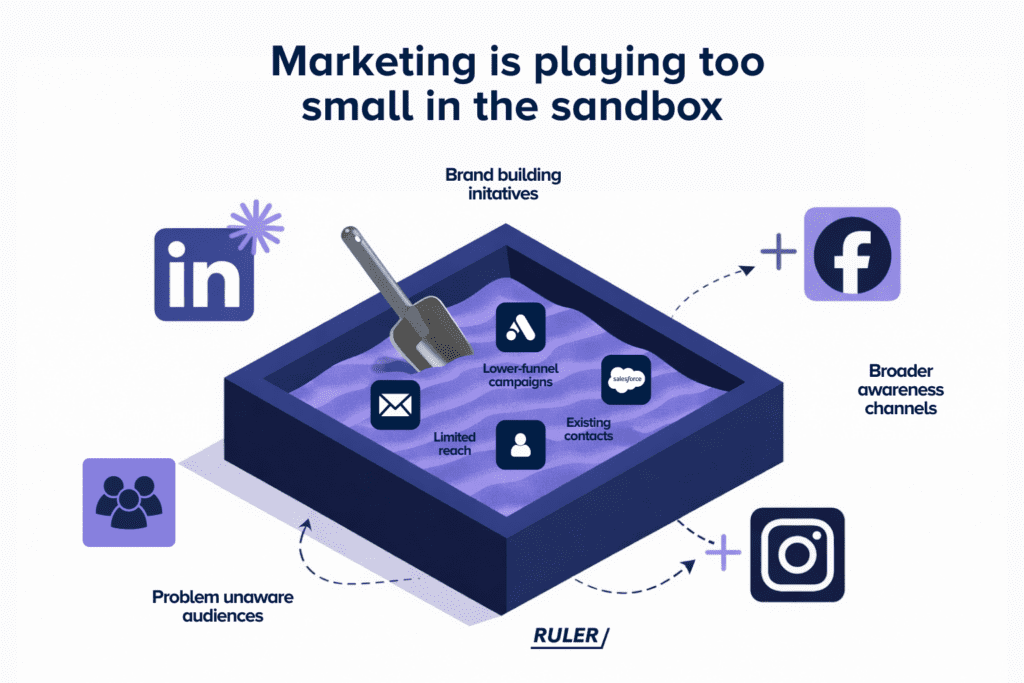
Industry research frequently suggests that B2B buyers engage with multiple channels before making a purchase decision. When marketing activity does not provide consistent, coordinated experiences across these touchpoints, engagement becomes fragmented and growth can naturally slow.
This dynamic creates a situation where marketing efforts continue across multiple channels, but results remain consistent rather than increasing.
Channel fragmentation as a limiting factor
Marketing outcomes are ultimately constrained by how effectively channels work together to create cohesive customer journeys. When campaigns operate independently without coordination, the cumulative impact becomes diluted over time.
Even with strong performance in individual channels, optimisation can only improve results within the boundaries of isolated channel strategies. If customers encounter inconsistent messaging, disconnected experiences, or gaps between channels, conversion rates are likely to remain static.
Related: Why GA4 and ad platform data don’t match and what to do
In competitive markets, this effect is amplified. Customers interact with multiple touchpoints across various channels before making decisions. Organisations that provide fragmented experiences struggle to maintain engagement throughout the journey, increasing costs and reducing differentiation.
Over longer time horizons, organisations that invest in coordinated, integrated channel strategies often develop stronger brand recognition and customer relationships. As customers progress through multiple touchpoints, they experience continuity and consistency, which builds trust and familiarity.
Common patterns we see in marketing strategies
Several patterns frequently appear in organisations experiencing consistent but limited growth:
1. Channel-specific optimisation without integration
Many teams optimise individual channels in isolation, focusing on channel-specific KPIs. Search advertising is optimised for keyword performance, email for open rates, social for engagement metrics, and display for click-through rates. While these channels may individually perform well, they often fail to create a cohesive customer experience or reinforce each other effectively.
2. Inconsistent messaging across touchpoints
Content and messaging vary significantly between channels, often managed by different teams or specialists. A customer might encounter educational content on LinkedIn, product-focused messaging in email, promotional offers in display ads, and technical content in search results, all without clear connection or progression.
3. Disconnected data and attribution
Customer interactions are tracked separately by channel, making it difficult to understand the complete journey. Performance is assessed through channel-specific metrics rather than integrated customer behaviour, leading to incomplete understanding of what drives conversions.
These patterns are not indicative of ineffective marketing. Rather, they reflect traditional approaches to channel management that prioritise channel efficiency over customer experience.
How omnichannel marketing supports growth
Omnichannel marketing is designed to create seamless, integrated experiences across all customer touchpoints, ensuring consistency in messaging, branding, and customer journey progression regardless of how or where customers engage.
Rather than optimising channels independently, omnichannel strategies coordinate resources and messaging to provide continuous, connected experiences as customers move between touchpoints throughout their decision-making process.
This approach acknowledges that purchasing journeys involve multiple channels, devices, and interactions, and that the quality of experience depends on how well these elements work together.
Creating integrated customer experiences
A significant portion of potential buyers interact with brands across multiple channels before making decisions. They might discover a brand through social media, research on the website, engage with email content, see display advertising, search for specific information, and eventually convert through a different channel entirely.
Omnichannel marketing ensures that each of these interactions reinforces the others. Messaging is consistent but adapted appropriately to each channel’s context. Customer data flows between systems to enable personalisation and continuity. Transitions between channels feel natural rather than disjointed.
This type of integration helps customers progress through their journey more smoothly and recognise that they’re engaging with a cohesive brand experience.
Coordination as a driver of performance
Channel coordination plays a central role in omnichannel marketing. Its purpose is to amplify the effectiveness of each touchpoint through strategic integration. Examples include:
- Aligning messaging themes across all channels while adapting format to each platform
- Using insights from one channel to inform strategy in others
- Creating sequential experiences that guide customers from awareness to conversion across multiple touchpoints
- Ensuring brand consistency in visual identity, tone, and value proposition
The objective is not channel efficiency in isolation, but cumulative journey effectiveness. Over time, this coordination contributes to stronger engagement, higher conversion rates, and improved customer relationships.
Integration and consistent exposure
Effective customer engagement is built through consistent, coordinated exposure across multiple touchpoints rather than single channel interactions. Omnichannel marketing therefore places emphasis on integration as well as channel execution.
This may include:
- Cross-channel campaign coordination with unified themes and sequencing
- Data integration to enable personalisation based on cross-channel behaviour
- Consistent remarketing strategies that adapt based on customer journey stage
- Connected experiences between online and offline touchpoints
Each interaction builds upon previous ones, creating cumulative recognition and supporting progression through the buying journey.
It’s important to note that upper-funnel channel activity does not replace lower-funnel tactics. Instead, omnichannel integration enhances their effectiveness. As customers experience consistent messaging across multiple touchpoints, several downstream effects often follow:
- Increased recognition when encountering the brand in conversion-focused channels
- Higher engagement rates due to familiarity built across multiple touchpoints
- Improved conversion efficiency as messaging reinforces consistent value propositions
- Stronger brand recall when making purchase decisions
Lower-funnel channels tend to perform more effectively when customers have experienced consistent, integrated engagement across their journey rather than isolated touchpoint interactions.
How to measure an omnichannel marketing strategy
Traditional performance metrics are often insufficient for evaluating omnichannel strategies.
Single-channel attribution, in particular, misrepresents the contribution of coordinated cross-channel experiences. A more comprehensive measurement framework includes:
Cross-channel reach: Tracking how many people are exposed to the brand across multiple channels provides insight into journey coverage. Understanding channel overlap and unique reach is essential for evaluating integration effectiveness.
Journey-based measurement: Measuring how customers progress through touchpoints, including frequency of cross-channel interactions, time between channel engagements, and patterns of channel usage throughout the journey.
Related: How to view full customer journeys with Ruler
Channel interaction patterns: Analysing which channel combinations are most effective, how sequence of exposure impacts outcomes, and where gaps in the customer journey occur.
Unified attribution: Connecting interactions across all channels to eventual conversions provides a complete view of omnichannel impact throughout the journey.
Experience consistency metrics: Evaluating message alignment, brand consistency, and continuity of experience across channels helps identify integration gaps.
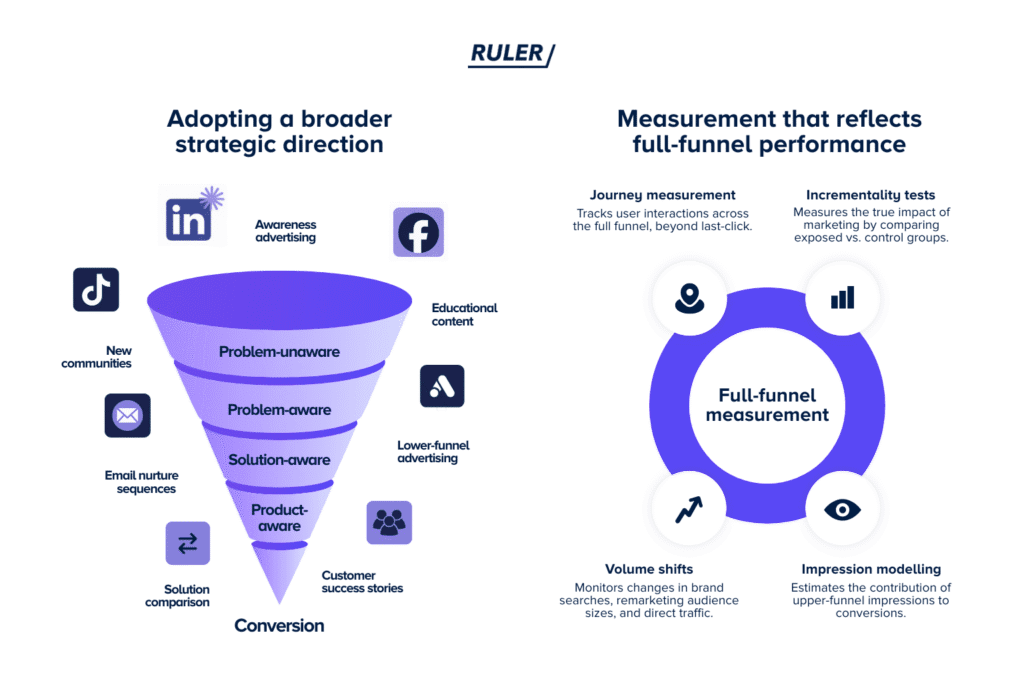
Advanced measurement approaches can help quantify the impact of omnichannel integration.
Multi-touch attribution connects interactions across channels and time, providing visibility into how different touchpoints contribute to outcomes. Marketing mix modelling uses statistical techniques to assess the contribution of channel combinations and interactions, including offline and hard-to-track impression-led efforts.
Related: Marketing mix modeling the future of measurement
Tools such as Ruler support these approaches by integrating data from all channels, enabling complete analysis of cross-channel customer journeys.
It’s important to note that omnichannel marketing typically delivers compounding returns as integration improves. The impact of coordinated experiences often exceeds the sum of individual channel performance.
As a result, performance should be evaluated using metrics that capture journey effectiveness rather than only channel-specific outcomes. Journey progression metrics provide signals of integration success before conversion rates change.
Over time, sustained investment in omnichannel integration often leads to broader reach, stronger engagement, improved customer experience, and enhanced conversion performance across all channels.
Moving forward with omnichannel marketing
Marketing plateaus are often a reflection of channel fragmentation rather than effort. When strategies optimise channels independently without coordination, growth naturally stabilises.
Omnichannel marketing addresses this limitation by integrating touchpoints throughout the customer journey, creating consistent experiences, and enabling channels to reinforce each other.
By combining strategic coordination, unified data, and appropriate measurement, organisations can move beyond channel-specific optimisation and support sustainable growth through superior customer experiences.
If you’d like to explore how omnichannel measurement and attribution can support this approach, tools like Ruler can provide the visibility required to understand impact across every channel and throughout the complete customer journey.