
When your attribution window closes before your conversions do, you’re optimising and allocating budgets on incomplete data.
There’s a pattern we see regularly when we dig into the data with teams running longer sales cycles.
The campaigns they’ve paused for underperformance? Often some of their best pipeline drivers. The channels they’ve scaled because the numbers looked strong? Frequently capturing credit they didn’t drive alone.
It’s not a case of bad calls being made, rather the measurement setup doesn’t reflect how their conversions actually close.
This comes up constantly in both B2B and B2C lead generation, but it’s not limited to either. Any time you’re selling something high-value, considered, or complex, whether that’s financial services, home improvement, enterprise software, or high-ticket B2C, the same dynamic plays out. The buyer takes time, but the attribution window doesn’t.
This post walks through exactly why that gap exists, what it tends to cost, and how to build a measurement approach that actually reflects reality.
We discuss:
- Why we see sales cycles getting longer
- Why traditional models breakdown
- How we’ve seen this impact marketers
- How to build a measurement framework for long sales cycles
💡 Pro tip
If your sales cycle runs longer than your attribution window, standard measurement will always give you an incomplete picture. Ruler connects every marketing touchpoint to closed revenue using first-party tracking and multi-touch attribution, with an unlimited lookback window, so no deal falls outside the measurement frame regardless of how long it takes to close.
Once that closed-loop is in place, Ruler feeds real revenue signals back to Meta and Google so your ad platforms are optimising on actual buyers, not form fills. And for the channels that don’t generate clicks, brand campaigns, display, offline activity, Ruler’s marketing mix modelling estimates their true contribution to pipeline, giving you a complete view across the full channel mix.
Book a demo to see how Ruler works.
Why we see sales cycles getting longer
Before we get into measurement, it’s worth acknowledging what we’re actually dealing with here, because from conversations we’ve had and the lead data we track, cycles have genuinely lengthened over the last few years. A few reasons stand out.
More people in the room. Most purchasing decisions now involve more stakeholders than they used to, across marketing, finance, legal, procurement. Even in eCommerce, big purchases often involve partners or households. More sign-off and consideration means more time.
Buyers do more research before they ever contact you. From what we see in the journeys we track, prospects are spending longer educating themselves across multiple channels before they fill in a form or pick up the phone. By the time they reach you, they may have already formed a strong view based on content, reviews, and word-of-mouth, none of which shows up neatly in your attribution data.
Internal processes have got heavier. Security reviews, budget approval cycles, procurement steps, these have become more formalised in most organisations. A deal that would have moved quickly a few years ago now has to clear several gates that simply weren’t there before.
It’s just how things work, but it makes the measurement problem significantly more acute.
Why traditional attribution models break down
The breakdown happens in a few consistent points.
The window closes before the deal does
The platform stops counting. A campaign that is actively building pipeline, warming up prospects, and contributing to deals that will close next quarter, that campaign looks like it generated zero ROI inside the window. Marketing teams, under real pressure to justify spend, cut it.
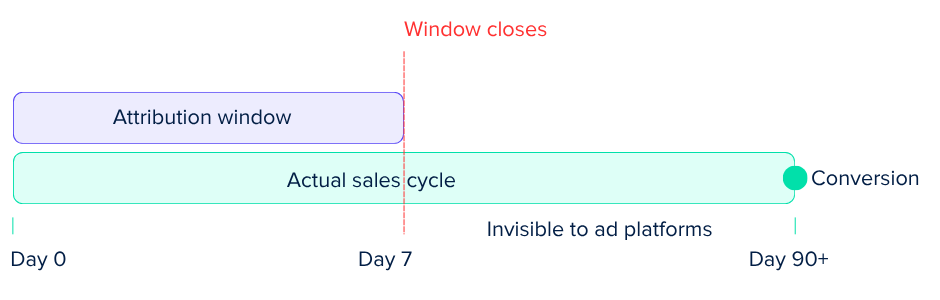
Budget flows toward whatever is generating conversions within the window, which usually means bottom-of-funnel channels sitting closest to the point of conversion. Not because those channels are working hardest, often because they’re just working last.
Last-click still dominates, and it’s still misleading
Even where attribution windows are extended, last-click is still the default in too many setups. What it does is give 100% of the credit to the final touchpoint before conversion, the branded search, the retargeting ad, the direct visit.
Related: Where last click falls short & how to blend it with modern measurement
The six months of nurturing emails, the webinar attendance, the three blog posts they read before ever raising their hand? Zero credit.
Platform reporting lives in silos
Meta measures within Meta’s ecosystem. Google measures within Google’s. From the opportunities we’ve analysed, it’s common to see both platforms claiming the same conversion.
A prospect clicks a Meta ad, comes back through a branded Google search two weeks later, and both platforms log the win.
Related: How double-counting conversions in ad platforms skews budget allocation
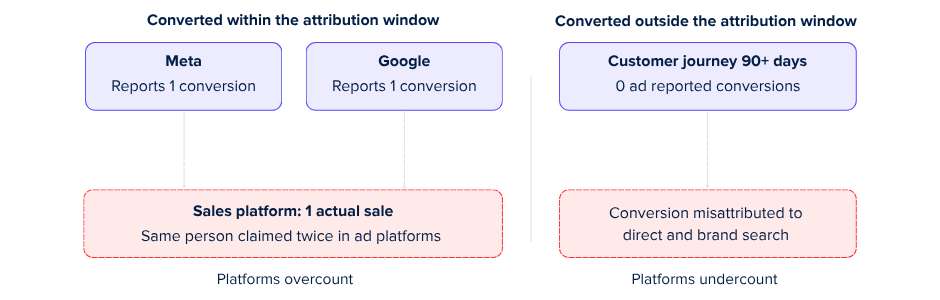
Meanwhile, if that deal closes after either platform’s attribution window has expired, neither claims it at all, even though both may have meaningfully contributed.
Impression-led channels get almost no credit
Deterministic attribution is built on clicks. That’s why paid search tends to look brilliant in platform reports, there’s a clean, trackable action at every step. But channels like TikTok, YouTube, or even display work differently. They influence through exposure, not interaction. Someone might see your product on social media, think about it for two weeks, and then search your brand name when they’re ready to act. If you’re only counting clicks, that social exposure gets nothing. The brand search gets everything. Which means you end up undervaluing the channels that seeded the demand.
How we’ve seen this impact marketers
The measurement problem doesn’t stay theoretical for long. Based on what we see when we get under the hood with teams, it tends to manifest in a few specific ways.
Budget shifts toward conversion capture, not pipeline generation. Bottom-of-funnel channels look like they’re driving results because they’re the ones left standing when the window closes. Top-of-funnel spend gets cut, pipeline generation slows, and eventually the bottom-of-funnel channels have less to capture. It tends to compound over time.
Ad platform algorithms lose their signal. Meta, Google, and others use conversion data to train their bidding. If conversions are happening outside the attribution window and those events never get reported back, the algorithm is optimising on proxies, clicks, engagement, whatever signals it can find, rather than the audiences that actually close. The result is platform-reported performance that diverges further and further from actual business outcomes.
Strategic decisions get made on incomplete data. Which channels are worth scaling? Which campaigns should be paused? If the answers to those questions are coming from attribution that’s missing the back half of the sales cycle, you’re making confident decisions based on a distorted picture.
Leadership loses confidence in marketing’s numbers. When reported performance consistently fails to match business outcomes, pipeline is down but platform dashboards look green, or campaigns get cut right before deals start closing, it creates a credibility gap that’s hard to close.. Finance and leadership start to discount the numbers, and marketing ends up having to work twice as hard to justify spend that should be straightforward to defend.
How to build a measurement framework for long sales cycles
Most of the teams we speak to aren’t missing the data, they’re missing the connection between it. Here’s what we’ve seen actually work:
Start with first-party data tracking
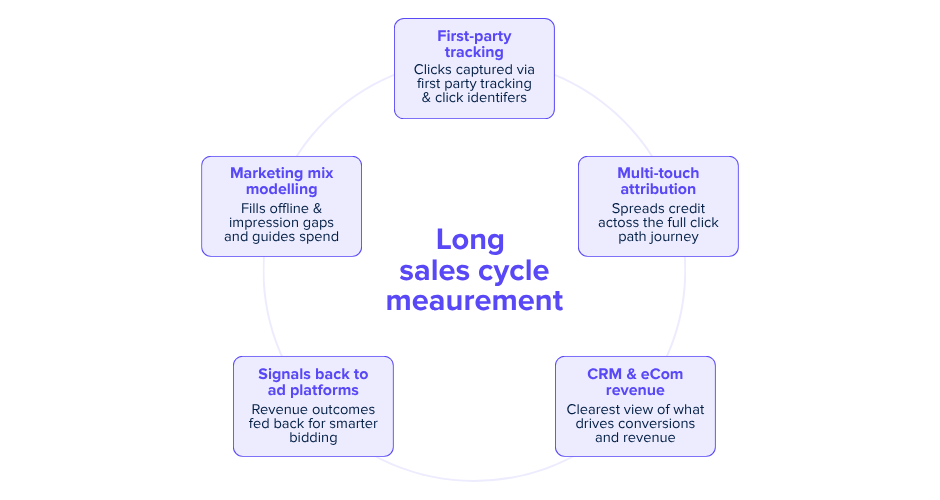
The foundation of everything else is capturing what actually happens at an individual user level across the full journey. UTM parameters, click IDs, session cookies, page view sequences, collected and stored in a way that persists across multiple visits and sessions.
Related: 4 steps to create a first-party data strategy
Most analytics tools aggregate this data or strip out personally identifiable detail before you can do anything useful with it. What you need is tracking that keeps the individual journey intact.
For example, which channel first brought this person to you, what they did across subsequent visits, and what eventually prompted the conversion. That granularity is what makes the rest of the framework possible.
Adopt multi-touch attribution
Instead of assigning 100% of credit to one touchpoint, multi-touch attribution models distribute it across the full journey. This gets you much closer to understanding which channels are actually contributing to pipeline and revenue, not just which one happened to be there at the moment of conversion.
The specific model (linear, time-decay, data-driven) matters less than the shift away from single-touch. From the journeys we’ve tracked, the difference in how channels appear in the data between last-click and any multi-touch model is often significant. Channels that looked marginal suddenly look essential, and vice versa.
Link with your CRM or eCommerce platform
Marketing data needs to follow the customer journey into your CRM or eCommerce system. When a prospect or customer converts, their full pre-conversion journey, every touchpoint, channel, and campaign, should flow through alongside them. As they move through the funnel and eventually purchase or close, you can connect revenue outcomes back to the marketing activity that influenced the journey.
This is what creates the closed loop. Instead of optimising to cost-per-lead or platform-reported conversions, you can measure cost-per-closed-sale or cost-per-purchase, broken down by channel, campaign, and content. From the cases we’ve analysed where this loop is properly implemented, it consistently changes how teams allocate budget across both acquisition and retention channels.
This also strengthens how marketing is represented internally. “This channel generated 40 leads” is less meaningful than “this channel contributed £200k of pipeline last quarter, with a 28% close rate.”
Send quality conversion signals back to ad platforms
Ad platforms can only optimise toward what you tell them matters. If you’re sending them lead form completions as conversion events, they’ll find you more people who fill in forms. If you send them closed-deal data, they can start to find you people who actually buy.
Related: How to integrate offline data into your digital strategy & targeting
Offline conversion imports, connecting CRM outcomes back to the original ad platform click, are one of the most underutilised levers we see. The impact on algorithmic performance is meaningful, because you’re giving the platform real signal rather than a proxy.
That said, you don’t have to wait for a deal to close before you start sending better signals. If your sales cycle runs longer than six months, waiting for closed-won data before feeding anything back to the platform means the algorithm is flying blind for most of that time.
What we’ve found works well is sending pipeline stage progressions as intermediate signal, when a lead becomes a qualified opportunity, when it moves to proposal stage, when it reaches late-stage negotiation. These events are far stronger quality signals than a form fill, and they’re available weeks or months before revenue is confirmed. The platform starts learning what a genuinely valuable prospect looks like, which improves targeting efficiency well before the final outcome is known.
Bring in marketing mix modelling for impression-driven and offline activity
Deterministic tracking captures actions. It can’t capture the influence of a campaign someone never clicked, a billboard they drove past, or a podcast ad they heard on their commute. For upper-funnel and offline activity, brand campaigns, awareness-focused social, out-of-home, events, you need a fundamentally different approach to measurement.
Marketing mix modelling works by analysing historical performance data across all your channels, both online and offline, to statistically estimate the contribution each one makes to revenue. Rather than relying on a click trail, it looks at patterns over time, when spend in a particular channel goes up, what happens to outcomes downstream? It accounts for factors that deterministic attribution simply can’t touch. The halo effect of a brand campaign, the lag between a TV spot and a spike in branded search, the cumulative impact of sustained awareness activity that never generated a single trackable click.
Related: How marketing mix modelling transforms budget planning
One of the more useful things MMM surfaces is diminishing returns by channel. From the models we’ve run, it’s common to find that a channel that looks efficient at current spend levels starts to plateau well before teams realise it.
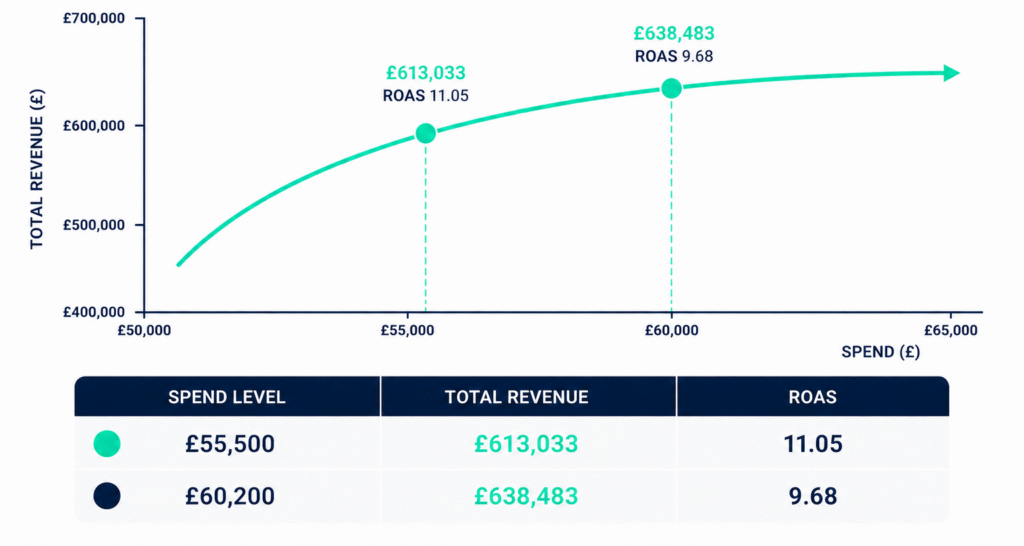
The model shows you the curve, at what point additional investment in a given channel stops producing proportional returns, and where budget could be redeployed more effectively. That’s insight you simply can’t get from platform dashboards, which have a natural incentive to tell you that more spend equals more results.
With a calibrated model in place, you can test hypothetical allocations before you commit to them. If we shift 20% of paid social budget into brand activity, what does the model suggest happens to pipeline over the next two quarters? You’re not guessing based on gut feel or last quarter’s ROAS figures. You’re working from a data-backed view of how your specific channel mix has historically performed, and projecting forward with a clearer sense of likely outcomes.
Building a measurement framework for long sales cycles that actually works
None of this is about proving that attribution was broken. It’s about building measurement that’s useful, that you can actually make budget and strategy decisions from with confidence.
From what we’ve seen when teams make this shift, the changes in how channels appear in the data are often surprising. Things that looked like they weren’t working turn out to be driving a disproportionate share of high-quality pipeline. Things that looked strong turn out to be mostly capturing credit from activity that happened elsewhere.
You can’t change the length of the sales cycle, but you can control the measurement framework.
Getting those two things aligned is one of the highest-leverage things a growth team can do, and it’s usually more achievable than it looks from the outside.
If you’re running longer sales cycles and suspect your current measurement isn’t giving you the full picture, Ruler connects your marketing touchpoints to closed revenue, tracks leads through your CRM pipeline, and sends quality conversion signals back to your ad platforms, so your budget decisions are based on what’s actually working, not just what’s easiest to measure. Book a demo to see how it works.