
You’ve spent months building a marketing strategy across half a dozen channels, and now someone in the boardroom wants to know which of them actually worked. Google Analytics 4 gives you one answer.
Each ad platform gives you a slightly different one, and none of them agree, and none of them include the phone call your best customer made last Tuesday before they signed.
This is the reality for most marketing teams. Attribution has become fragmented, customer journeys have grown longer and harder to see, and predicting what happens next feels difficult when you can’t fully agree on what happened last month.
Predictive marketing software exists to help with exactly this, using historical performance and customer journey data to forecast what happens if you shift spend, channels or targeting. Below, we’ve reviewed the tools worth shortlisting.
We discuss:
- What is predictive marketing software
- What we expected predictive software to deliver
- Our picks for predictive marketing tools
Pro Tip
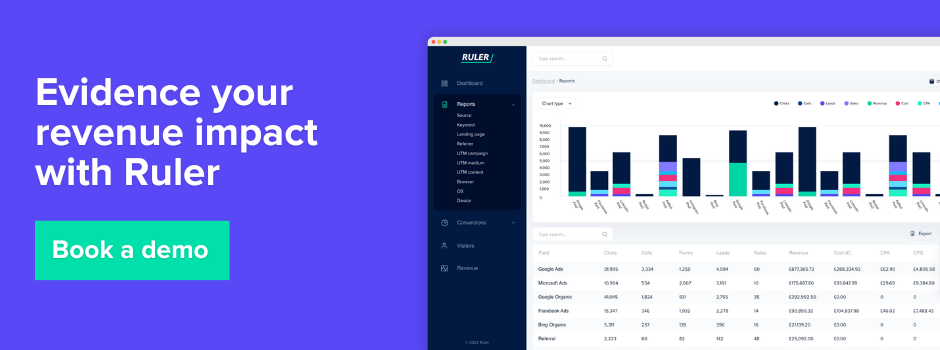
If proving marketing ROI across multiple channels is the thing keeping you up at night, book a demo with Ruler and we’ll show you how first-party attribution and statistical modelling can give everyone in the business one number they trust.
Our definition of predictive marketing software
We get asked a lot what “predictive marketing software” actually means, mostly because the term gets used loosely across a huge range of tools.
In our own conversations with marketing and data leaders, the software that earns this label does two things well.
First, it uses historical marketing and customer journey data, spanning paid, organic, offline and CRM sources, to build a statistical or machine learning model of how marketing drives outcomes. Second, it uses that model to forecast what happens under different conditions, whether that’s a change in budget, a new channel, or a shift in seasonality.
That’s a meaningfully different job to reporting software, which tells you what already happened, or basic dashboarding tools, which simply pull numbers into one place.
Predictive marketing software should tell you what’s likely to happen next and, ideally, what to do about it. It’s a distinction worth holding onto, because a lot of the market gets sold as “predictive” when really it’s descriptive analytics with a forecast bolted on.
In our experience, 31% of marketers say proving ROI is their single biggest challenge, and that’s usually a sign the tools they’re using can explain the past but not guide the future.
What we expect predictive marketing software to deliver
Based on what we hear from customers and prospects evaluating this space, here’s what we think genuinely good predictive marketing software needs to deliver.
- A measurement foundation that isn’t biased towards the bottom of the funnel. Last-click and platform-reported data both tend to over-credit channels like paid search and direct, so any predictive layer built on top of that data inherits the same bias.
- Forecasting grounded in real customer journeys, not just aggregate spend. The best tools connect individual touchpoints, including offline ones, to actual revenue outcomes rather than working from top-line spend and conversion totals alone.
- Transparent modelling that finance can interrogate. If a tool can’t explain why it’s recommending a budget shift, marketing leaders struggle to defend that recommendation in a budget meeting.
- Scenario planning, not just historical reporting. You should be able to model “what if we spent 20% more on CTV” before you commit the spend, not only measure it afterwards.
- The ability to account for cross-channel and offline journeys. We know from our own data that 44% of marketers cite cross-channel journeys, both online and offline, as a challenge for effective attribution, so any tool that only looks at digital click paths is working from an incomplete picture.
- A model that improves as new data arrives, rather than a static report that’s out of date within a quarter.
Predictive marketing software reviewed for 2026
We’ve reviewed 8 platforms below, ranging from dedicated marketing measurement tools through to general-purpose BI and machine learning platforms that marketing teams sometimes adapt for this use case.
Features and pricing were checked against each provider’s own site, though we’d always recommend confirming current details directly with the vendor before you buy.
Ruler Analytics
Ruler Analytics is a marketing measurement and attribution platform built specifically to solve the cross-channel, online-and-offline measurement problem that most other tools in this list only partially address.
It combines first-party tracking, multi-touch attribution and marketing mix modelling in one platform, so marketing teams get both the granular, campaign-level detail of click-path attribution and the channel-level, budget-planning view of statistical modelling.
What we’ve designed it to solve
We built Ruler because platform-reported metrics and GA4 weren’t giving our own customers a complete or unbiased view of what was driving revenue.
Ruler tracks calls, form submissions, live chat and other conversions using a first-party JavaScript tag that follows the full customer journey, then matches those enquiries back to CRM records so you’re reporting on revenue, not just leads.
Because tracking is first-party, it holds up better against the privacy changes that have degraded third-party cookie-based tools.
On top of attribution, our marketing mix modelling measures the impact of every channel, including offline activity like TV, radio and print, accounting for seasonality, competitor activity and diminishing returns across more than 30 variables.
Where we see it work best
Ruler tends to work best for marketing teams running multiple paid channels, including impression-heavy ones like CTV, display or paid social, alongside offline conversions such as phone enquiries or showroom visits.
Because it blends click-path attribution with impression-based modelling, credit shifts away from over-attributed channels like direct and brand search and towards the upper-funnel activity that actually influenced the decision.
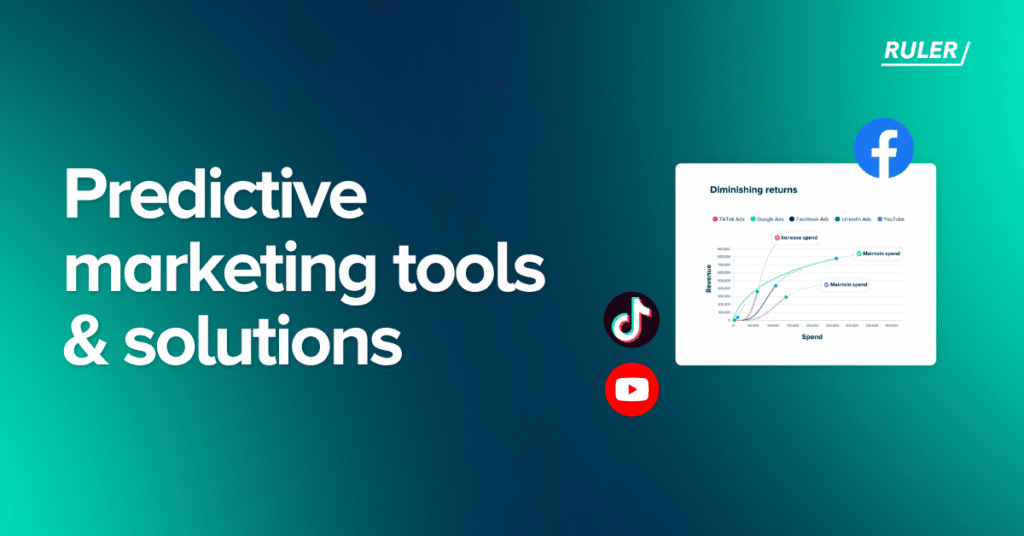
We also see it work well for teams that need to justify budget decisions to finance, since our budget scenario planner lets you model efficiency, growth or custom budget scenarios and see predicted diminishing returns before you commit spend. If you’d like a deeper look at how that connects to marketing mix modelling specifically, we’ve written about budget allocation using marketing mix modelling on our blog.
Consider Ruler if
Consider Ruler if you’re managing budget across more than a couple of channels, if some of your best conversions happen offline or over the phone, or if you’re tired of platform reports that don’t add up to your actual sales figures. It’s also worth a look if you want attribution and marketing mix modelling working together rather than as two disconnected tools.
Pricing
Ruler’s published plans start with a Small Business tier from £199 per month for up to 5,000 visits, rising through Medium Business at £649 per month and Large Business at £1,149 per month, with custom Advanced pricing above 200,000 visits. Exact pricing depends on your traffic volume and requirements, so it’s worth booking a book demo for a tailored quote.
Adobe Analytics
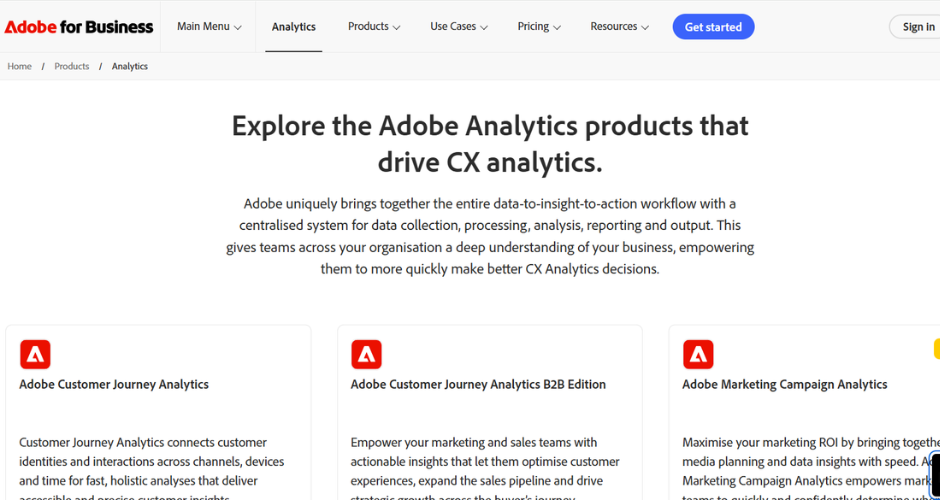
Adobe Analytics is an enterprise analytics platform with predictive features built into its Adobe Sensei AI layer, most commonly used by large organisations already invested in the Adobe Experience Cloud ecosystem.
Where the tool shines
Adobe Analytics shines on depth of segmentation and its predictive metrics, which use machine learning to flag users likely to convert or churn based on historical patterns.
Its algorithmic attribution modelling lets you compare rule-based and data-driven models side by side, and the optional Customer Journey Analytics module unifies online and offline data for cross-channel analysis. For large enterprises with multiple brands or regions, the governance and flexibility on offer is hard to match.
Where it falls short
The complexity that makes Adobe Analytics powerful also makes it a heavy lift for smaller teams.
Implementation typically takes months rather than weeks, and much of its predictive value depends on deep integration with the wider Adobe stack, so teams outside that ecosystem may not see the full benefit. Pricing is also opaque, which makes it hard to budget for in advance.
Pricing
Adobe doesn’t publish pricing publicly. Third-party estimates put full-featured Ultimate deployments anywhere from roughly $100,000 to $200,000 or more annually, though the actual figure depends on data volume, report suites and support level. You’ll need to speak to Adobe directly for a quote.
Akkio
Akkio is a no-code AI platform aimed largely at media agencies and marketing teams who want predictive modelling without a dedicated data science function.
Where the tool shines
Akkio’s strength is accessibility. Non-technical users can upload a CSV or connect a source like HubSpot, Salesforce or Google Sheets, and build a working churn, lead-scoring or forecasting model in minutes through a guided, drag-and-drop interface.
Its Chat Explore feature lets you query connected data in plain language, and it’s found genuine traction with agencies such as Horizon Media and Havas for audience building and media planning.
Where it falls short
Because Akkio is a generalist predictive AI tool rather than a marketing-measurement platform, it doesn’t offer the built-in attribution or first-party tracking that dedicated marketing analytics tools provide.
Teams in more regulated sectors have also noted that its model explainability and tuning controls are thinner than specialist enterprise machine learning platforms. As of mid-2026, Akkio has also moved to enterprise-only, custom pricing, so it’s lost some of the self-serve accessibility that used to be part of its appeal.
Pricing
Akkio previously offered self-serve plans from around $49 per user per month, but as of recently pricing sits behind a “Contact Sales” enterprise model with no public rates.
Domo
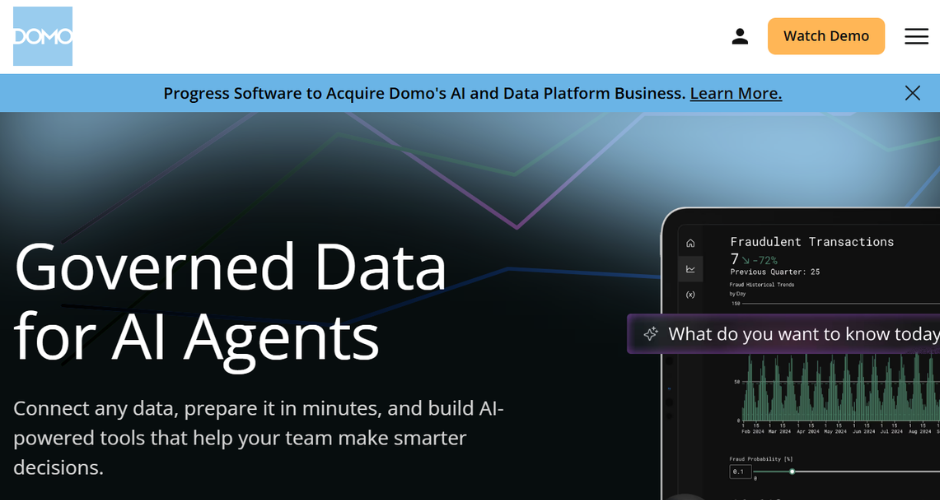
Domo is a cloud-based business intelligence platform used across departments, including marketing, with AutoML and forecasting features layered on top of its dashboarding tools.
Where the tool shines
Domo connects to more than a thousand data sources and lets teams build dashboards, then apply predictive models using its no-code AutoML interface for forecasting, anomaly detection and basic lead scoring.
It’s a genuinely useful option for organisations that want one BI platform shared across marketing, sales, finance and operations, rather than a marketing-specific tool.
Where it falls short
Domo isn’t built specifically for marketing measurement, so it lacks native attribution or first-party tracking, and predictive accuracy depends heavily on how the underlying model is trained and maintained.
Some users have reported models that perform well in pilot but degrade once real-world seasonality or shifting customer behaviour kicks in. Domo also moved from fixed tiers to a consumption-based credit model, which several buyers describe as difficult to predict, and mid-market deployments can run well into six figures annually.
Pricing
Domo doesn’t publish transparent list pricing. Based on third-party transaction data, small deployments can start from around $30,000 a year, with mid-market deployments of 50 to 100 users often running $100,000 to $150,000 annually.
Improvado
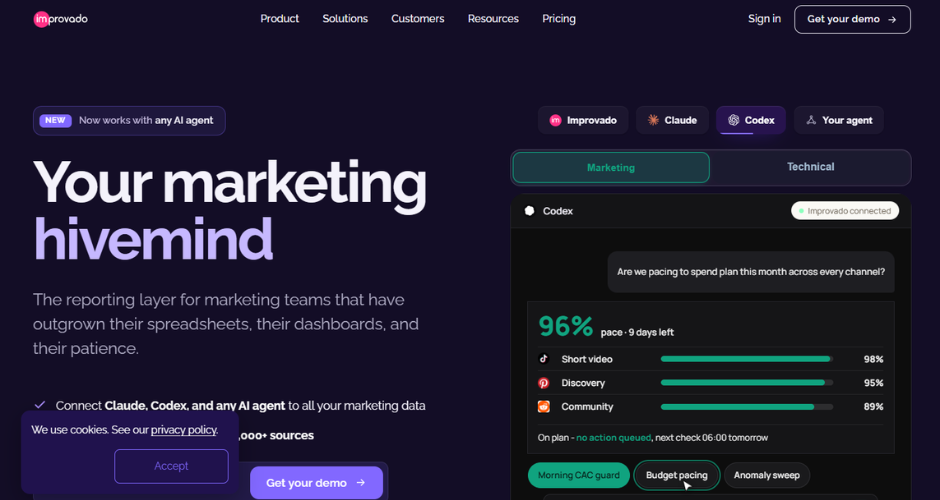
Improvado is a marketing intelligence and data integration platform focused on consolidating marketing data from multiple sources into unified dashboards, with AI-assisted reporting layered on top.
Where the tool shines
Improvado’s core strength is data harmonisation. It centralises marketing data from a wide range of platforms into one place, handles governance across regions and brands, and offers attribution modelling, multi-touch attribution and campaign analytics once that data is unified.
For organisations whose data infrastructure isn’t ready for advanced measurement, Improvado is often used as the step that makes measurement possible in the first place.
Where it falls short
Improvado is explicitly a company’s own marketing, performance and sales data platform, and it doesn’t track competitive or market intelligence, so it needs to be paired with other tools for that.
It’s also primarily a data integration and reporting layer rather than a purpose-built predictive engine, so predictive and forecasting capability tends to sit downstream, in whatever BI or modelling tool you connect it to.
Pricing
Improvado uses outcome-based, volume-driven pricing tailored to each client’s data sources and volume, spread across Growth, Advanced and Enterprise editions. There’s no public price list, so you’ll need to request a quote.
Struggling to know if your predictive model is actually right, or just confident?
Most tools in this space are only as good as the attribution data feeding them. Ruler’s first-party tracking and multi-touch attribution give your forecasting a foundation that isn’t skewed towards last-click. Book a demo to see it against your own data.
LiftLab
LiftLab is a marketing mix modelling and incrementality testing platform aimed at growth-stage and enterprise brands that need continuously updated, causal measurement rather than a quarterly report.
Where the tool shines
LiftLab’s main differentiator is its Two-Stage Agile Marketing Mix Model, which separates ad auction cost dynamics from genuine consumer response, so saturation in the model reflects real demand exhaustion rather than rising auction prices.
Models refresh continuously rather than quarterly, which suits brands making weekly or monthly budget decisions, and its Trust Engine feeds incrementality test results back into the model to keep narrowing forecast ranges over time.
Where it falls short
LiftLab’s sophistication comes with a learning curve, and it’s built for teams that can commit to ongoing incrementality testing to keep the model calibrated, which is more operational overhead than a simpler dashboard tool.
It’s also positioned firmly at growth and enterprise budgets, so smaller marketing teams may find it more platform than they need.
Pricing
LiftLab doesn’t publish pricing publicly. Visit the official LiftLab site to request a quote.
Microsoft Azure Machine Learning
Azure Machine Learning is Microsoft’s general-purpose machine learning platform, used across industries for forecasting and predictive modelling rather than being a marketing-specific tool.
Where the tool shines
Azure ML gives data science teams a flexible environment for building custom forecasting, churn prediction and demand modelling using Python tools and libraries, with strong integration into the wider Azure ecosystem.
For organisations with in-house data science capability who want to build bespoke predictive marketing models rather than use an off-the-shelf platform, it offers essentially unlimited flexibility.
Where it falls short
That flexibility comes at a cost. Azure ML requires genuine data science expertise to configure and maintain, unlike the no-code tools elsewhere on this list, and it has no built-in marketing attribution or first-party tracking of its own, so it needs to be fed clean, unified marketing data from elsewhere.
Usage-based compute pricing can also be difficult to forecast without close monitoring.
Pricing
Azure ML itself has no platform fee, but you pay for the compute, storage and other Azure services you consume. Small predictive projects can start from a few hundred dollars a month, while larger ones scale into the thousands.
Odins
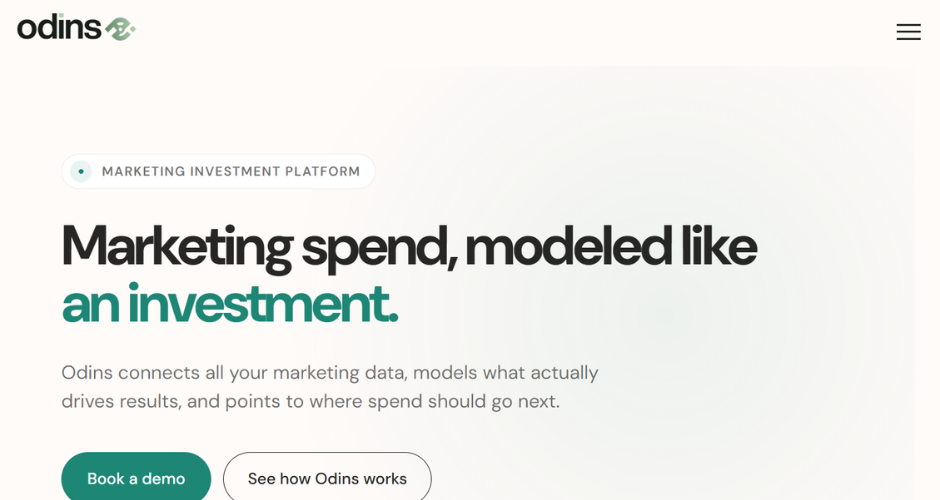
Odins is a marketing mix modelling and budget optimisation platform aimed at companies spending significantly across many channels who want an independent, model-backed view of what’s driving revenue.
Where the tool shines
Odins pairs AI-enhanced Bayesian marketing mix modelling with a team that manages the data integration and reviews every recommendation before it’s delivered, so you get software combined with analyst oversight rather than a self-serve black box.
It connects to more than 600 marketing platforms and produces scenario planning, monthly optimisation recommendations and structured tests for channels where confidence is lower, aimed at answering the board-level question of whether overall marketing spend is right, not just how it’s split.
Where it falls short
Odins is built for companies spending meaningfully across many channels, typically upwards of several million a year, so it’s not aimed at smaller marketing teams.
Because recommendations are reviewed by an analyst team before delivery, it’s also a slower, more managed-service style of engagement than tools designed for marketers to self-serve day to day.
Pricing
Odins doesn’t publish pricing publicly. Visit the official Odins site to enquire.
Booking a demo with Ruler
If you’ve read this far, you’re probably comparing predictive marketing tools because your current measurement setup doesn’t give you a straight answer to “what’s actually working.”
That’s the exact problem we built Ruler to solve, combining first-party attribution across every conversion type with statistical modelling that accounts for offline activity, seasonality and diminishing returns, so budget decisions are based on predicted outcomes rather than assumptions.
Book a demo with our team and we’ll walk through your current measurement setup, show you where the gaps are likely to be, and demonstrate how Ruler would fill them.