


The law of diminishing returns can make or break your marketing strategy, here’s how to stay ahead.
You know the scenario well. The CEO wants 30% growth and finance has cut your budget by 15%.
Your team is shrinking, and they aren’t being replaced. Yet somehow, you’re expected to deliver more with less while proving every penny spent drives measurable impact.
Today, understanding diminishing returns isn’t just a nice-to-have analytical exercise.
It’s the difference between allocating resources strategically and throwing good money after bad. And, that’s exactly what we’ll explore in this post.
We discuss:
- What are diminishing return curves?
- The errors in traditional budget planning
- How to identify diminishing returns with MMM
💡 Pro Tip
Ruler makes spotting diminishing returns effortless. It maps saturation curves across all your channels, shows exactly where you stand, and calculates the marginal ROAS, so you know the likely return from your next pound spent. Book a demo to see Ruler in action and optimise your budget with confidence.
What are diminishing return curves?
Diminishing returns is a simple principle. As you spend more on a marketing channel or campaign, each additional pound eventually generates less revenue past a certain point.
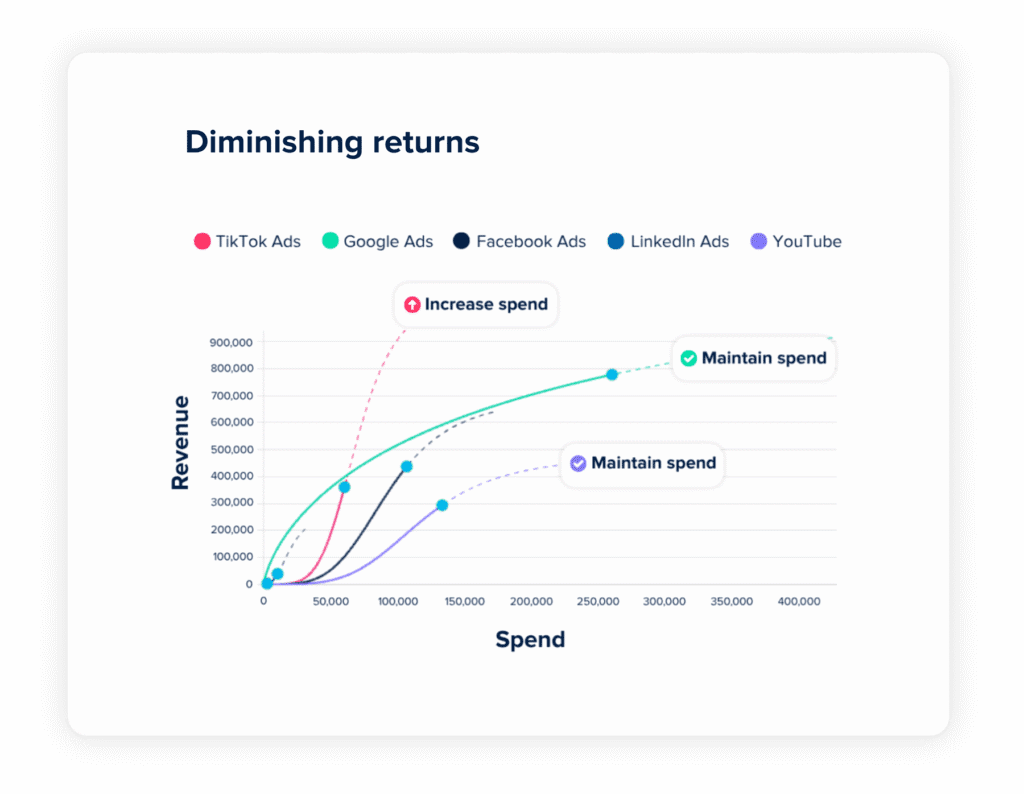
Many marketers assume budgets scale linearly, they don’t.
Every marketing channel moves through three distinct performance phases as spend increases.
- Increasing returns: This is the sweet spot. The channel is gaining momentum, learning what works, and benefiting from optimisation. Each additional pound delivers disproportionately strong returns.
- Diminishing returns: You’re still profitable, but efficiency is declining. The low-hanging fruit has been captured. Cost per acquisition rises, and the incremental revenue generated by each additional pound shrinks. The key question now is whether performance remains above your acceptable ROI threshold.
- Negative returns: This is where additional spending actually damages performance. You’re over-saturating your audience with ads, potentially causing fatigue and brand damage. This is where budget burns with no return.
Here’s a simple example:
- Your first £1,000 in spend might generate £5,000 in revenue.
- Your second £1,000 might return £4,000.
- By the time you reach the tenth £1,000, the revenue might only be £1,500.
Each incremental investment contributes less. Understanding exactly where that decline starts is essential for allocating your budget effectively.
Why traditional budget planning falls short
Most marketing teams approach budgeting in one of three flawed ways:
1. Historical lookback. Many teams base their budget on last year’s allocation, perhaps adjusting for inflation or budget changes. It’s efficient but assumes last year’s mix is still optimal, which is rarely true. Markets evolve, customer behavior changes, and channels mature.
2. Whatever is easiest to measure: Budgets often flow to campaigns that are simple to track or have shown recent success. Retargeting or Google pMax campaigns often win because attribution is clear and dashboards report results neatly. Brand awareness campaigns, which influence conversions indirectly over time, are often ignored. Traditional attribution models like last-click or short-window analytics typically undervalue these campaigns.
3. Gut-feel guessing: Sometimes senior stakeholders rely on intuition rather than data, “putting a finger in the air” to decide where the budget should go. Fast and confident, it may feel strategic, but it’s dangerously subjective, decisions are driven by anecdotes, personal channel preferences, or what seems important at the time, rather than evidence of actual performance.
Neither method accounts for the fundamental reality that channels respond differently to spend and reach saturation at different points. Without analysing these curves systematically, you are flying blind.
How to identify your point of diminishing returns
Marketing mix modelling is one of the most reliable ways to uncover diminishing returns. It uses historical data to estimate the relationship between marketing spend and business outcomes across channels.
Instead of assuming linear growth, MMM calculates how each additional unit of spend contributes to revenue, highlighting where the law of diminishing returns kicks in.
Related: How marketing mix modelling transforms budget planning
Here’s how to approach it:
1. Collect accurate data across channels: Start by gathering spend and performance data across all marketing channels, paid search, social, display, TV, email, and others. Include both short-term conversion metrics and longer-term indicators like brand awareness or engagement. MMM requires a full view to model interactions correctly.
2. Use a statistical model to fit response curves: At its core, MMM fits a mathematical curve to describe how spend affects outcomes. Commonly, models use logarithmic or S-shaped (sigmoid) functions to capture diminishing returns. These curves show clearly where additional spend contributes less to revenue.
3. Adjust for external factors: Seasonal trends, competitor activity, pricing changes, and macroeconomic conditions influence performance. Proper MMM accounts for these factors, isolating the true impact of marketing spend.
4. Identify saturation points: Once the response curve is established, you can pinpoint the spend level where returns start to taper. This is the channel’s saturation point. Spending beyond this point is inefficient and should be redirected elsewhere.
5. Prioritise spend based on efficiency: With clear curves for each channel, allocate budget to maximise total ROI. Some channels will reach diminishing returns quickly; others may have room to grow. MMM gives a data-driven view, replacing guesswork with evidence.
One practical application of this approach is what Ruler Analytics offers through its marketing mix modelling solution.
Rather than providing generic benchmarks, Ruler gathers your marketing and external data and directly ties it to revenue outcomes across channels, taking care of the heavy lifting.
It shows not just which campaigns are performing, but where incremental spend stops delivering proportional value. This contextual insight allows teams to reallocate budget where it counts most.
Take this example straight from Ruler.
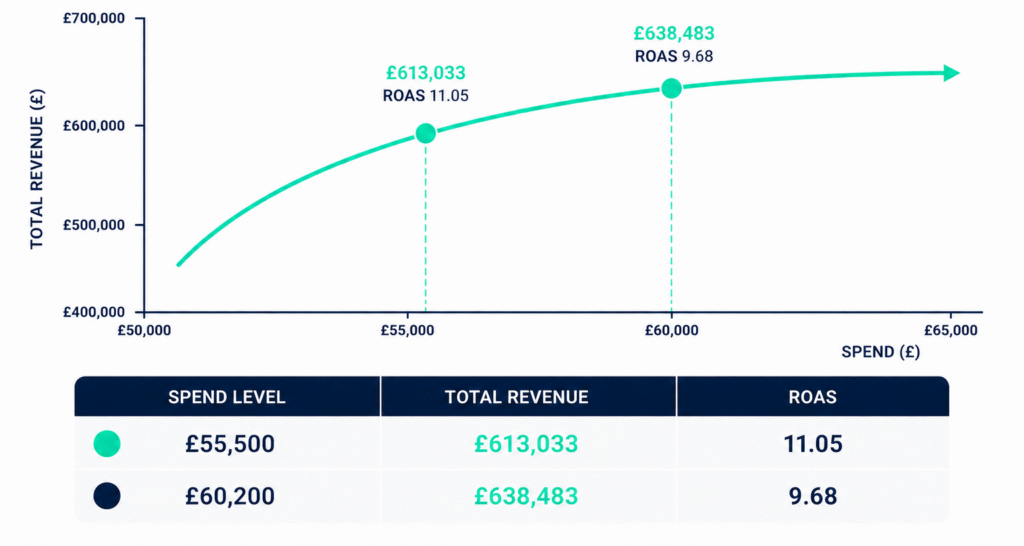
Imagine you’re running a Facebook paid prospecting campaign.
Currently, you spend £55,500 and generate £613,033 in revenue, a very strong return, with ROAS of 11.05.
Your marketing analytics team runs a model and recommends increasing spend to £60,200.
Revenue grows to £638,483, but ROAS drops.
The marginal ROAS, the revenue generated per extra £1 spent, is now 5.22, roughly half of the overall ROAS.
Each additional pound is delivering less value than the last. The campaign is still profitable, but you’re now entering the phase of diminishing returns.
If spend continues to increase without careful analysis, extra investment could deliver minimal incremental revenue, or worse, reduce overall efficiency.
Understanding this curve allows you to make informed decisions. Instead of assuming more spend automatically drives proportional revenue, you can reallocate budget to channels that still have room for growth, improving overall ROI.
Identify your diminishing returns with marketing mix modelling
In today’s high-pressure marketing environment, understanding diminishing returns is essential.
It ensures budget decisions are grounded in data, not assumptions, and allows leaders to maximise impact with constrained resources.
Traditional approaches, looking backward or funding the squeaky wheel ,ignore the real dynamics of marketing spend.
Only through careful analysis, using tools like marketing mix modelling, can you identify saturation points, allocate budget efficiently, and confidently justify every investment.
If you’d like to see how diminishing returns appear in a marketing mix modeling solution, book a demo and we’ll walk you through it.