
Most marketing teams we speak to are already sitting on more data than they know what to do with. The problem isn’t a shortage of numbers. It’s that so few customers make an important purchasing decision in a single session anymore.
Customers rarely convert after a single interaction. They research across multiple channels, engage with ads they never click, return weeks later, and often complete their purchase offline.
As a result, standard attribution models and platform reports miss part of the customer journey, making it harder to measure performance accurately and invest with confidence.
Machine learning software helps fill these gaps by combining more signals, modelling missing touchpoints, and providing a more complete view of marketing’s impact. In this guide, we’ll look at how these tools work and compare the leading options available today.
Pro tip
If long consideration windows, hard-to-track channels, and offline conversions are making it harder to measure ROI accurately, it’s worth seeing how marketing mix modelling and data-driven attribution work together to close that gap before you commit budget to next quarter’s plan. Book a demo with our team and we’ll walk through what that could look like for you.
Our definition of machine learning software
When we talk about machine learning software in a marketing and analytics context, we mean tools that use statistical and predictive modelling to learn patterns from historical data and apply them to new situations.
That covers a fairly wide range of use cases, from predicting which website visitors are likely to convert, through to attributing revenue across a customer journey, to forecasting how a marketing budget will perform under different spend scenarios.
It’s worth being upfront that not every tool on this list is “machine learning software” in the narrow, standalone sense. Some, like Google Meridian and Meta Robyn, are open-source statistical modelling frameworks built specifically for marketing mix modelling.
Others, like Adobe Analytics and Tableau Pulse, are broader analytics platforms with machine learning capabilities layered on top for anomaly detection, forecasting, or natural language insights.
A few, including Ruler, blend first-party tracking and attribution with machine learning and statistical modelling to solve a specific measurement problem.
We’ve tried to be clear about what each tool actually does rather than lumping everything under one banner, because from the leads and enquiries we’ve tracked from marketers researching this category, the biggest source of frustration is buying a tool that turns out to be something narrower than expected.
What we recommend looking for in machine learning software
Based on the conversations we have with marketing leaders evaluating this category, a handful of things consistently separate a good fit from a bad one.
How the model is trained and what data it needs. Some tools need very large volumes of first-party behavioural data before predictions become reliable (GA4’s predictive metrics, for example, need a minimum of 1,000 returning users triggering a given event within a 28-day window). Others, like marketing mix models, need at least two to three years of historical channel-level spend and revenue data. Know what you can actually feed the model before you buy it.
Whether it’s a black box or something you can interrogate. Some platforms will tell you what happened without explaining why, or will shift attribution credit between channels without much visibility into the reasoning. Others, particularly the open-source frameworks, let you inspect and adjust the model itself. Neither approach is automatically wrong, but you should know which one you’re getting.
Who is actually going to use it. A handful of these tools genuinely need a data scientist on staff to get any value out of them. Others are built for marketing teams to use without writing code. Match the tool to the team you actually have, not the team you’d like to have in eighteen months.
How it fits with what you already track. Machine learning software rarely works in isolation. It needs clean, first-party data as its foundation, whether that’s website behaviour, CRM records, or offline conversions. A predictive model built on incomplete or fragmented data will confidently produce misleading answers, which is arguably worse than no model at all.
What it costs once you’re actually using it, not just the sticker price. A lot of the platforms in this list price on consumption, server calls, or event volume, which means the number on the pricing page and the number on the invoice can end up a long way apart. It’s worth asking every vendor for a realistic cost projection based on your actual usage before you sign anything.
This lines up with what we’ve seen from our own research. 64% of respondents said they base the majority of their marketing decisions on data in analytics, yet 23% said turning that data into actionable insight is one of their main challenges, and 22% pointed to joining up data from different sources as another.
Those two challenges, insight and integration, are exactly what separates the tools below from each other.
Machine learning software reviewed for 2026
We’ve put together this list of machine learning tools using our own experience, feedback from marketers we’ve spoken to, and insights gathered from trusted online reviews.
1. Ruler Analytics
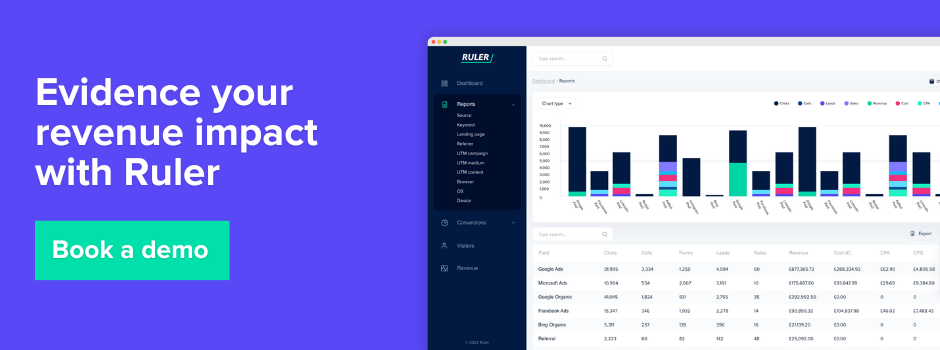
Ruler Analytics is a marketing measurement platform that combines first-party tracking and data-driven attribution with machine learning and marketing mix modelling, built specifically to help marketing and commercial teams understand which channels are actually driving revenue, and how to allocate budget accordingly.
What we’ve designed it to solve
First, Ruler tracks calls, form submissions, live chat enquiries and other key conversions using a first-party JavaScript tag that follows the full customer journey from first visit through to revenue. As it’s first-party, it isn’t degraded by the same privacy changes affecting third-party cookies, which gives it a tracking foundation that holds up as the landscape keeps shifting. On top of that sits multi-touch attribution, letting you compare first click, last click, linear, position-based, time decay and data-driven models side by side, with conversions matched to your CRM, ecommerce platform or other business systems and enriched with full journey data, so you’re reporting on revenue attribution rather than lead volume or transactions alone.
Where Ruler differs from a traditional attribution tool is in how it uses data-driven attribution alongside marketing mix modelling. The DDA model combines click-path data with impression weightings derived from the marketing mix model, shifting credit away from over-attributed channels like direct and brand search and towards the upper-funnel activity that influenced the decision but never earned a click.
For businesses investing in channels such as CTV, display, video or out-of-home, Ruler’s marketing mix modeling gives a far more complete picture of what’s actually working. The statistical modelling side accounts for seasonality, competitor activity, economic conditions and diminishing returns across more than 30 variables, using both historical performance and forward-looking forecasts.
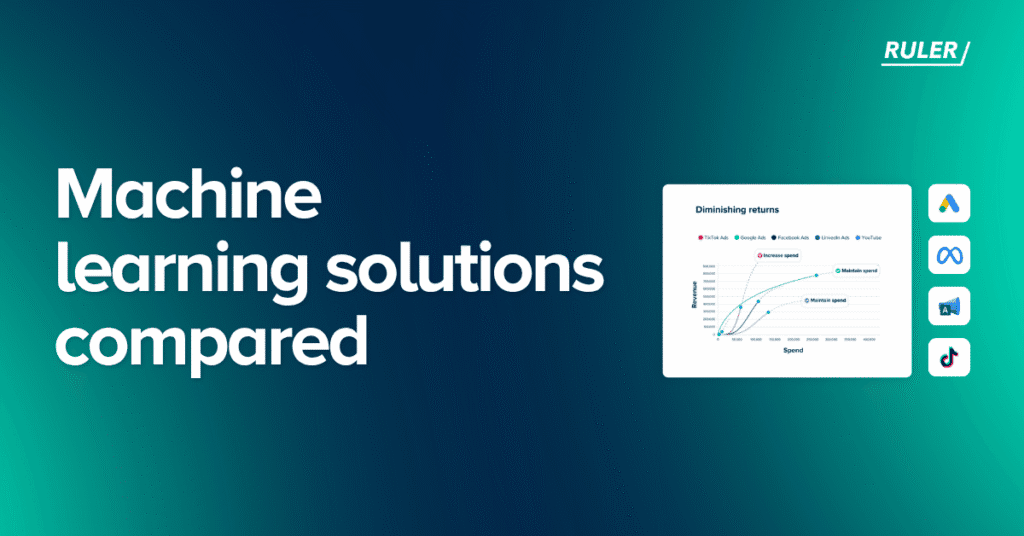
From there, the budget scenario planner shows diminishing return curves so you can see where each channel is approaching saturation, and model efficiency, growth or custom budget scenarios before committing spend. You can read more detail on how the budget allocation process works in practice.
Ruler also ingests data from advertising platforms, CRMs, ecommerce platforms and other business systems, then pushes enriched attribution data back out. Records in your CRM, ecommerce platform or other business systems can be updated with source, campaign and customer journey data, while ad platforms receive offline conversion and revenue signals that improve bidding and audience optimisation, so the attribution data doesn’t just sit in a report, it actively feeds back into campaign performance.
Where we see it work best
From what we’ve seen across our customer base, Ruler tends to deliver the most value for B2B, B2C and considered-purchase businesses with complex customer journeys, a mix of online and offline conversion points, and marketing spend across more than two or three channels, particularly where some of that spend sits in upper-funnel or offline activity that platform reporting struggles to credit properly.
Consider Ruler if
You’re making budget decisions based on GA4 or platform-reported ROAS alone and suspect the numbers don’t add up, you have offline or back-office conversions that never make it back into your attribution data, or you’re investing in upper-funnel channels that look underperforming purely because last-click attribution can’t see them.
Pricing
Starts at £199/month for small businesses (up to 50,000 monthly visits), scales to £649/month for mid-market and £1,149/month for enterprise. Custom pricing for 200,000+ monthly visits.
2. Adobe Analytics
Where the tool shines
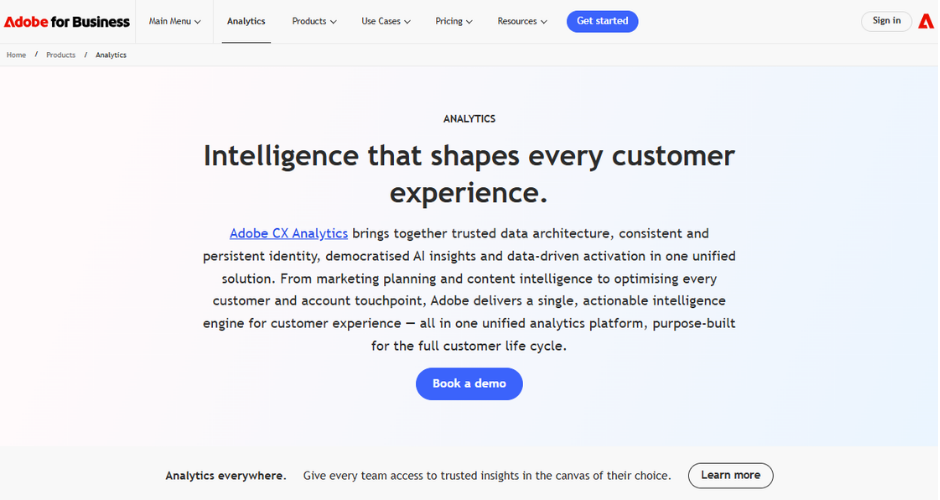
Adobe Analytics is built for large enterprises that need governance and flexibility across multiple brands, regions or product lines, particularly those already invested in the Adobe Experience Cloud stack. Its Analysis Workspace supports genuinely deep, drag-and-drop data exploration, and the platform’s machine learning capabilities cover anomaly detection, cohort and funnel analysis, cross-device stitching and sophisticated marketing attribution models. Adobe has also continued investing in AI features, adding one-click report generation and expanded identity stitching in early 2026, and rolling out a generative AI assistant that lets users query reports in natural language.
Where it falls short
The learning curve is steep even for experienced analysts, and implementation is a genuine undertaking rather than a quick setup. Adobe Analytics uses a custom, quote-based pricing model rather than public list prices, and most sources agree that six-figure annual contracts are the norm for full enterprise deployments once implementation and training are factored in. For teams focused mainly on website analytics and conversion tracking rather than complex, multi-brand customer journeys, this level of investment is usually more than the use case needs.
Pricing
Adobe structures its Web and Mobile Analytics offering into Select, Prime and Ultimate packages, with cost depending on data volume, digital properties and required features. Industry estimates put most enterprise deployments somewhere between $100,000 and $200,000 or more per year, before implementation and training costs.
3. Amplitude
Where the tool shines
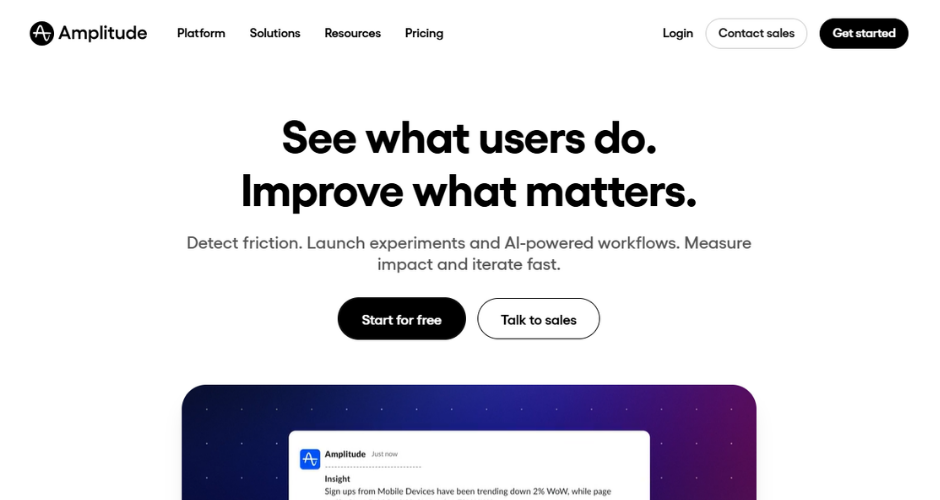
Amplitude is a product analytics platform built for teams that want to understand user behaviour at an individual level rather than aggregate traffic. It goes well beyond standard web analytics with predictive analytics that leverage machine learning to forecast future trends and user behaviours, alongside behavioural cohorting, custom dashboards and experimentation tools. In 2026 the platform expanded further with AI agents, session replay and natural language querying built directly into the core suite, letting non-technical stakeholders ask plain-English questions of the data.
Where it falls short
Amplitude was built for data teams rather than marketers working solo, and that shows in the learning curve, particularly around building complex cohorts. Costs can also escalate quickly. The Plus plan is listed at $49 a month, but one dataset of real buyer contracts put the median annual spend at over $64,000, so the headline price and the real cost of a production deployment can be very different numbers.
Pricing
Amplitude offers a free Starter plan capped at 10,000 monthly tracked users and 2 million events per month, with the Plus tier starting around $49 per month for up to 1,000 monthly tracked users. Growth and Enterprise tiers move to custom, sales-led pricing as usage scales.
4. Analytic Partners
Where the tool shines
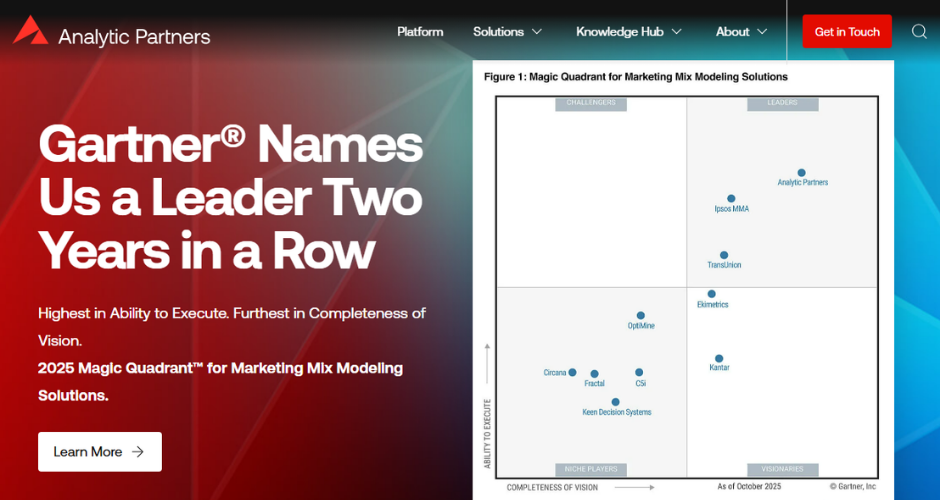
Analytic Partners is one of the longest-standing names in marketing mix modelling, built around its proprietary ROI Genome, a benchmark dataset drawing on over two decades of marketing and commercial data across hundreds of brands. Rather than treating MMM as a standalone project, the platform has evolved into what it calls Commercial Analytics through its GPS Enterprise platform, integrating marketing, sales, operations and external factors into forward-looking scenario planning rather than backward-looking report cards. The Forrester Wave named Analytic Partners a Leader in Q1 2026, praising its strategic thought partnership and global footprint
Where it falls short
This is a consulting-led, hybrid platform rather than pure self-serve software, which means longer engagement cycles and a higher cost structure than SaaS-native alternatives. Analytic Partners remains a strong choice for large enterprises with budgets exceeding $100 million annually and the patience for multi-month implementations, but that scale and timeline puts it out of reach for most mid-market teams.
Pricing
Analytic Partners doesn’t publish pricing, and engagements are quoted individually based on scope. Industry guides note that MMM engagements with hybrid consulting providers like Analytic Partners typically run into six-figure annual contracts.
5. Domo
Where the tool shines
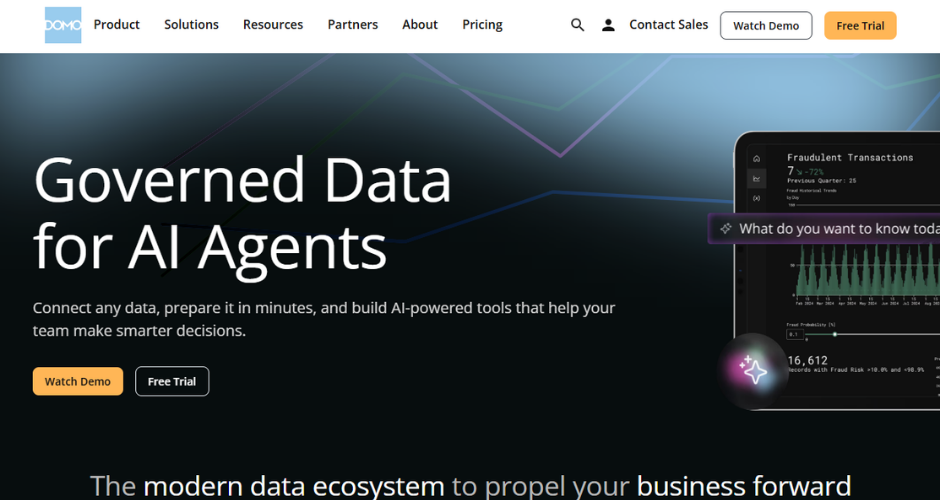
Domo is an all-in-one data platform combining data integration, ETL, visualisation and collaboration in a single tool, with a genuinely large library of pre-built connectors. Its machine learning capabilities sit inside Magic ETL, covering classification, clustering and outlier detection, alongside AutoML and Jupyter Notebook integration for teams that want to train and deploy their own models. Domo scores highly for built-in data science capabilities, and features like Gain ML Insights help teams build cash flow forecasts and customer lifetime value models without leaving the platform.
Where it falls short
Domo moved to a consumption-based credit model in 2023, and reviewers consistently flag it as one of the harder platforms to budget for as a result. The median buyer pays approximately $60,500 per year, but the range runs from $17,500 for a minimal deployment up to over $130,000, and costs can shift significantly depending on refresh frequency and AI feature usage. The proprietary Magic ETL system also creates meaningful vendor lock-in once transformation logic is built inside it.
Pricing
Domo offers a 30-day free trial with no credit card required, after which all usage runs on a purchased credit pool. Based on market data, small teams typically start around $30,000 a year, with mid-market deployments commonly landing between $100,000 and $150,000 annually.
6. Google Analytics 4 (GA4)
Where the tool shines
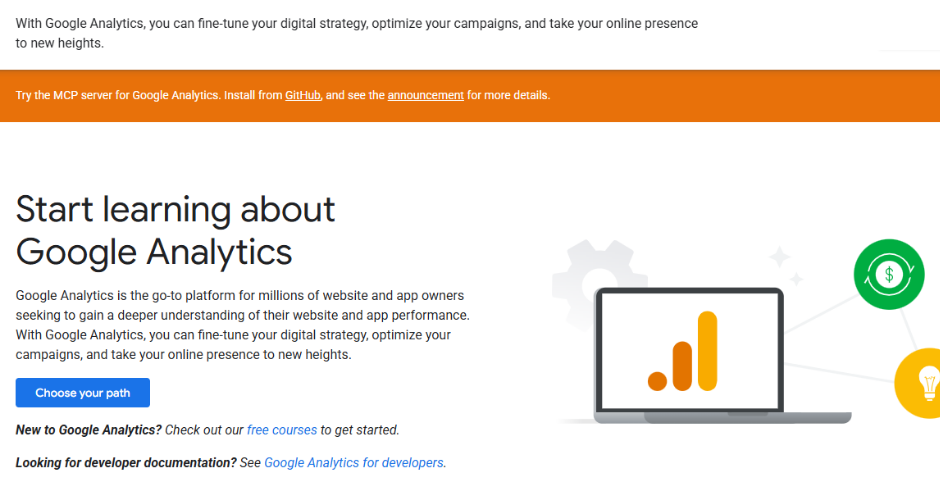
GA4 is the default web analytics platform for the vast majority of businesses, and its machine learning features have matured considerably. Predictive metrics use machine learning to forecast churn probability, purchase probability and predicted revenue based on a property’s historical event data, and these can be built directly into predictive audiences for Google Ads targeting. GA4 also uses behavioural modelling to fill gaps left by cookie consent choices, and has added automated insights, anomaly detection and Gemini-powered natural language querying throughout 2025 and 2026.
Where it falls short
Predictive metrics only activate once a property meets fairly strict data thresholds, requiring at least 1,000 returning users who triggered the relevant event and 1,000 who didn’t, sustained over a 28-day window, which rules out smaller sites entirely. The modelling itself is also something of a black box.
Conversion modelling can re-attribute conversions from one channel to another based on machine learning predictions, but there’s no visibility into why a specific conversion was reassigned, which makes the numbers harder to defend in a budget conversation. Adoption is shallow too. Only around a third of GA4 users have configured predictive metrics at all, and GA4’s model is built entirely on data that lives inside GA4, meaning it can’t account for offline conversions or channels it never sees a click or impression from.
Pricing
GA4 is free for standard use, with the enterprise GA4 360 tier starting around $50,000 annually for organisations that need higher data limits and SLA-backed support.
7. Google Meridian
Where the tool shines
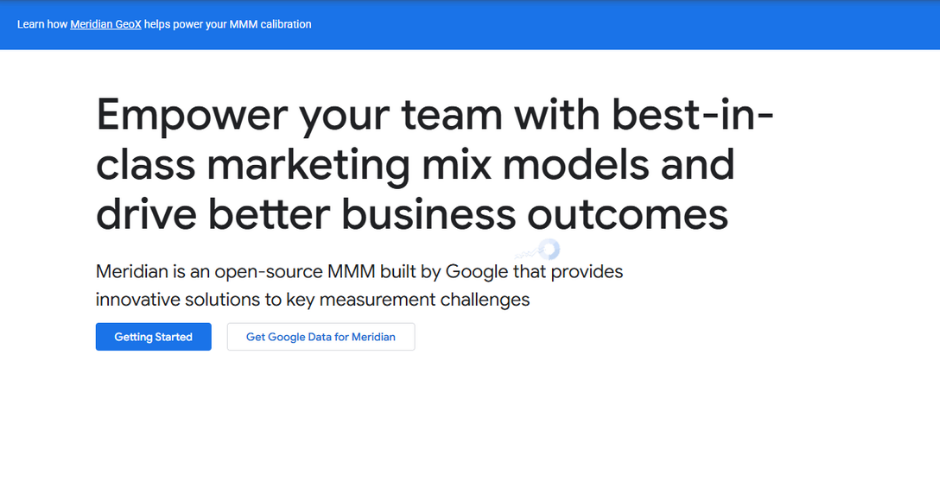
Meridian is Google’s free, open-source marketing mix modelling framework, and it’s a genuinely sophisticated one. It’s based on Bayesian causal inference and is capable of handling large-scale geo-level data, producing a full probability distribution for each channel’s effect rather than a single point estimate, which is a more honest way of representing uncertainty than older regression-based approaches.
Meridian supports reach and frequency modelling, budget optimisation and scenario planning built off its statistical foundation, and in February 2026 Google added a no-code Scenario Planner interface that lets marketers run budget scenarios without writing Python.
Where it falls short
Open-source doesn’t mean easy. Running Meridian properly requires Python proficiency, data engineering skills, an understanding of Bayesian priors, and the ongoing capacity to refresh the model as new data arrives, and Google recommends at least one GPU for practical use. There’s also no campaign-level optimisation and no built-in data connectors, so pulling data in and getting outputs out still means custom engineering work.
Pricing
Meridian is free for anyone to use, though the real cost is the data science time needed to build, calibrate and maintain the model.
8. Meta Robyn
Where the tool shines
Robyn is Meta’s free, open-source alternative to Meridian, and takes a different modelling approach. It combines automated hyperparameter optimisation using Meta’s Nevergrad library, ridge regression for model fitting, and time-series decomposition for trend and seasonality detection, with a gradient-based optimiser handling budget allocation recommendations. It’s specifically built for granular datasets with many independent variables, making it well suited to digital and direct response advertisers with rich data sources, and one documented case study showed a business achieving 20% quarter-over-quarter revenue growth after using Robyn to shift media budget.
Where it falls short
Like Meridian, Robyn is a code-first framework rather than a polished product, built in R rather than Python, which narrows the pool of analysts who can pick it up quickly. Its ridge regression approach doesn’t produce the confidence intervals or ability to incorporate external information that Bayesian modelling offers, which is a meaningful trade-off if your team wants to express uncertainty in its forecasts rather than a single output number.
Pricing
Robyn is free and open-source, distributed as an R package, with the same caveat as Meridian that the real investment is in the skills needed to run it well.
9. Microsoft Power BI
Where the tool shines
Power BI remains one of the most widely adopted business intelligence tools, particularly for organisations already inside the Microsoft ecosystem. Its Copilot integration has expanded significantly through 2026, with a March update increasing Copilot’s input from 500 to 10,000 characters, meaningfully improving how it handles complex analytical queries. Natural language report generation lets non-technical users create reports via conversational prompts without needing to know DAX or data modelling, and native Azure integration means connectors to Azure SQL, Synapse and Cosmos DB with minimal setup overhead.
Where it falls short
The machine learning and Copilot capabilities that make Power BI genuinely powerful sit behind additional licensing. Enabling Copilot requires either Fabric capacity at F64 or higher, or Premium Per User with a Fabric trial enabled, and the licensing structure across Pro, Premium Per User and Fabric capacity tiers takes some working through before you know what you’re actually paying for.
Pricing
Power BI Pro costs $14 per user per month, with Premium Per User at $24 per user per month, both billed annually. Fabric F64 capacity, needed for full Copilot functionality at scale, starts at roughly $5,258 per month reserved.
10. Mixpanel
Where the tool shines
Mixpanel is a product analytics platform built around tracking specific user actions rather than page views, and it’s widely regarded as one of the strongest tools in the category for funnel, retention and cohort analysis. In 2025 and 2026 Mixpanel shipped Spark, an AI query builder, AI summaries on session replays, AI-powered playlists, and an MCP server that connects the platform directly to tools like Claude and ChatGPT for conversational analytics. The self-serve interface is genuinely built for product managers and growth teams to use without writing SQL.
Where it falls short
Mixpanel is a product analytics tool first, which means it’s a better fit for understanding in-app behaviour than for cross-channel marketing attribution. Pricing is event-based and can scale quickly, with 10 million monthly events costing around $2,520 a month and 50 million running to roughly $13,720 a month, and several features that B2B teams tend to need, including group analytics and data pipelines, are priced as separate add-ons on top of that.
Pricing
Mixpanel is free for up to 1 million monthly events, then charges $0.28 per 1,000 events above that on the Growth plan, with Enterprise pricing negotiated individually and typically starting from around $25,000 a year.
11. Tableau Pulse
Where the tool shines
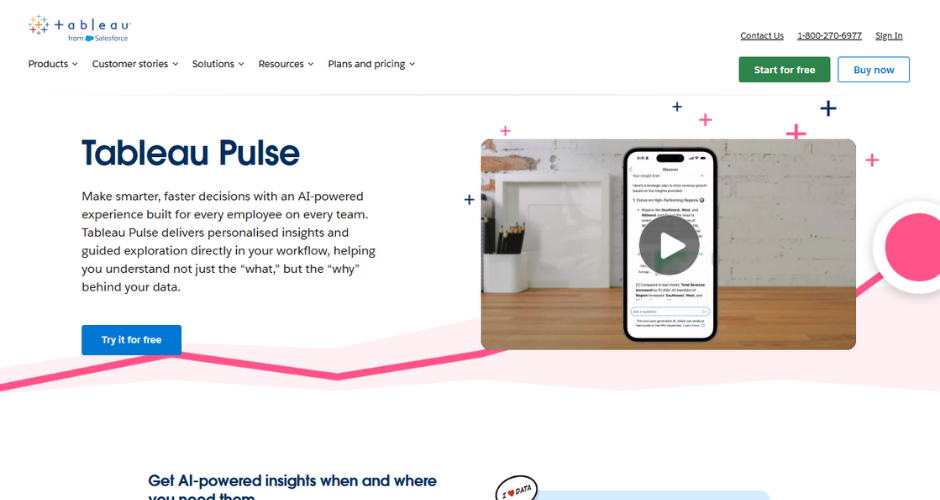
Tableau Pulse takes a different approach to analytics delivery entirely. Rather than waiting for someone to open a dashboard, it automatically detects drivers, trends and outliers in the metrics you follow, summarising them in natural language and visual explanations, and pushes those insights directly into Slack, email or the Tableau mobile app. It’s built on Salesforce’s Einstein machine learning models, which power predictive forecasting, anomaly detection and automated cohort analysis, and the tight Salesforce integration means CRM-driven predictions surface inside Tableau with little manual setup.
Where it falls short
A 50-user Tableau deployment can cost three to five times a comparable Power BI setup, and several of the most useful AI features, including enhanced natural language Q&A across grouped metrics, are gated behind the premium Tableau+ tier rather than included in the base Creator licence. Pulse is also exclusive to Tableau Cloud and isn’t available for on-premise Tableau Server deployments, which rules it out for organisations with strict data residency requirements.
Pricing
Tableau Creator starts from $75 per user per month, with Tableau+, needed for the full Pulse AI experience, priced on a custom basis.
Getting more from your machine learning software
If there’s one thing that comes through consistently in the conversations we have with marketing and data leaders, it’s that no single tool on this list solves the whole measurement problem on its own. A product analytics platform like Amplitude or Mixpanel won’t tell you how your CTV spend is influencing offline sales. An open-source framework like Meridian or Robyn won’t track a single visitor’s journey. And a general-purpose BI tool like Power BI or Domo is only as good as the first-party data you feed into it.
That’s really the gap we built Ruler to close. By pairing first-party tracking and attribution with machine learning and marketing mix modelling, Ruler gives marketing and commercial teams one place to see which channels are genuinely driving revenue, including the ones that never get proper credit under last-click attribution, and to model what happens to that revenue under different budget scenarios before any money moves.
If any of the pain points in this guide sound familiar, particularly long consideration windows, offline conversions that go untracked, or platform numbers that never quite add up, it’s worth seeing what your own data looks like once it’s properly connected.
Book a demo with Ruler Analytics and we’ll show you exactly how it would work with your existing marketing stack.