
If you have ever sat in a budget meeting trying to explain why paid social “isn’t working” when you know, deep down, that it’s doing more than the numbers suggest, you already understand why marketing forecasting is such a headache. The channels that get the credit aren’t always the channels doing the work.
We see this constantly in conversations with marketing and data leaders. Few customers make a big decision in a single session, and by the time a sale happens, many of the touchpoints that influenced it have fallen out of your attribution model.
If you’re relying on GA4 and platform-reported metrics alone to decide next quarter’s budget, you’re working from an incomplete picture. This is where marketing forecasting software earns its place, giving marketing leaders a defensible way to answer the questions finance always asks next.
We discuss:
- What’s marketing forecasting software
- What to look for in marketing forecasting tools
- Marketing forecasting software analysed
Pro tip
Before you shortlist any forecasting tool, get clear on whether you actually have the underlying attribution data to feed it. Forecasting is only as good as the inputs, and most teams find that fixing measurement gaps (calls, offline sales, cross-channel duplication) delivers more accuracy than any modelling upgrade alone. If you want to see what that looks like with your own data, book a demo with Ruler Analytics and we’ll walk through it together.
Our definition of marketing forecasting software
We define marketing forecasting software as any platform that uses historical performance data, attribution signals and statistical modelling to predict the future outcome of marketing investment, whether that’s revenue, pipeline, leads or return on ad spend.
That’s a broad definition on purpose, because “marketing forecasting” actually covers a few different jobs depending on who’s asking.
- A CFO wants a forecast that ties marketing spend to a revenue number they can put in a board deck.
- A demand generation manager wants to know which channels are worth scaling before next quarter’s plan is locked.
- A data leader wants a model that accounts for seasonality, diminishing returns and the fact that not every channel behaves the same way when you double its budget.
Good marketing forecasting software should be able to answer all three of those questions from the same underlying data, rather than forcing you to stitch together spreadsheets, platform dashboards and gut feel.
Some of the tools in this list were built from the ground up for that job. Others are broader planning or CRM platforms that have grown forecasting capability over time. Both approaches can work, but they solve slightly different problems, which is worth keeping in mind as you read the reviews below.
What we recommend looking for in marketing forecasting software
We speak to a lot of marketing and analytics teams evaluating tools in this space, and the same handful of questions come up again and again. Before you get to those questions, it’s worth understanding why marketing has become so hard to measure in the first place.
Long consideration windows mean last-click attribution hands all the credit to the final touchpoint and nothing to the channels that built awareness weeks earlier.
Offline and untracked conversions, such as calls, showroom visits or replies to an email, often never get connected back to the marketing that influenced them, so some of your best revenue disappears from the model entirely.
In fact, 28% of respondents in our own research told us that changes to tracking and data privacy are now a top challenge for their team.
Ad platforms rarely help, since Google, Meta, LinkedIn and TikTok each report conversions within their own attribution windows, and added together they’ll often exceed your actual sales or leads.
With that context in mind, here are the questions we’d recommend building into your own shortlisting process.
1. How does it handle attribution before it forecasts anything? A forecast is only as reliable as the data feeding it. If your attribution model is still last-click, or if it’s double-counting conversions across ad platforms, any forecast built on top of that data will inherit the same bias.
Look for tools that either bring strong first-party attribution of their own, or that integrate cleanly with the attribution data you already trust.
2. Can it model diminishing returns, not just straight-line growth? Marketing spend rarely scales in a straight line. Every channel eventually saturates, and pushing more budget in past that point produces smaller and smaller returns.
Our own research found that 35% of marketers say more budget would improve their outputs, but budget on its own isn’t the whole answer if it’s poured into a channel that’s already saturated. A forecasting tool that can’t model diminishing returns will tend to recommend scaling whatever is currently performing well, which is often the wrong call.
3. Does it connect marketing activity to revenue, or does it stop at leads and clicks? Plenty of platforms are excellent at forecasting traffic, leads or MQLs, but marketing leaders increasingly need to defend budget in revenue terms, particularly with longer B2B sales cycles.
Check whether the tool matches marketing activity through to closed revenue in your CRM, not just conversion volume.
4. Can it run scenarios, not just historical reports? Forecasting should let you test “what if” before you spend, not just explain what already happened. Look for genuine scenario planning, ideally with the ability to model efficiency, growth and custom budget scenarios side by side.
Our own marketing mix modelling approach, for instance, is built specifically around this kind of forward-looking planning rather than backward-looking reporting.
A quick note before you keep reading. If measurement and attribution gaps are the reason your forecasts don’t feel trustworthy yet, that’s exactly the problem we built Ruler to solve, and it’s worth seeing before you compare the rest of this list. Book a demo and we’ll show you what your own data looks like once it’s properly connected.
Marketing forecasting software and tools reviewed for 2026
Below is our shortlist of marketing forecasting software for 2026 and beyond.
Ruler Analytics
What we’ve designed it to solve
Ruler exists to close the gap between what your ad platforms and analytics report and what actually happened in revenue terms. Most marketing teams are working with conversion data that’s duplicated across Google, Meta and LinkedIn, disconnected from offline sales, and blind to anything that happened over a phone call. We built Ruler to deduplicate those conversions and unify reporting across every channel, so you’re forecasting from one accurate picture of performance rather than several conflicting ones.
Ruler combines first-party data tracking with statistical modelling to improve marketing measurement, forecasting and budget allocation together, rather than treating them as three separate problems. First-party tracking follows the full click path, linking to calls, form fills and live chat, and matches it all to CRM or backend revenue. Marketing mix modelling accounts for impressions, offline activity, seasonality, competitor activity, economic conditions and diminishing returns across more than 30 variables at once.
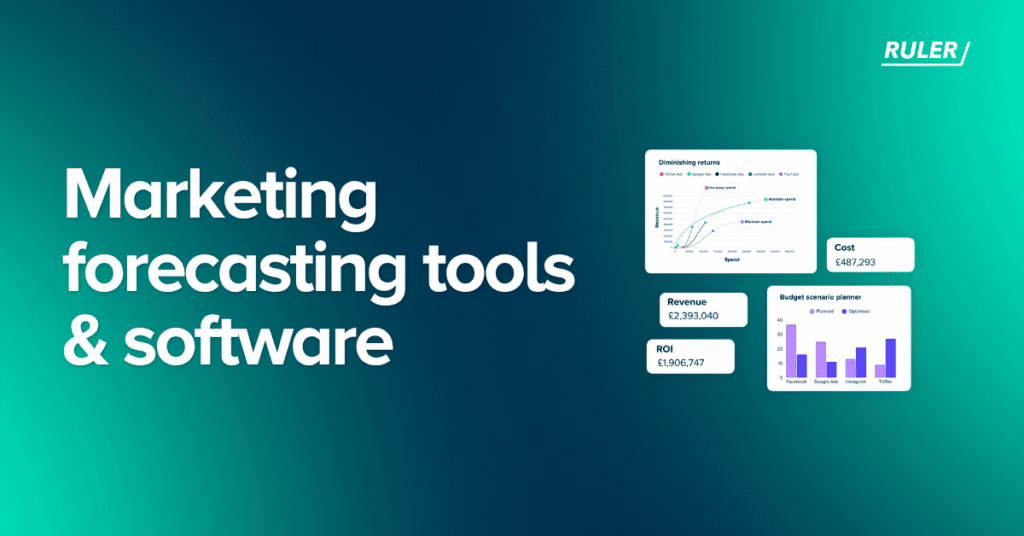
The part of the platform we’d point to specifically for forecasting is the budget scenario planner. It uses diminishing return curves to show where each channel is approaching saturation, so you can model efficiency, growth or custom budget scenarios before committing spend, rather than finding out after the fact that a channel had already plateaued. We’ve written more about how that kind of budget allocation through marketing mix modelling works in practice, if you want the detail behind the model.
Ruler also pushes data back out, not just in. Revenue and offline conversion signals get sent back to your ad platforms, which improves bidding and audience optimisation, so the attribution work you’re doing actively feeds better campaign performance rather than sitting in a report nobody revisits.
Where we see it work best
Ruler tends to be the strongest fit for marketing teams running paid activity across several channels (Google, Meta, LinkedIn, TikTok, display, CTV or offline) who need to understand the full customer journey rather than just what happened in the last click. It’s a particularly good fit for B2B and considered-purchase businesses where calls, live chat and form fills all feed the sales pipeline, since those are exactly the conversion types that tend to fall out of platform-level reporting. We also see it work well for teams who want their attribution and forecasting to live in one place, rather than exporting data between an analytics tool and a separate planning platform.
Consider Ruler if
You’re currently making budget decisions from GA4 or platform dashboards alone, if a meaningful share of your conversions happen offline or by phone, or if you want a scenario planner that’s grounded in your own first-party data rather than generic industry benchmarks.
Pricing
Ruler’s pricing is based on your business size and requirements, so it’s worth booking a demo to get an accurate quote for your setup rather than relying on a generic number here.
Anaplan
Where the tool shines
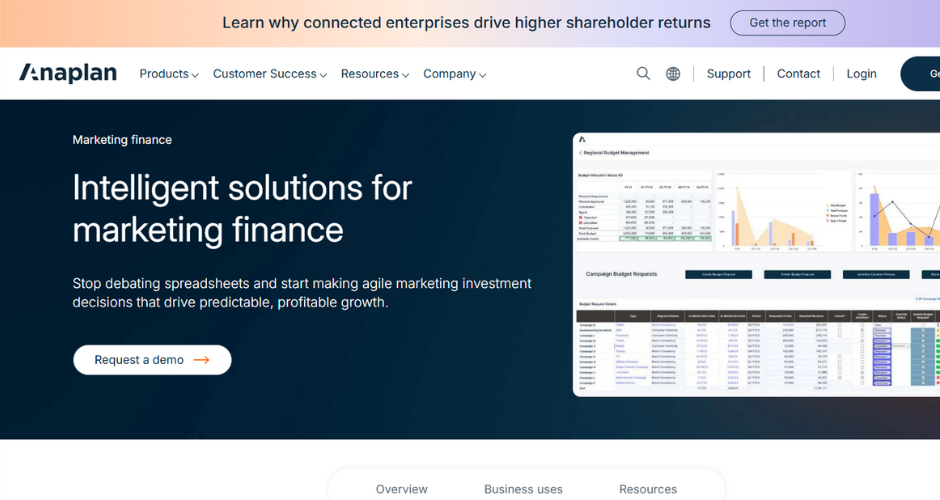
Anaplan is a connected planning platform, and its strength is scale. It lets marketing, sales, finance and HR data sit in one modelling environment, which means marketing budget scenarios can be built alongside broader company forecasts rather than in isolation. Its in-memory calculation engine is genuinely fast even on large, complex models, and its scenario planning tools let you compare unlimited “what-if” analyses across marketing and sales performance metrics. For enterprises that already run their FP&A process through Anaplan, extending that into marketing budgeting and forecasting is a natural next step.
Where it falls short
Anaplan wasn’t built specifically for marketing, and it shows. It has no native first-party attribution or campaign-level tracking of its own, so it relies entirely on the quality of the data you feed it from elsewhere. It’s also a genuinely complex platform to implement and maintain, typically needing a dedicated modelling or FP&A resource, which puts it out of reach for smaller marketing teams who just want a forecasting answer without a multi-month build.
Pricing
Anaplan doesn’t publish pricing publicly. Third-party estimates put enterprise deployments well into five and six figures annually depending on modules and user count, and you’ll need to contact Anaplan directly for a quote.
Clari
Where the tool shines
Clari is best known as a revenue forecasting and pipeline inspection platform for sales teams, and its AI-driven forecasting is genuinely well regarded, with some enterprise customers reporting forecast accuracy in the high nineties by the back half of a quarter. It pulls together CRM data, conversation intelligence and workflow automation into one view, which gives revenue leaders a clear read on whether they’re going to hit their number.
Where it falls short
Clari’s forecasting strength is built around sales pipeline, not marketing channel performance, so it’s less useful if what you actually need is a view of how paid media, organic and offline channels are contributing to that pipeline. Pricing is also entirely quote-based and modular, and costs tend to expand quickly once you add Copilot, integrations and implementation on top of the core forecasting product.
Pricing
Not published. Estimates for the core forecasting module typically sit around $100 to $120 per user per month, with full-stack deployments running considerably higher once add-ons are included. Contact Clari for a quote.
HubSpot
Where the tool shines
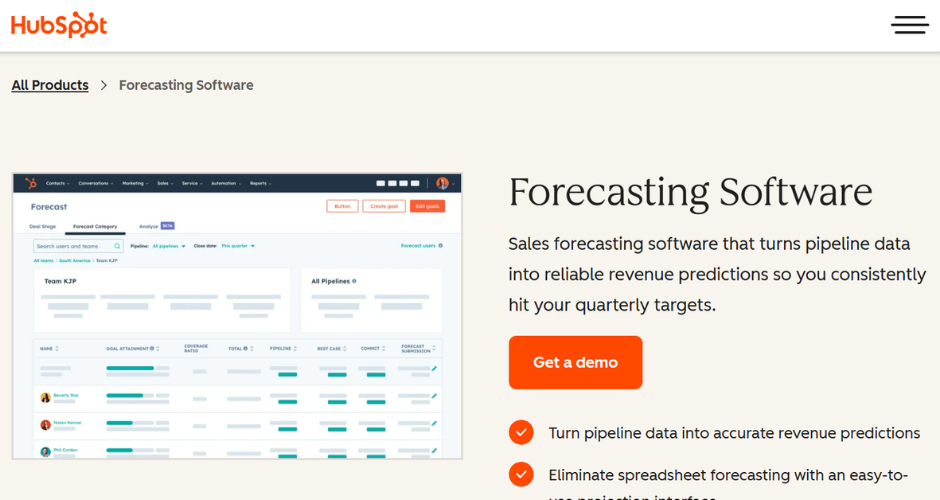
HubSpot’s forecasting tools sit inside its Smart CRM, and they’re genuinely easy to use if your sales and marketing data already live in HubSpot. Deal-based forecasting, pipeline tracking and team rollup views let managers see a forecast broken down by rep or team, and because it’s native to the CRM, there’s no separate integration to maintain.
Where it falls short
HubSpot’s forecasting is fundamentally sales pipeline forecasting rather than marketing performance forecasting. It doesn’t model channel-level diminishing returns, budget scenarios or cross-channel attribution in the way a dedicated marketing forecasting tool does, so marketing teams often end up using it alongside another platform rather than instead of one.
Pricing
HubSpot’s forecasting tools are bundled within Sales Hub, with pricing starting on the free tier and scaling through Starter, Professional and Enterprise editions depending on features and contact volume. Full details are on HubSpot’s pricing page.
Google Analytics
Where the tool shines
GA4’s predictive metrics are free, which is a genuine advantage if budget is tight. Purchase probability, churn probability and predicted revenue are all built on Google’s own machine learning models and require no extra setup beyond standard ecommerce event tracking. For businesses that want a lightweight, no-cost way to flag which users are likely to convert or churn in the near term, it’s a reasonable starting point.
Where it falls short
GA4’s predictive metrics need a minimum volume of purchase events to train reliably (Google recommends at least 1,000 positive and 1,000 negative examples over a rolling 28-day window), which rules it out for lower-traffic or longer sales-cycle businesses. It’s also still built on last-click and data-driven attribution models that struggle with offline conversions, and it doesn’t offer true budget scenario planning or marketing mix modelling.
Pricing
GA4’s predictive metrics are included at no extra cost within standard Google Analytics, though GA360 is available for enterprise support and higher data limits at additional cost.
OrbitDeck
Where the tool shines
OrbitDeck is built specifically for agencies, combining growth forecasting with marketing scorecards in one platform. It’s designed for teams that need to track KPIs and collaborate on real-time dashboards across multiple client accounts, which is a genuinely useful niche if you’re managing forecasting for several businesses at once rather than a single in-house marketing function.
Where it falls short
OrbitDeck’s positioning is narrower than most of the other tools on this list, and there’s limited public detail on the statistical rigour behind its forecasting models compared with platforms built around marketing mix modelling or first-party attribution. It’s likely a better fit as a client-facing reporting layer than as a primary forecasting engine for complex, multi-channel budget decisions.
Pricing
Not publicly listed. Contact OrbitDeck directly for pricing.
Planful
Where the tool shines
Planful started life as an FP&A platform and expanded into marketing through its acquisition of Plannuh, which shows in how tightly its marketing module ties campaign budgets and goals back into the wider financial planning process. That makes it a strong option for marketing teams that need to speak the same budgeting language as finance, particularly around goal-to-budget alignment and collaborative forecasting.
Where it falls short
Planful’s marketing forecasting is planning-led rather than attribution-led. It’s very good at helping you plan and track a budget against goals, but it doesn’t natively solve the underlying measurement problem of knowing which channels actually drove the revenue those goals are based on. Teams often need it alongside a proper attribution or MMM tool rather than instead of one.
Pricing
Not published, though third-party estimates put the marketing module starting around $6,000 a year, with mid-market deployments more typically in the $15,000 to $25,000 range. Contact Planful for an accurate quote.
Salesforce
Where the tool shines
Salesforce’s Einstein forecasting sits inside Sales Cloud and compares current opportunities against historical deals to predict expected revenue, close dates and pipeline health. For organisations already deep in the Salesforce ecosystem, extending into AI-driven forecasting is a relatively natural step, and it integrates well with marketing automation tools for lead scoring and engagement analysis.
Where it falls short
Einstein Forecasting is fundamentally a sales pipeline tool, not a marketing channel forecasting tool, and it requires clean, well-maintained CRM data to be reliable, which is a bigger lift than it sounds for a lot of organisations. It also gets expensive quickly. Meaningful Einstein features generally require Enterprise edition and above, and total costs including the underlying Sales Cloud licence can run well beyond the advertised entry price once add-ons are factored in.
Pricing
Einstein Forecasting typically adds $50 to $100 per user per month on top of a Sales Cloud licence, with Enterprise edition licences themselves starting around $165 to $175 per user per month. Full detail is on Salesforce’s pricing page.
Vena
Where the tool shines
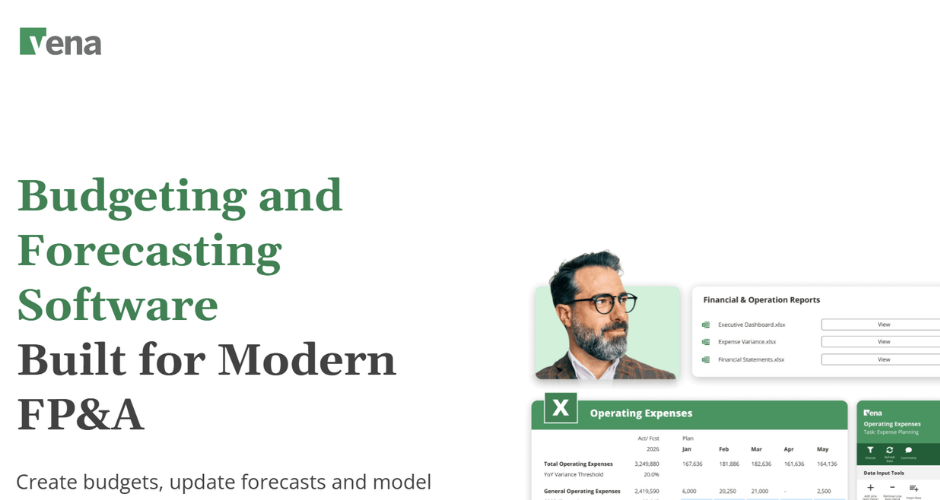
Vena’s defining feature is that it’s genuinely Excel-native, so finance and marketing teams who already live in spreadsheets can keep working the way they’re used to while gaining centralised data, version history, audit trails and real-time collaboration on top. Its marketing planning templates connect spend to campaigns and give visibility into full-funnel budget attribution, and its integration with Power BI, PowerPoint and Microsoft 365 makes reporting to stakeholders straightforward.
Where it falls short
Vena’s own users note that exporting reports outside Excel can be cumbersome, and several reviews mention wanting more AI-driven predictive analytics than the platform currently offers. It’s also priced at a premium and the pricing model itself is often described as non-transparent, which makes early-stage budget comparison harder than it should be.
Pricing
Not publicly listed. Vena is generally positioned for mid-market to enterprise budgets, with quotes available directly from Vena.
Ready to see what your own forecasting could look like
Choosing the right marketing forecasting software isn’t really about finding the tool with the longest feature list. It’s about finding the one that’s honest about where your revenue is actually coming from, because a forecast built on flawed attribution will always be a flawed forecast, however sophisticated the modelling on top of it looks.
That’s the problem we set out to solve with Ruler. First-party tracking that follows the full customer journey, attribution that unifies and deduplicates conversions across every channel, and a budget scenario planner grounded in your own diminishing return curves rather than industry averages.
In our own research, 38% of marketers told us that better attribution allowed them to allocate budget more effectively, and that’s really the whole point. A forecast is only as useful as the confidence you have in the numbers feeding it.
If you’d like to see what that looks like against your own data, book a demo with Ruler Analytics and we’ll show you exactly where your budget could work harder.