


Few customers make an important purchasing decision in a single session anymore. They research across multiple channels, compare options, read reviews, ask people they trust, engage with ads on more than one platform, and often convert in ways that leave little or no digital trace.
By the time a sale actually happens, many of the touchpoints that shaped that decision have already dropped out of the attribution model tracking it.
If your budget decisions are based on GA4 or platform-reported metrics alone, you’re working from an incomplete picture, and it’s usually the upper-funnel activity that pays the price.
This is exactly the conversation we have with marketing leaders every week, and it’s why the question of multi-touch attribution vs marketing mix modeling comes up so often. Both approaches matter. The question isn’t really which one wins, it’s what each one is actually built to tell you.
We discuss:
- Our definition of MTA vs MMM
- What MTA and MMM do well
- Where MTA and MMM fall short
- Why MTA and MMM work better together
Pro Tip
If you’re trying to work out whether your current measurement setup is giving you the full picture, it’s worth having a proper look under the bonnet. Book a demo with Ruler and we’ll show you what multi-touch attribution and marketing mix modeling look like when they’re working from the same data.
Our definition of multi-touch attribution vs marketing mix modeling
Before getting into where each approach shines and where it struggles, it’s worth being clear about what we actually mean by each term, because “attribution” gets used quite loosely across the industry.
- Multi-touch attribution (MTA) is a customer-level measurement approach. It tracks an individual’s journey across the touchpoints they interact with, whether that’s a paid social ad, an organic search visit, an email click or a form submission, and assigns credit for the eventual conversion across those touchpoints. Depending on the model you use (first click, last click, linear, position-based, time decay or data-driven), credit gets distributed differently. What all of these models have in common is that they need identifiable, trackable interactions to work with. If someone clicks, MTA can generally see it. If they don’t, it can’t.
- Marketing mix modeling (MMM), by contrast, is a statistical, top-down approach. Rather than tracking individuals, it looks at aggregate spend and performance data over time, across every channel including offline media like TV, radio, print and out-of-home, and models the relationship between marketing investment and business outcomes. It accounts for variables that MTA simply can’t see, such as seasonality, competitor activity, pricing changes and macroeconomic conditions. It doesn’t need a click or a cookie to work, which is exactly why it’s become more relevant as privacy regulation and cookie deprecation have chipped away at the reliability of click-based tracking.
You can read more detail on how each approach works in our guides to marketing attribution and marketing mix modeling, but the short version is this.
MTA answers “which touchpoints did this specific customer interact with on their way to converting?”
MMM answers “what impact did each channel have on revenue overall, once everything else is accounted for?” They’re answering different questions, which is really the whole point of this article.
It’s also worth flagging that most standard analytics tools weren’t built to answer either question particularly well.
Google Analytics, for example, is a last-click, session-based tool at heart. It doesn’t account for impression-based modeling, which means it tends to undervalue the upper-funnel impact of campaigns that build awareness and influence conversions later on. Instead, that credit often gets handed to direct traffic or brand search, simply because that’s the last thing the platform saw before the conversion happened.
This is one of the most common frustrations we hear from marketing leaders, and it’s one of the reasons 54% of respondents in our own research told us they only find the last-touch model somewhat effective, rather than fully effective.
What we’ve seen MTA and MMM do well
When we talk to customers who use both approaches, a fairly consistent pattern emerges. Each one earns its place for different reasons, and neither is trying to do the other’s job.
What multi-touch attribution does well
MTA tends to be valued for its granularity. It gives marketing and sales teams a customer-level view they can act on almost immediately, from campaign optimisation to lead qualification to sales follow-up.
As it operates at the individual level, it can be tied directly into CRM data, which means revenue, not just leads or form fills, becomes the metric everyone is optimising towards. It’s also fast.
MTA data updates in near real time, so campaign managers can shift budget or creative within days rather than waiting for a quarterly model refresh.
76% of the marketers we surveyed said they prefer a multi-touch attribution model over single-touch approaches, largely because it reflects the reality that most journeys involve more than one interaction.
What marketing mix modeling does well
MMM, on the other hand, tends to be valued for its objectivity and its ability to see the whole picture, including channels that MTA structurally can’t measure. Because it isn’t dependent on tracking individual clicks or cookies, it holds up well regardless of privacy regulation, ad blockers or cross-device journeys.
It’s particularly good at answering strategic, forward-looking questions, such as what would happen to revenue if TV spend increased by 20%, or where diminishing returns are starting to set in on a particular channel.
It’s also the only approach in this comparison that can genuinely account for factors outside marketing altogether, like a competitor’s price change or a shift in consumer confidence.
Here’s roughly how the two approaches compare on the things marketing leaders tend to ask us about most.
| What you need to know | Multi-touch attribution | Marketing mix modeling |
| Level of measurement | Individual customer journey | Aggregate, channel-level |
| Data required | Trackable digital touchpoints | Historical spend and performance data |
| Offline channel visibility | Limited, unless integrated with CRM/call data | Strong, includes TV, radio, print, OOH |
| Speed of insight | Near real time | Periodic, typically monthly or quarterly |
| Privacy resilience | Depends on tracking method | High, not reliant on cookies or clicks |
| Best suited to | Campaign optimisation, lead quality, sales alignment | Budget planning, forecasting, scenario modeling |
| Accounts for external factors (seasonality, competitors) | No | Yes |
Neither column is the “right” one to focus on. In our experience, the businesses getting the most value from measurement are the ones using both columns together, which we’ll come back to shortly.
Where we see MTA and MMM fall short
It’s just as important to be honest about where each approach hits its limits, because a lot of frustration with marketing measurement comes from asking one method to answer a question it was never designed for.
Where MTA falls short
MTA’s biggest limitation is that it can only measure what it can see. If a customer’s journey includes an offline touchpoint, such as a phone call, a showroom visit, or a conversation at an event, and that touchpoint isn’t connected back into the tracking, the credit for that interaction disappears entirely.
We see this constantly with B2B and considered-purchase businesses, where a meaningful share of revenue comes through sales calls or email replies rather than a straightforward online checkout.
When those conversions aren’t linked back to the marketing that drove them, digital campaigns end up looking underwhelming and offline activity looks disconnected from marketing altogether, even when it isn’t.
There’s also the platform reporting problem. Google, Meta, LinkedIn and TikTok each report conversions within their own attribution windows, and none of them account for what the others are claiming credit for.
Add the numbers together across platforms and you’ll often find they exceed your actual total sales or leads. This isn’t because any one platform is being dishonest, it’s simply that each one is reporting from its own vantage point.
The issue is that a lot of budget decisions still get made using these individual, siloed reports rather than a single consolidated source of truth. In fact, 28% of the marketers we surveyed told us siloed data is one of the biggest obstacles to effective marketing measurement, which lines up closely with what we hear anecdotally.
Where marketing mix modeling falls short
MMM has its own limitations. As it’s a statistical model built on aggregate, historical data, it typically can’t tell you which specific customer or campaign drove a conversion, and it doesn’t help much with day-to-day campaign optimisation.
It also needs a reasonable volume of historical data to produce reliable outputs, which can make it less practical for newer businesses or brand-new channels with limited spend history.
And because MMM tends to run on a monthly or quarterly cadence, it isn’t built for the kind of fast, tactical decisions that a campaign manager might need to make this week.
Neither of these are flaws exactly, they’re just the natural trade-offs of each methodology. MTA is precise but partial. MMM is comprehensive but slower and less granular. Trying to force one to do the other’s job is usually where measurement strategies start to break down.
Why we think MTA and MMM work better together
This is really the crux of it. In practically every customer conversation we have about measurement maturity, the businesses getting the clearest picture of performance are the ones that stopped treating MTA and MMM as competing options and started treating them as complementary layers of the same strategy.
The logic is fairly straightforward once you see it laid out.
MTA gives you the granular, customer-level detail needed to optimise campaigns and support sales in the short term.
MMM gives you the wider, statistically grounded view needed to plan budgets and understand channel impact over the long term, including the offline and upper-funnel activity that MTA can’t see on its own. Used together, each approach helps correct the other’s blind spots.
This is the thinking behind Ruler’s own data-driven attribution model, which combines click-path data from MTA with impression-based weightings derived from marketing mix modeling.
In practice, this means credit shifts away from channels that tend to get over-attributed, such as direct traffic and brand search, and towards the upper-funnel activity, think CTV, display, video or out-of-home, that actually influenced the decision long before anyone clicked anything.
For businesses investing meaningfully in awareness channels, this blended view tends to be a lot closer to reality than either approach on its own.
It’s also worth saying that 64% of the marketers we surveyed base the majority of their marketing decisions on data from analytics tools, which is exactly why it matters that the underlying data is as complete as possible.
A blended MTA and MMM approach doesn’t just make the reporting more accurate, it changes the actual decisions being made with it.
How we use attribution and modeling to support budget allocation
Budget allocation is where the difference between having one measurement approach and having both becomes most obvious, and it’s a topic we’ve written about in more detail in our guide to budget allocation using marketing mix modeling.
Here’s how we blend attribution and marketing modeling to guide budget decisions.
1. Our approach starts with first-party tracking. A JavaScript tag follows the full customer journey from first visit through to revenue, capturing calls, form submissions and live chat enquiries along the way, then matches those enquiries and sales back to CRM records. As it’s first-party, it isn’t degraded by the same privacy changes that have hit third-party cookie tracking, so the foundation stays reliable as the landscape keeps shifting.

2. From there, our data-driven attribution model layers in impression weightings derived from marketing mix modeling, giving a channel-level view that reflects both click-path behaviour and upper-funnel influence.
3. The MMM layer itself accounts for seasonality, competitor activity, economic conditions and diminishing returns across more than 30 variables simultaneously, which is a level of insight no single ad platform can offer on its own.
4. The output of all this feeds into our budget scenario planner, which uses diminishing return curves to show where each channel is approaching saturation and where additional spend is likely to generate genuinely incremental revenue.
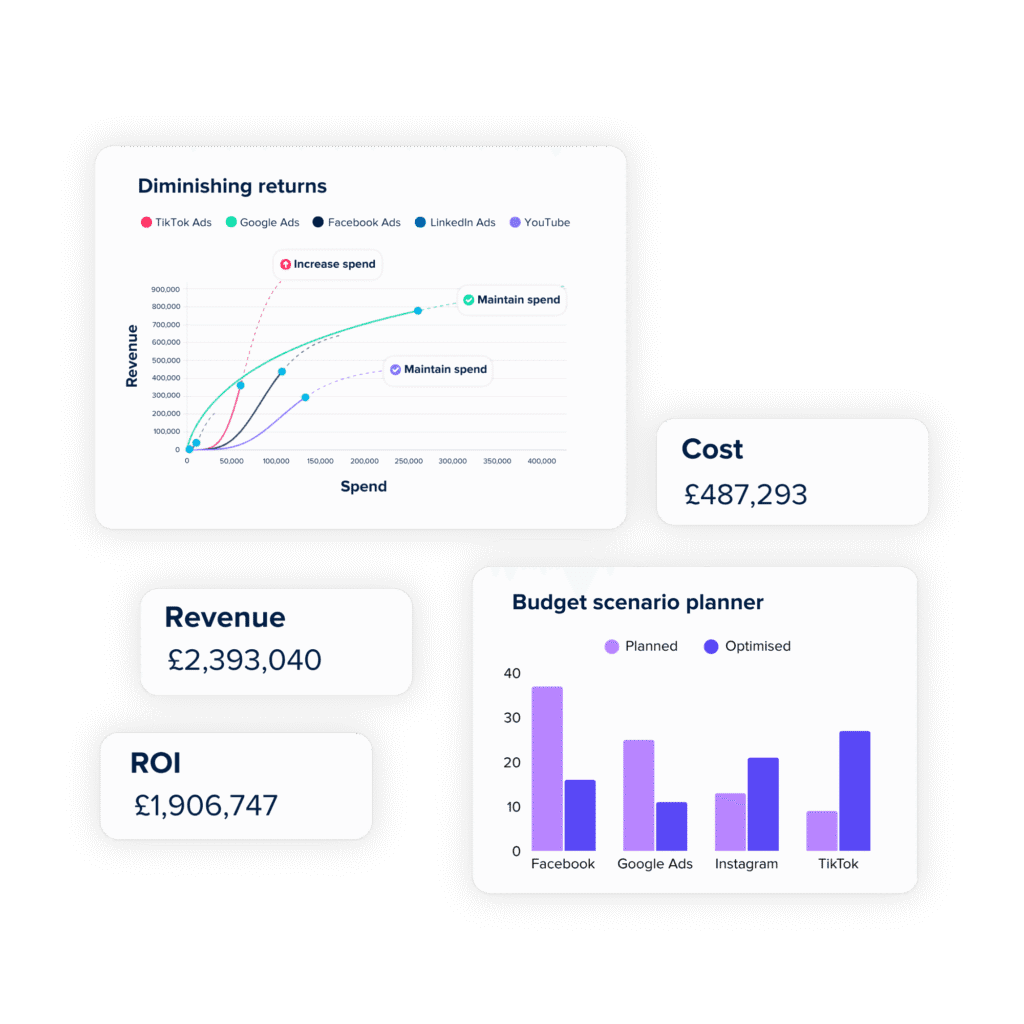
Rather than shifting budget based on gut feel or last month’s platform reporting, marketing leaders can model efficiency, growth or custom spend scenarios before committing anything, and make the call based on predicted outcomes rather than assumptions.
None of this data sits still in a dashboard either. Ruler pushes enriched attribution data back out to the systems that need it, updating CRM records with source, campaign and customer journey detail, and feeding offline conversion and revenue signals back to ad platforms to improve bidding and audience targeting.
The attribution work actively improves the campaigns it’s measuring, rather than just reporting on them after the fact.
Bringing it all together
The debate between multi-touch attribution vs marketing mix modeling isn’t really a debate that needs a winner.
MTA gives you the customer-level precision to optimise what’s happening today. MMM gives you the statistical, whole-market view to plan what happens next, including the offline and upper-funnel activity that click-based tracking was never going to catch on its own.
Used together, they cover far more ground than either one manages alone, and that’s consistently what we see in the businesses getting the most value from their measurement strategy.
If you’re currently relying on one approach and wondering whether the other would fill in the gaps, that’s a conversation worth having properly rather than guessing at.
Book a demo with Ruler and we’ll walk you through what a unified MTA and MMM approach could look like for your own customer journeys and budget planning.