

Marketing data often contains gaps that can make it difficult to fully understand performance. For example, Google Analytics numbers may not align with revenue in the CRM.
One platform may report more revenue than another, while actual sales are lower. In other cases, analytics may underreport performance, even when customers consistently indicate exposure to multiple marketing touchpoints before converting.
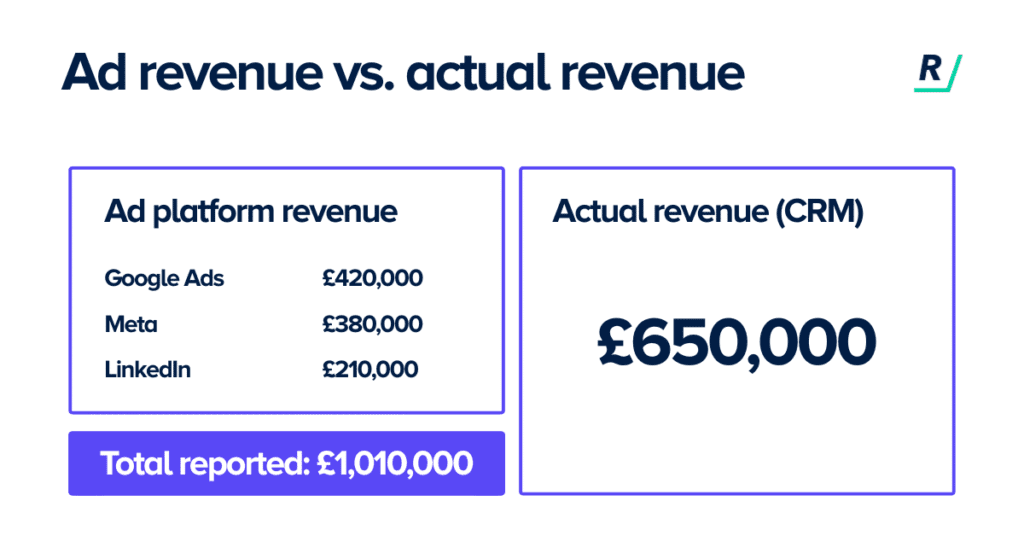
These gaps are not minor. Industry data indicates that cookie-based tracking can miss 15–20% of conversions due to privacy changes and the decline of third-party cookies. Ad platforms may over-attribute conversions because each platform tracks independently.
Traditional analytics often focus on last-click attribution, overlooking upper-funnel activities that contribute to conversions.
Incomplete measurement can make it challenging to allocate budgets with confidence. Without clear visibility into what drives revenue, organisations may:
- Over-invest in channels that appear to perform well but are receiving duplicated credit
- Under-invest in channels that generate significant impact but receive limited attribution
- Delay budget decisions due to uncertainty in the data
Accurate measurement is essential for connecting marketing activities to revenue, optimising investments, and supporting strategic growth. Organisations that address these gaps are better positioned to make informed decisions and scale effectively.
Why these gaps occur in marketing measurement
Reporting gaps often arise from structural limitations in the modern measurement ecosystem.
Last-click attribution
Many analytics and ad platforms, including Google Analytics, default to last-click attribution. This method assigns 100% of credit for a conversion to the final touchpoint before a sale, while prior interactions are not accounted for.
For example, a customer might engage with LinkedIn ads, read multiple blog posts, attend a webinar, and interact with an email campaign before converting through a Google Search ad. Last-click attribution assigns all credit to the final Google Search interaction, which can underrepresent the impact of upper-funnel awareness activities.
Cookie deprecation and signal loss
The phase-out of third-party cookies has created significant gaps in tracking. Safari and Firefox already block third-party cookies, and Chrome is in the process of phasing them out. iOS privacy updates also reduce the trackable portion of mobile traffic.
As a result, cross-device and multi-session conversions are often missed. Estimates suggest that 15–20% of conversions may be lost due to cookie limitations. In long sales cycles, initial engagement may occur weeks or months before conversion, by which time tracking cookies may no longer be active.
Independent attribution by ad platforms
Ad platforms report conversions independently. For example, one platform may attribute £50,000 in revenue, another £40,000, and a third £20,000, while actual revenue is £60,000. This occurs because each platform measures conversions within its own ecosystem, sometimes including view-through conversions, where a user sees an ad but does not engage directly. This can result in overlapping attribution.
The missing middle: impressions vs. clicks
Analytics primarily track clicks, which indicate deliberate engagement, while impressions, exposure to ads or content, are often unmeasured.
Related: Understanding the difference between click and impression measurement and what to trust
Impressions can influence customer behavior even without direct engagement, but they require different measurement approaches than clicks. Accurate assessment of marketing impact depends on considering both types of interactions.
Limitations of Google Analytics
GA4 addresses some gaps from Universal Analytics but still has limitations:
- No spend data by default: Cost data must be imported to calculate ROAS or CPA across channels.
- No CRM integration: Leads are tracked, but conversions to revenue are not automatically connected, limiting outcome-based optimisation.
- Cookie limitations: GA4 is affected by cookie blocking, deletion, and cross-device tracking gaps.
Related: 8 limitations of Google Analytics 4 and how to overcome them
As a result, even modern analytics platforms provide only a partial view of performance, particularly for upper-funnel awareness activities and cross-device journeys.
How these gaps affect business decisions
Measurement gaps have tangible effects on decision-making, resource allocation, and growth planning.
Inability to scale with confidence
When reports show a high ROAS but do not account for duplicated conversions or conversions that would have occurred through other channels, it becomes difficult to make confident investment decisions. Without clarity, scaling channels that appear to perform well can be uncertain.
Related: ROAS and marginal ROAS benchmarks by ad platform
This uncertainty can slow decision-making, while competitors with more complete measurement may be able to respond faster and capture additional market share.
Over-investment in claimed performance
Measurement gaps can also result in over-investment. For example, a platform may report consistently high ROAS, leading to increased spend. However, actual incremental revenue may fall short if multiple platforms are claiming credit for the same conversions.
In this scenario, cost-per-acquisition can be significantly higher than reported, and budgets may be consumed without generating proportional revenue. When replicated across multiple channels, over-attribution can lead to substantial inefficiencies.
Under-investment in upper-funnel activities
Last-click attribution tends to undervalue awareness and upper-funnel channels. As a result, investment is often concentrated on bottom-funnel activities targeting in-market audiences.
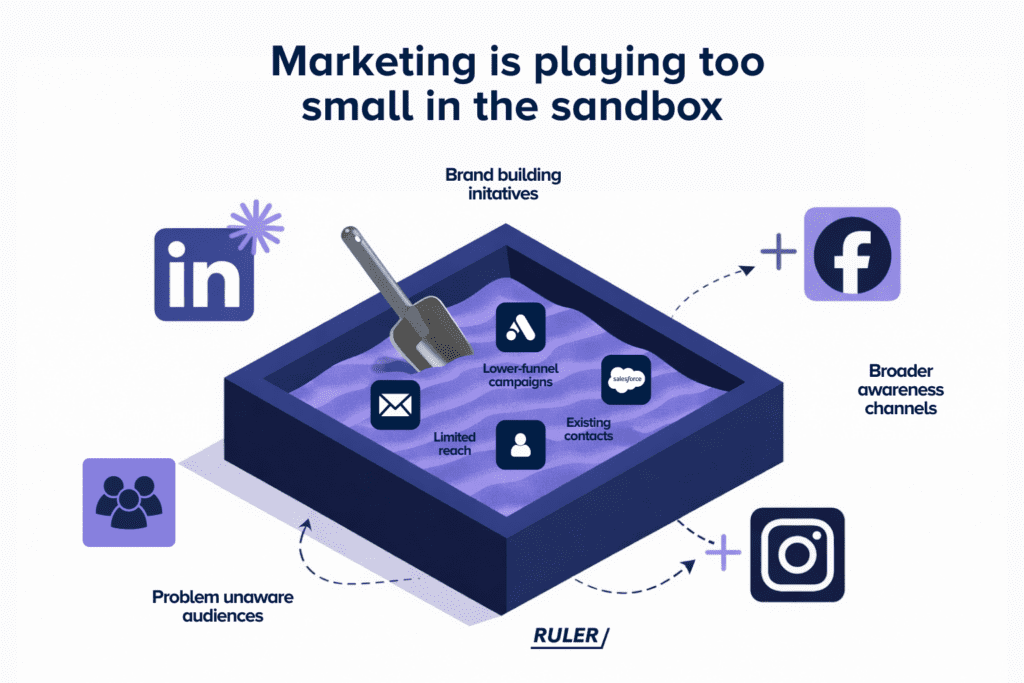
Industry patterns suggest that many B2B organisations allocate the majority of their budgets to lower-funnel channels. This approach limits exposure to potential customers earlier in the buying journey, which can constrain long-term growth and reduce the overall addressable audience.
Impact on executive decision-making
Measurement gaps can also affect broader organisational confidence in marketing performance. Without a clear understanding of which activities are driving revenue, executives may hesitate to approve aggressive growth initiatives. This can limit overall investment in marketing and reduce opportunities to scale effectively.
Accurate, unified measurement enables more informed investment decisions, supports strategic growth, and improves alignment between marketing performance and organisational objectives.
Closing the gaps and regaining confidence
Addressing reporting gaps requires improvements in both measurement systems and decision-making processes. The objective is not perfect accuracy, but rather sufficient clarity to make confident investment decisions.
Implement unified measurement
A key approach is to move from fragmented, platform-specific reporting to a unified measurement framework that:
- Deduplicates conversions across channels: When multiple platforms claim the same conversion, unified measurement identifies overlaps and assigns credit appropriately, avoiding double-counting.
- Fills cookie gaps with modeling: Machine learning can estimate untracked conversions caused by cookie restrictions, providing a more complete view of performance. For example, Ruler’s Smart Fill Impression Modelling analyses aggregated data to estimate the incremental impact of ad exposure over time. It accounts for the delay between viewing an ad and making a conversion, the cross-channel halo effects of impressions, and the brand awareness generated that doesn’t appear in any direct click path.
- Tracks clicks deterministically: For direct-response channels, user-initiated clicks are accurately tracked and linked to outcomes.
- Models impression impact probabilistically: Awareness-focused channels generate impressions rather than clicks. Probabilistic attribution and marketing mix modeling estimate the contribution of these exposures without relying on deterministic tracking.
- Connects website activity to CRM revenue: Integrating website tracking with CRM data allows organisations, particularly B2B companies, to understand which channels drive not just leads, but revenue and customer lifetime value.
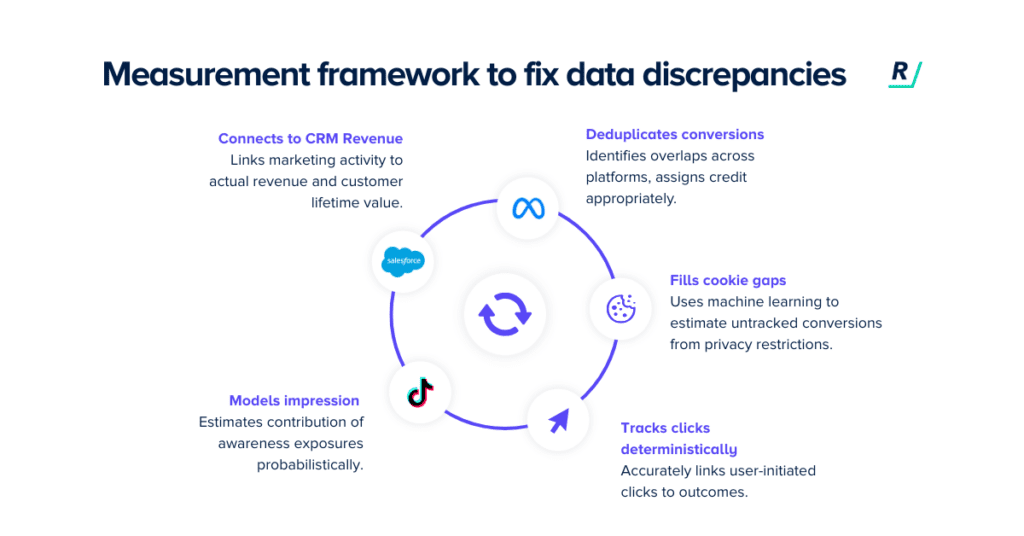
This approach provides a more accurate and comprehensive understanding of marketing performance, enabling informed decisions and more effective allocation of resources.
Adopt the right attribution model for each channel
Different types of marketing activities require tailored measurement approaches to accurately assess their impact.
Direct-response, click-based channels
For channels where users actively engage, such as paid search, email clicks, organic search, and direct traffic, multi-touch attribution can track clicks across the customer journey and allocate credit based on actual engagement. This provides a clearer understanding of which interactions contributed to conversions.
Awareness, impression-based channels
For channels focused on exposure, such as display advertising, social media awareness campaigns, and upper-funnel content, modeling approaches can estimate the lift or impact of impressions without attributing conversions to any single interaction.
Related: How to measure top of the funnel marketing and brand awareness
This avoids creating false precision while still capturing the influence of awareness activities.
The key distinction
Clicks indicate user intent, whereas impressions represent exposure. A click demonstrates deliberate engagement, while an impression may contribute to overall influence. Measurement approaches should reflect this difference to accurately evaluate the contribution of each channel.
Establish ground truth with CRM data
The CRM or e-commerce system provides the definitive record of revenue and should serve as the foundation for all measurement.
Steps to establish a baseline:
- Review actual revenue recorded in the CRM or backend system.
- Compare this revenue to what is reported in Google Analytics to identify potential signal loss.
- Aggregate all conversions claimed across advertising platforms and compare the total to actual revenue to assess duplication.
Interpreting the results:
- If claimed conversions significantly exceed actual revenue, duplication across platforms is likely.
- If CRM revenue exceeds GA4 or other analytics conversions, tracking gaps are present.
These comparisons provide a clear baseline of current measurement accuracy. Significant discrepancies indicate the need for a more comprehensive and unified measurement approach to ensure reliable insights and informed investment decisions.
Change how you make decisions
Even with better measurement, you need to change how you use data to make decisions:
- Focus on incrementality, not just attribution: The key question isn’t “which channels touched this conversion?” It’s “which channels drove conversions that wouldn’t have happened otherwise?” This requires testing, holdout groups, and modeling, not just tracking.
- Use data to inform decisions, not make them: No measurement system is perfect. Improved data should guide investment decisions, but it is important to recognise and account for inherent uncertainty.
- Look at leading indicators alongside lag indicators: In addition to conversion metrics, track leading indicators such as impression growth, audience reach, engagement rates, and branded search volume. These metrics can provide early signals of future performance.
- Test systematically: Conduct incrementality testing to validate that channels which appear to be performing are actually generating incremental results. Systematic testing ensures that investment decisions are based on demonstrated impact rather than attribution alone.
Discovering the gap and regaining confidence
Consider the case of an e-commerce company that discovered massive reporting gaps and changed their entire approach:
What tipped them off
The company was scaling Facebook advertising based on strong in-platform ROAS numbers showing 7-8x returns. But when the finance team looked at actual bottom-line profitability, the math didn’t add up. They were spending more on Facebook but profit margins were actually shrinking.
When they started digging into the data, they found:
- Facebook was claiming roughly 40% more conversions than they were actually generating
- There was significant overlap between Facebook-claimed conversions and Google-claimed conversions
- Many “Facebook conversions” were people who had also clicked Google ads, organic search results, or came through direct traffic
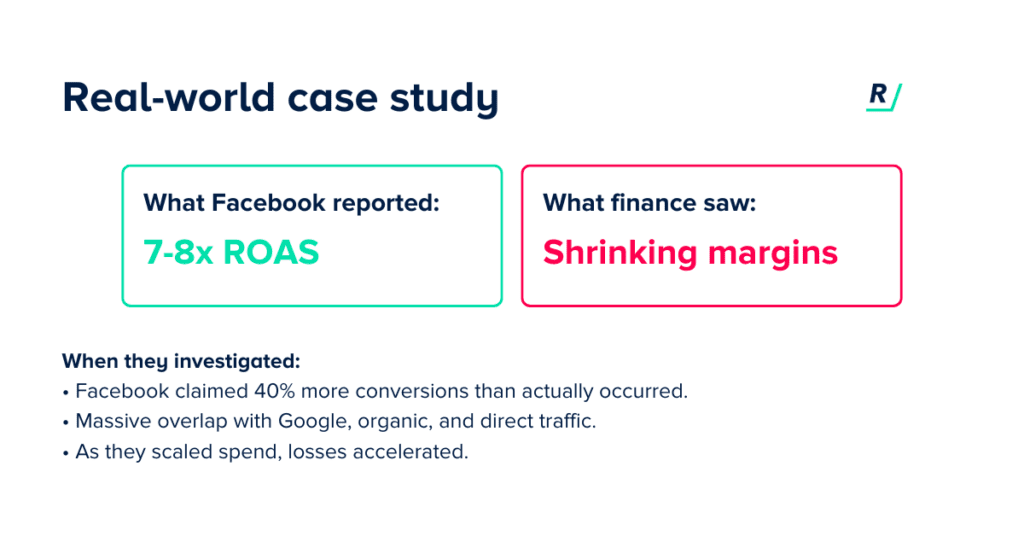
The tipping point was when they tried to aggressively scale based on the strong Facebook ROAS numbers. As spend increased, the gap between claimed performance and actual results became impossible to ignore. They were hemorrhaging money.
This led them to:
- Implement unified attribution that deduplicated conversions across platforms
- Track actual revenue in their e-commerce backend as the source of truth
- Build reporting that showed both platform-claimed performance and deduplicated, actual performance side-by-side
- Implement server-side tracking to fill cookie gaps
- Stop making investment decisions based on individual platform reports
- Require all budget requests to be justified with deduplicated attribution data
- Implement systematic incrementality testing for major channels
- Shift focus from ROAS to actual profit contribution
With this, they discovered:
- Their true cost-per-acquisition on Facebook was nearly 2x what the platform reported
- Several channels they had under-invested in (like organic search and email) were actually much more valuable than they thought
- Upper-funnel awareness activities were contributing significantly but getting zero credit in last-click attribution
This led to a complete reallocation of budget. They reduced Facebook spend to profitable levels, increased investment in channels that were truly driving incremental value, and started investing more aggressively in upper-funnel activities now that they could properly measure their contribution.
Most importantly, they regained confidence in their ability to make decisions. The CMO could walk into budget meetings with the CFO and justify investments with data everyone trusted.
Marketing went from being seen as a cost center with questionable returns to a growth driver with predictable, measurable impact.
Final thoughts
Gaps in marketing reports aren’t a minor technical problem, they’re a strategic crisis that undermines your ability to grow confidently.
When you can’t trust your data, you can’t scale what works, you waste budget on duplicated conversions, and you lose the confidence of your executive team.
The solution isn’t to throw up your hands and declare measurement impossible. It’s to:
- Acknowledge that platform-specific reporting is systematically biased and incomplete
- Implement unified measurement that deduplicates conversions and fills tracking gaps
- Use the right attribution approach for different types of marketing activities
- Ground everything in CRM or e-commerce revenue as your source of truth
- Focus on incrementality, not just attribution
Companies that solve their measurement problem don’t just get better reports, they get the confidence to make bigger, faster investment decisions that drive real growth. They stop second-guessing every budget decision and start scaling aggressively based on data they trust.
The question isn’t whether your reports have gaps, they almost certainly do. The question is whether you’re going to fix them before those gaps cost you another quarter of missed growth opportunities.